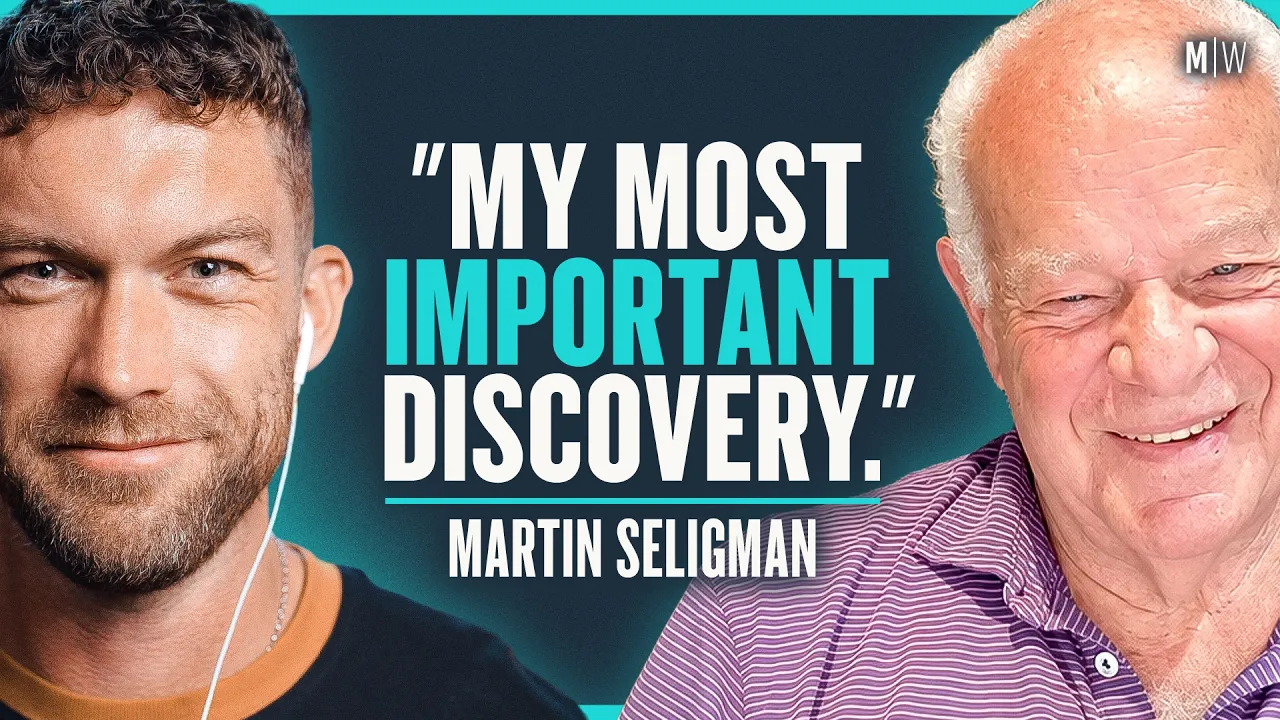
Positive Psychology Founder: How To Stop Your Negative Thoughts - Martin Seligman
Chris Williamson
658 views • 18 hours ago Save 71 min 10 min read
Video Summary
For over 50 years, Martin Seligman has pioneered the study of human flourishing, challenging psychology's historical focus on misery. He identified and overturned three core premises: that psychology only dealt with suffering, that thinking was irrelevant, and that the past determined the future. Seligman's research on learned helplessness evolved into understanding learned hopefulness and optimism, demonstrating that individuals can actively change their perspectives and behaviors.
His work culminated in the development of positive psychology, shifting the focus from correcting errors to identifying and leveraging individual strengths. Seligman argues that agency—the combination of efficacy, optimism, and imagination—is crucial for both individual well-being and societal progress. He now explores how artificial intelligence can further enhance human agency and creativity, viewing it not as a threat, but as a powerful tool for augmenting human potential.
Short Highlights
- Psychology's historical focus was on misery, not happiness or flourishing.
- Learned helplessness research revealed the impact of perceived control.
- Optimism and pessimism are learned, not fixed traits.
- Positive psychology shifts focus to strengths and well-being.
- Agency comprises efficacy, optimism, and imagination.
- AI can augment human creativity and agency.
- A good life requires agency and a future orientation.
Key Details
The Three Blind Spots of Psychology [00:01:00]
- Psychology historically focused on misery, trauma, and suffering, neglecting happiness.
- Thinking was excluded, seen as mere byproduct of conflict or nonexistent.
- Determinism, the belief that past and present dictate the future, was a core premise.
"The first blind spot was happiness itself. And that is, psychology was all about misery 60 years ago, trauma, suffering, panic, depression, anxiety. Happiness was a dirty word. No one worked on it."
From Learned Helplessness to Agency [00:03:00]
- Early research on learned helplessness showed animals and humans become passive and "stupid" when exposed to uncontrollable negative events.
- The opposite—learned hopefulness and mastery—emerged when individuals experienced control.
- Traumatic events that can be influenced are energizing, not debilitating.
"So where my interest in this started was the opposite of agency. And that is, what impedes agency? What makes us helpless?"
The Arc to Learned Hopefulness [00:05:00]
- Despite finding that one-third of subjects resisted learned helplessness, this was initially overlooked.
- Further research identified optimism and pessimism as key factors in resilience.
- Pessimistic explanations are global, stable, and internal ("it's me, it's going to last forever, and it's going to undermine everything I do"), while optimistic explanations are temporary and specific.
"But importantly, three out of every eight people, three out of every eight animals didn't become helpless. I tried to sweep that under the rug."
The Shift to Positive Psychology [00:08:00]
- Seligman's presidency of the American Psychological Association revealed psychology's financial incentives favored treating illness over promoting well-being.
- An epiphany with his five-year-old daughter, Nikki, highlighted the importance of capitalizing on strengths rather than solely correcting errors.
- This led to the development of positive psychology, focusing on strengths and flourishing.
"And the third big thing I realized was that psychology was half-baked. It was baked on misery, suffering, divorce, panic. And there was no psychology of flourishing, of happiness, of well-being."
Training Optimism and Agency [00:14:00]
- Seligman asserts that optimism and agency can be learned and trained through specific techniques.
- Pessimism is natural due to evolutionary biases toward catastrophization.
- Techniques include actively disputing catastrophic thoughts and putting them in perspective.
"So being negative, being a pessimist comes naturally. What does not come naturally and needs learning is being an optimist."
Technique 1: Disputing Catastrophic Thoughts [00:15:00]
- Individuals are encouraged to identify their most pessimistic self-talk.
- Seligman uses his own morning anxieties as an example, actively arguing against them with realistic evidence.
- This process, when practiced consistently, can shift pessimism to optimism and reduce depression and anxiety.
"So at four in the morning, uh, I said, Hey, wait a minute. Uh, I did an interview last week with someone like Chris. And again, I thought I can't do it at all. And it was super."
Technique 2: Putting Things in Perspective [00:17:00]
- This technique involves imagining the worst-case scenario, the best-case scenario, and the most likely outcome of a stressful situation.
- It helps to reframe catastrophic thinking by grounding individuals in realistic possibilities.
- This exercise, among others, has been tested with thousands of people, including U.S. Army drill sergeants.
"First, uh, we have people imagine the very worst that could happen at four o'clock. They get into it. She's going to take me apart and I'm going to be fired."
The Components of Agency [00:22:00]
- Agency is defined by three components: efficacy, optimism, and imagination.
- Efficacy is the belief in accomplishing goals in the present.
- Optimism is the belief in accomplishing goals in the future.
- Imagination is the range of goals one can envision.
"So for me, agency has three components and optimism is the second one. Uh, the first component is efficacy."
Agency and Human History [00:23:00]
- The book "Agency" explores how human innovation and flourishing correlate with the presence of full-blown agency throughout history.
- Periods of stagnation, like the Middle Ages, are contrasted with periods of progress.
- The hypothesis is that increased agency leads to societal progress and innovation.
"So the challenge was to go back through history and ask the question, what is the role of agency in human progress and human innovation?"
Agency in Ancient Greece [00:25:00]
- Ancient Greek texts show an evolution from the gods dictating actions (Achilles in the Iliad) to individuals exercising agency (Odysseus).
- This shift correlates with progress in thought, arts, technology, quality of life, and political freedom.
"A hundred years later, you've got Odysseus, the clever, wily, agentic person."
The Impact of St. Augustine [00:26:00]
- St. Augustine's doctrine in 383 AD, emphasizing God's arbitrary grace over human will, is seen as a turning point.
- This belief system, dominant for nearly a thousand years, coincided with stagnation and regression across various societal domains.
"Augustine comes along in 383 and renounces human agency, declares that if you ever resist temptation, if you ever do good things, if you ever avoid bad things, it's because God arbitrarily injected you with grace."
Protestantism and Agency [00:28:00]
- Early Protestantism (Luther, Calvin) held deterministic views, but later evolved to incorporate human participation in grace.
- Modern Protestantism's emphasis on agency is linked to societal progress in the last 200 years.
"So Protestantism of the original Calvin-Luther form kills progress in all five realms."
Cultivating Agency Today [00:30:00]
- Efficacy is best developed through successful actions, often starting with small, graded tasks.
- Optimism is enhanced by disputing catastrophic thoughts and putting situations in perspective.
- Teaching efficacy and optimism has a strong empirical basis with thousands of studies.
"The best techniques for efficacy, and this all comes from the modern psychological laboratory, is actually doing things and having them succeed."
AI as a Supplement to Agency [00:32:00]
- Seligman sees AI not as a threat to agency, but as a powerful tool for augmenting it.
- He uses AI to write stories with his grandsons, making him more visible and connected.
- AI can be a creative partner, as demonstrated by its ability to help bridge gaps in his book's narrative.
"But AI has done exactly the opposite in my life. And let me take you through my story about AI and why I've come to believe AI AI is the best companion and supplementer of human agency of my lifetime."
The Wright Brothers Model of Creativity [00:35:00]
- Seligman proposes a collaborative model of creativity, akin to the Wright brothers, where ideas are developed through back-and-forth interaction.
- AI excels in this model, facilitating creative breakthroughs by identifying connections humans might miss.
- An example is AI generating a transition between chapters on Chinese and Hebrew history by identifying a shared theme of individual versus collective agency.
"This is the sense in which AI is massively creative. And let me give you two examples of this."
The Mystery of the Axial Age Solved by AI [00:37:00]
- AI helped Seligman solve the mystery of the Axial Age (1000-500 BCE), a period of rapid innovation across disparate cultures.
- Through extensive linguistic analysis, AI demonstrated that the development of words for human agency coincided with this explosion of progress.
- The availability of language for agency enabled greater human agency and innovation.
"And after a day of going back and forth, they basically demonstrate that the words don't exist. And that by 500 BCE, all five of these cultures have discovered words about human agency."
The Double-Edged Sword of Agency [00:41:00]
- While agency is crucial, it has potential downsides: efficacy can lead to harmful inventions, optimism can lead to victim-blaming, and imagination (like AI) carries unknown consequences.
- Wisdom and morality are needed to guide the application of agency.
"So efficacy, being able to do something, doesn't tell us we should do it."
Optimism and Election Outcomes [00:43:00]
- Analysis of nomination acceptance speeches and press conferences suggests a correlation between a candidate's optimism and electoral success.
- Trump's increasing optimism in the lead-up to an election, despite sounding like a doomsayer, was a key predictor of his victory.
"And by Election Day, Trump is considerably more optimistic than Harris."
The Attractiveness of Optimism [00:44:00]
- Optimism is an attractive characteristic; people are more likely to hang up on depressed callers.
- Positive demeanor, like a "resting smiling face," influences how people perceive and interact with others.
"Chris, misery loves company, but company does not like misery."
The Cost of Complaining [00:46:00]
- Seligman shares a personal anecdote about his own complaining at restaurants, which made his family cringe.
- He resolved to stop complaining and found he could change this ingrained behavior, recognizing the negative impact it had.
"And I realized, really, for the first time in my life, watching them cringe, that if Mandy, my wife, who is a sunny, positive, good resting face, in fact, if she were as complained as much as I did, I wouldn't want to be married to her."
Keys to a Worthwhile Life [00:47:00]
- The two crucial elements for a good life are agency and a future orientation.
- Agency allows for mastery and optimism, while focusing on the future drives planning and progress.
"The first is that having agency. Waking up in the morning and having things that you can master that you're optimistic about is crucial for well-being, happiness, and how long you live."
The Theory of Dreaming [00:48:00]
- Seligman believes his theory of dreaming, involving visual hallucinations, emotional tone, and plot-making, is his best, yet least-read, work.
- The theory faced significant resistance from reviewers, leading to its publication in an obscure journal.
"Well, I think that explains dreaming. I think I nailed it. In fact, it's the only thing I've ever written which I didn't have doubts about."
Malleability vs. Immutability [00:49:00]
- Seligman's book "What You Can Change and What You Can't" highlights that some aspects of personality and behavior are malleable, while others are not.
- Understanding this distinction is crucial for effective self-improvement and avoiding wasted effort.
"And it's very important for people to realize what is malleable and what is not."
The Future with AI [00:51:00]
- Seligman is incredibly excited about the potential of AI, viewing it as the most significant technological development of his lifetime.
- He believes AI will fundamentally change his field and his own work, wishing he were younger to explore it further.
"And that's because there's something hugely new on the horizon. And that's AI. So in my field and in my life, AI changes everything."