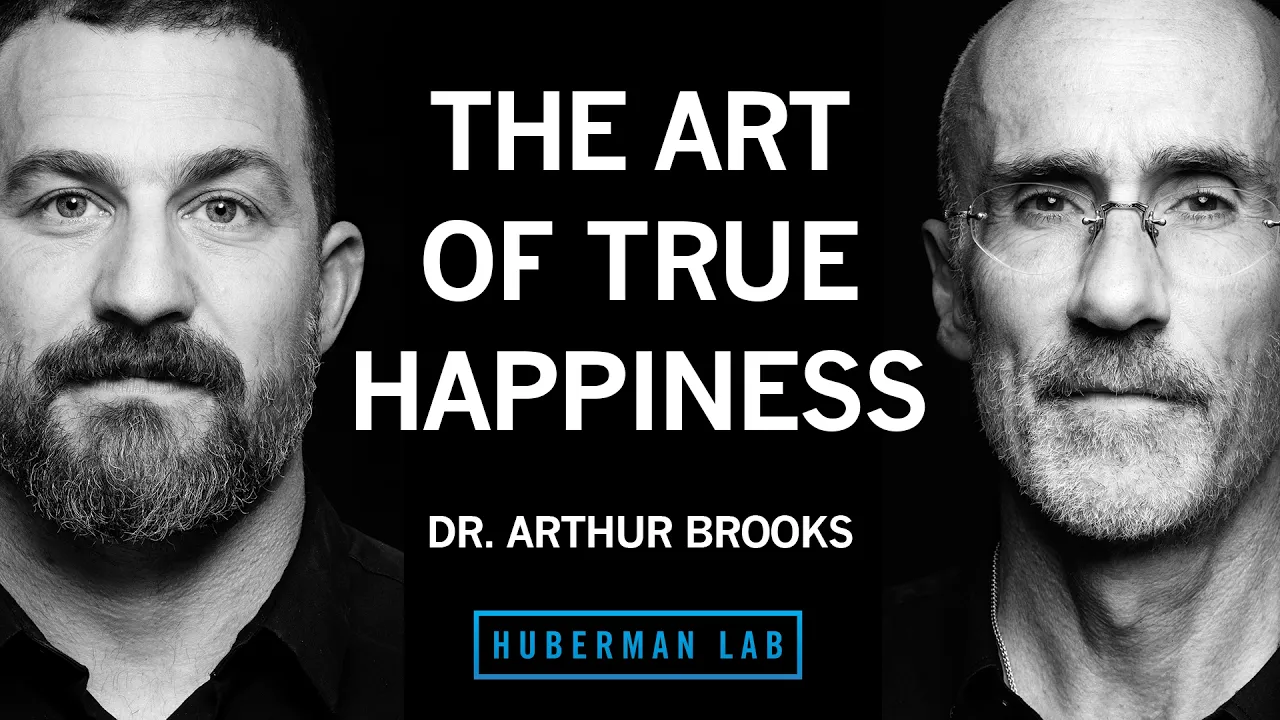
The Art of True Happiness | Dr. Arthur Brooks
Andrew Huberman
5,150 views • 15 hours ago Save 163 min 6 min read
Video Summary
Happiness is not merely an emotion but a complex state built on three macronutrients: enjoyment, satisfaction, and meaning. While many people mistakenly pursue pleasure—a fleeting limbic response—the happiest individuals actively cultivate enjoyment, which integrates pleasure with moral aspiration, memory, and social connection. True satisfaction, meanwhile, is the joy derived from accomplishments earned through struggle, making the avoidance of suffering a counterproductive strategy that paradoxically prevents genuine fulfillment.
To navigate these macronutrients, one must identify their personal "idols"—money, power, pleasure, or honor—that can derail life's purpose when pursued as ends in themselves. By shifting focus toward faith, family, friends, and work as expressions of love, individuals can transcend the hedonic treadmill. This process requires a commitment to "metaphysical fitness," where one practices life's commitments—such as marriage or faith—even when feelings of fulfillment are absent, ultimately leading to a more integrated and meaningful existence.
Short Highlights
- The three macronutrients of happiness are:
- Enjoyment: Pleasure integrated with moral aspiration and social connection.
- Satisfaction: The joy of accomplishment earned through struggle.
- Meaning: The "why" of existence, often found in complex, ungoogleable questions.
- Avoidance of suffering paradoxically prevents happiness.
- Identify and challenge your personal "idols" to prevent them from becoming the primary focus of your life.
- Practice life commitments—like marriage or faith—even when you do not feel like it.
- Understand that your greatest strengths are often the opposite side of your greatest weaknesses.
Key Details
Defining Happiness [0:05:00]
- Happiness is not an emotion but a structural state similar to nutrition.
- The three macronutrients of a happy life are enjoyment, satisfaction, and meaning.
The happiest people have enjoyment, satisfaction, and meaning. Those are the three macronutrients.
Pleasure vs. Enjoyment [0:10:30]
- Pleasure is a limbic, animalistic phenomenon that is fleeting and potentially addictive.
- Enjoyment requires adding people and memory to pleasure, elevating it to a human, executive experience.
The pursuit of pleasure is not the secret to happiness. It's the secret to rehab.
The Role of Suffering [0:15:45]
- Unhappiness is naturally intertwined with the macronutrients of happiness.
- Trying to eliminate suffering paradoxically leads to missing out on true happiness.
If you spend your life, which many people do today, trying to avoid unhappiness, trying to avoid and eliminate suffering, they will paradoxically miss their own happiness.
Moral Aspiration and Animal Impulse [0:22:15]
- Humans have a prefrontal cortex that allows us to choose between animal impulses and moral aspirations.
- A great life involves pointing these two forces in the same direction.
One of the great strategies for life is how to point them in the same direction.
Commitment Bias [0:35:00]
- Publicly declaring moral aspirations creates a commitment bias that helps maintain path dependency.
- Wedding vows are an ancient, effective way to commit to a life that includes inevitable suffering.
You're basically saying, bring it on. It's like courage. It's a declaration of your independence from the world and your dependence on each other.
Moral Foundations [0:45:10]
- Everyone shares foundations of care and fairness, but they define them differently.
- Differences in loyalty, purity, and authority often drive political and social friction.
Each side will say the other side is immoral. No, they're differently moraled.
Proper Leisure [0:55:20]
- Leisure is a critical indicator of a person's true character.
- Proper leisure involves deepening relationships, learning for its own sake, and metaphysical development.
I can tell you everything you need to know about a culture by how they actually use leisure.
Satisfaction and Struggle [1:15:40]
- Satisfaction is defined as the joy experienced after struggle.
- People who achieve goals without struggle often feel empty, leading to a cycle of needing more.
Real satisfaction from your accomplishments comes from the struggle not from the accolades.
The Hedonic Treadmill [1:30:15]
- The brain resets after rewards, leading to a constant need for more.
- Success addiction is often a result of trying to prove one is "enough."
The limbic system resets because emotions are not there to give you a nice day they give you a set of signals about threats and opportunities.
The Four Idols [1:45:30]
- Money, power, pleasure, and honor are beguiling idols that promise satisfaction but fail to deliver.
- These are not evil, but they become destructive when pursued as the primary goal of life.
Those four things are money resources power which is influence over other people pleasure which also is comfort or security right or honor.
Identifying Your Idol [2:00:10]
- Eliminating idols one by one helps reveal which one is most likely to beguile you.
- This exercise helps individuals recognize when they are sacrificing love for an idol.
When you pursue these things you're doing it at cost and the cost is almost always love.
Meaning and the Right Hemisphere [2:15:50]
- The left hemisphere handles quantification and "how-to," while the right hemisphere handles meaning and complex questions.
- Meaning is found in ungoogleable questions about existence and purpose.
Meaning resides which is the last macronutrient of this the right side of our brain.
Breaking Technological Addiction [2:25:30]
- Breaking cycles of addiction requires getting "pissed" and rebelling against the current state.
- Changing circumstances is ineffective if one does not learn to live with themselves.
You have to learn to live with you is the hard thing that actually comes from this.
Faith as Practice [2:40:20]
- Faith is not necessarily a feeling or a constant belief, but a practice.
- Like marriage, faith requires showing up even when the emotional reward is absent.
You practice your marriage you practice in your job you practice friendship and you practice your religion for precisely the same reason that you practice lifting weights.
The Four Quarters of Life [2:55:10]
- Life can be viewed in four stages: student, householder, retiree (forest dweller), and sannyasi (seeker of divine luminescence).
- This model encourages a gradual shift away from worldly scoreboards toward deeper meaning.
Life is in four quarters this is called the theory of the ashramas.
Conclusion: The Pilgrimage [3:10:45]
- Life is a pilgrimage where progress is made through daily practice and openness to metaphysical truth.
- Excellence is an expression of love through one's daily work.
We're walking through this life we're all learning Andrew's on a pilgrimage Arthur is on a pilgrimage.