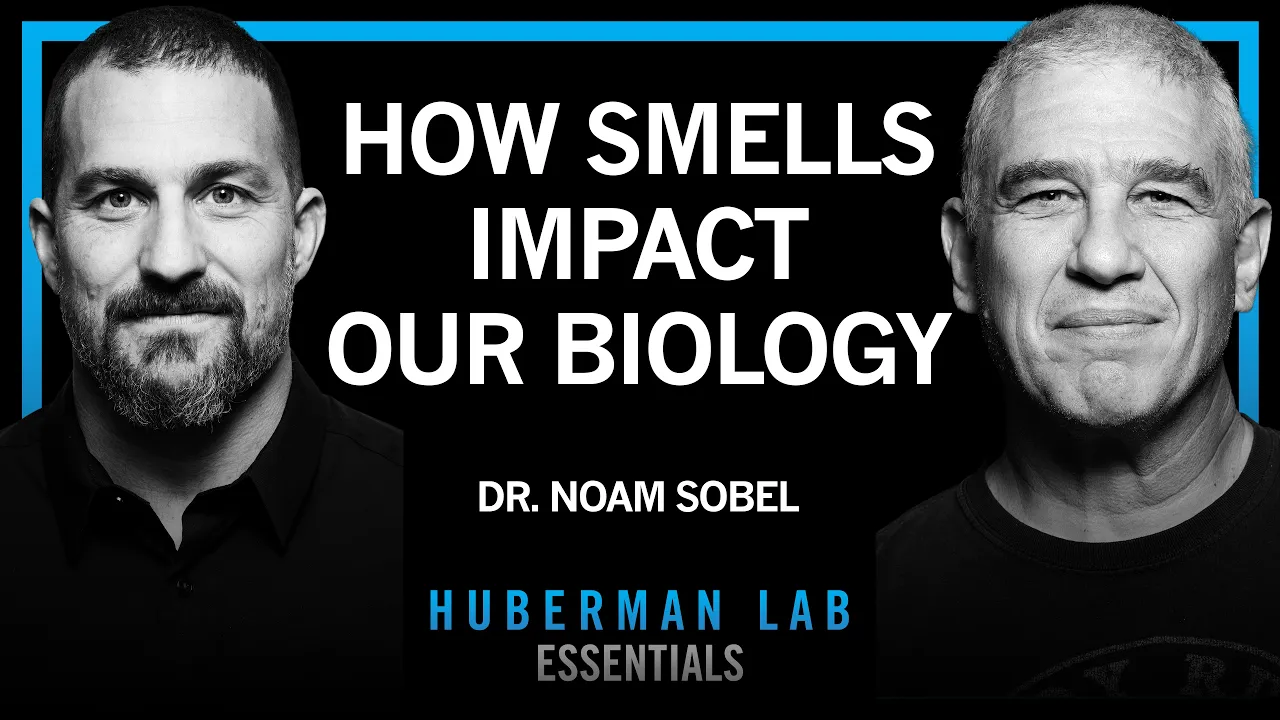
Essentials: How Smells Influence Our Hormones, Health & Behavior | Dr. Noam Sobel
Andrew Huberman
5,912 views • 15 hours ago Save 28 min 6 min read
Video Summary
Humans possess a remarkable, often subconscious, olfactory system that influences behavior and social bonding. Research reveals that even simple actions like handshaking can lead to an increase in nose-touching, suggesting an olfactory exchange. Studies on "click friendships" indicate that similar body odors may contribute to instant rapport, with strangers who smell alike rating each other as more likable and potential friends.
Further exploration into chemo-signaling demonstrates that human tears, though odorless, can reduce testosterone levels in those who smell them, potentially acting as a chemical signal for dampening aggression. This effect is mirrored in rodents, suggesting a conserved biological mechanism. In a groundbreaking development, scientists have created an algorithmic framework to predict and even generate smells, achieving the transmission of "violets" over IP and laying the groundwork for digitizing smell for applications like medical diagnostics.
Short Highlights
- Humans possess a sophisticated olfactory system influencing behavior.
- Handshaking may involve subconscious olfactory exchange.
- Similarity in body odor can foster "click friendships."
- Human tears act as a chemical signal to reduce aggression.
- Scientists are developing technology to digitize and transmit smells.
- Future applications include medical diagnostics via electronic noses.
Key Details
The Olfactory System [00:00:55]
- Airborne molecules travel up the nose to the olfactory epithelium.
- Around seven million receptors of about 350 different subtypes are present.
- Odorants interact with receptors, converting them into neural signals.
"molecules, airborne molecules travel up our nose, a distance in the human of about six or seven centimeters to about here, where they interact with, I will use the word sheet of receptors, but sheet is a bit misleading here."
Neural Pathways of Smell [00:01:49]
- Neural signals propagate via the olfactory nerve to the olfactory bulb.
- The olfactory bulb exhibits extreme convergence, with receptors of one subtype converging to a glomerulus.
- This convergence creates a "map" of receptor identity in the bulb.
"The pattern of that synapsing follows what's referred to as the most extreme case of convergence in the mammalian nervous system."
Brain Projection and Coding [00:02:45]
- Information from the olfactory bulb projects to the piriform cortex, entorhinal cortex, amygdala, and hypothalamus.
- The map that may exist on the bulb does not appear to exist in the rest of the brain.
- How olfactory coding occurs in the rest of the brain remains unclear.
"And information goes from the bulb to several targets in the brain. I mean, what is referred to as primary olfactory cortex is piriform cortex and enthrinal cortex."
Subconscious Olfactory Behavior: Handshaking [00:03:50]
- Humans often touch their face, particularly their nose, after shaking hands.
- This behavior was quantified in a study where participants were videoed.
- A handshake significantly increased the frequency of hands going to the nose, suggesting an olfactory exchange.
"And there was a remarkable increase in the hand going to the nose after handshake. It's unreal."
Olfactory Exchange During Handshakes [00:04:31]
- Participants not only brought their hand to their nose but also sniffed it after a handshake.
- This behavior was confirmed as olfactory, indicating a comparison between self and other.
- The study suggests a subconscious comparison of body odors might be occurring.
"So they're sniffing their hands. So this was an olfactory behavior, no doubt about it."
Body Odor and "Click Friendships" [00:05:55]
- A study investigated whether similarity in body odor contributes to "click friendships."
- Click friends, who bond instantly, were found to have more similar body odors than expected by chance.
- An electronic nose device and human smellers confirmed this similarity.
"And she found that click friends are indeed more similar to each other than you would expect by chance by random dyads."
Causality in Friendship Formation [00:07:15]
- To test causality, strangers engaged in a non-verbal "mirror game."
- While similarity in smell did not predict better performance in the game, it predicted desire for friendship.
- People who smelled more similar rated each other as more likely to be friends and nicer.
"So people who smell more similar to each other, think that the other person is more likely to be their friend is more likely to be a nice person, et cetera, et cetera."
The "Smell of Fear" and Chemo Signals [00:09:10]
- Humans emit body odor when in a state of fear, which can influence others.
- This "smell of fear" can increase autonomic arousal and sympathetic state, making fear contagious.
- Studies have shown that humans can smell fear in other humans, similar to dogs.
"So the smell of fear is contagious. By the way, culturally, we know for ages that dogs can smell fear in humans, but actually that was only really shown about a year and a half ago in a study."
Hexadecanal: A Chemical Signal [00:10:47]
- Hexadecanal, a molecule found in mice, promotes social buffering.
- In humans, hexadecanal reduced aggression in men but increased aggression in women.
- This effect is hypothesized to be beneficial for mammalian offspring, making mothers more protective and fathers less aggressive.
"So the bottom line of all this is that hexadecanal is the most abundant semi-volatile in baby hits."
Tears and Hormonal Effects [00:12:57]
- Emotional tears, though odorless, were found to reduce testosterone levels in men and women.
- Smelling women's tears led to a significant drop in free testosterone, a strong pharmacological effect.
- This effect was replicated in independent studies and also observed in rodents, suggesting a chemical blanket against aggression.
"And yet, when you sniff them, you have a pronounced reduction in testosterone within about 20 minutes, half an hour."
Digitizing Smell: Algorithmic Framework [00:15:00]
- Researchers developed an algorithmic framework to predict the perceptual similarity of molecular mixtures.
- This framework allows for the generation of "olfactory metameras" – mixtures with non-overlapping molecular structures that smell the same.
- A metamera for Chanel No. 5 was created without using any of its original components.
"And in this paper, we develop an algorithmic framework, uh, where we can predict the perceptual similarity of any two molecular mixtures with very, very high accuracy."
Transmitting Smells Over IP [00:16:32]
- The team successfully transmitted the smell of "violets" over IP using a device that mixes "odor primaries."
- Initial attempts to recreate "rose" resulted in a smell perceived as "bubble gum," and "anise" was perceived as "cherry."
- While not yet perfect, this represents a significant step towards digitizing and transmitting smells.
"The first odor ever transmitted over IP is violets."
Future of Olfaction: Medical Diagnostics [00:17:36]
- The digitization of smell holds potential for medical diagnostics.
- Every disease may have a unique odor due to specific metabolic processes and metabolites.
- Future electronic noses in bathrooms could perform continuous diagnostics.
"Because this is over extension, but you can almost say that every disease will have an odor."