What Is a Smart Contract?
Coin Bureau
246 views • 16 hours ago Save 10 min 5 min read
Video Summary
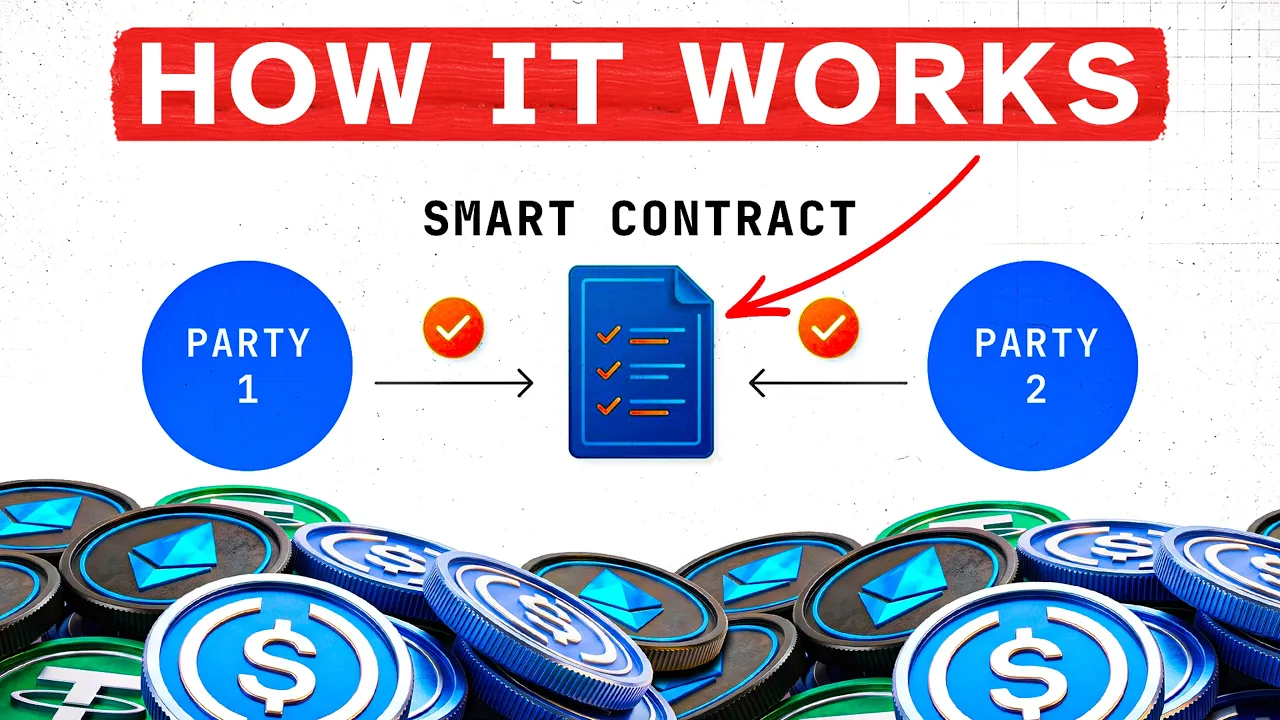
Smart contracts, the automated code that underpins much of the crypto world, are not actually smart in an AI sense, nor are they inherently legal contracts. Instead, they are self-executing programs on a blockchain that run on "if this, then that" logic, replacing traditional middlemen like banks and lawyers.
Originally conceived by computer scientist Nick Szabo in 1994 and brought to life by Ethereum in 2015, these contracts execute agreements automatically once predefined conditions are met. They operate through a five-step process: writing code, deploying it to the blockchain, locking it (making it immutable, with some exceptions), triggering it with a transaction, and network consensus on the outcome. This enables complex transactions, from token swaps to managing NFTs and decentralized finance protocols, all without direct human oversight, though they are vulnerable to bugs and cannot access external data without oracles.
Short Highlights
- What a Smart Contract Is: A program on a blockchain that automatically executes the terms of an agreement when conditions are met.
- The Problem They Solve: Ordinary agreements rely on trusted middlemen (banks, lawyers) who are slow, expensive, and have limited hours; smart contracts replace them with code.
- How They Work (5 Steps):
- Developer writes rules in code (e.g., Solidity on Ethereum).
- Code is compiled into bytecode and deployed to the blockchain, receiving an address.
- Code becomes fixed and immutable at that address (though upgradable proxies exist).
- A transaction triggers the contract.
- Thousands of network computers run the code via the Ethereum Virtual Machine (EVM), agree on the result, and record it permanently.
- Key Benefits: Remove middlemen, operate 24/7, and offer transparency as code is publicly auditable.
- Applications: Powering Decentralized Finance (DeFi), stablecoins, Non-Fungible Tokens (NFTs), and Decentralized Autonomous Organizations (DAOs).
- Risks and Limitations: Vulnerable to bugs in code (e.g., The DAO hack, Parity wallet freeze) and cannot access real-world data without oracles (e.g., Mango Markets exploit).
Key Details
What is a Smart Contract? [0:00]
- A smart contract is a program on a blockchain designed to automatically execute the terms of an agreement once specific conditions are met.
- They are fundamental to many crypto applications, including stablecoins, token swaps, NFTs, and DeFi apps.
- The term was coined by computer scientist Nick Szabo in 1994, inspired by vending machines.
"a computerized transaction protocol that executes the terms of contract."
The Trust Problem Solved [0:00]
- Traditional agreements often require trusted intermediaries like lawyers or banks, which adds cost, delays, and limitations.
- Smart contracts replace these human intermediaries with code, automating the execution of agreements.
- The core logic follows simple "if this, then that" rules.
"If the payment arrives, release the assets. If the deadline passes and it hasn't arrived, send everything back."
From Concept to Blockchain [0:00]
- Nick Szabo conceptualized smart contracts in 1994, but lacked the technology to run them.
- Ethereum, launched in 2015, provided a public blockchain platform specifically designed to run smart contracts.
- The term "smart contract" can be misleading, as they are not intelligent in an AI sense and not necessarily legal contracts.
"It's a program that does exactly what it was written to do. Nothing more and nothing less."
How Smart Contracts Execute [0:00]
- Step 1: Writing Code: Developers write the contract logic, often in Solidity for Ethereum, which is compiled into bytecode.
- Step 2: Deployment: The bytecode is deployed to the blockchain via a special transaction, giving the contract a permanent address.
- Step 3: Immutability: Once deployed, the code at that address is fixed and cannot be edited (though upgradable proxies offer a workaround).
- Step 4: Triggering: A transaction from a wallet or another contract initiates the contract's execution.
- Step 5: Consensus: Thousands of network computers (nodes) run the same code within the Ethereum Virtual Machine (EVM) and agree on the outcome, which is then permanently recorded.
"Write, deploy, lock, trigger, agree."
Example: A Simple Swap [0:00]
- Alice wants to swap ETH for Bob's "TogenX" token, but they don't trust each other.
- They use a swap contract: Alice deposits ETH, Bob deposits TogenX.
- The contract verifies both deposits and automatically sends TogenX to Alice and ETH to Bob.
- If conditions aren't met by a deadline, both get their assets back.
- This process eliminates the need for an escrow service and ensures trust is placed in the code, not the individuals.
"At no point does either of them have to trust the other. They only have to trust the code, which is public for everyone to see."
The Ecosystem and Its Risks [0:00]
- Smart contracts enable DeFi, stablecoins (like USDT, USDC), NFTs (ERC-721 standard), DAOs, and tokenized real-world assets (RWAs).
- However, they are vulnerable to bugs. The DAO hack in 2016 resulted in a hard fork of Ethereum, and a Parity wallet bug in 2017 froze over 500,000 ETH.
- Smart contracts also cannot access external data without oracles, which can be manipulated, as seen in the $114 million Mango Markets exploit.
"A smart contract is only ever as good as its code, and the data that it's given."