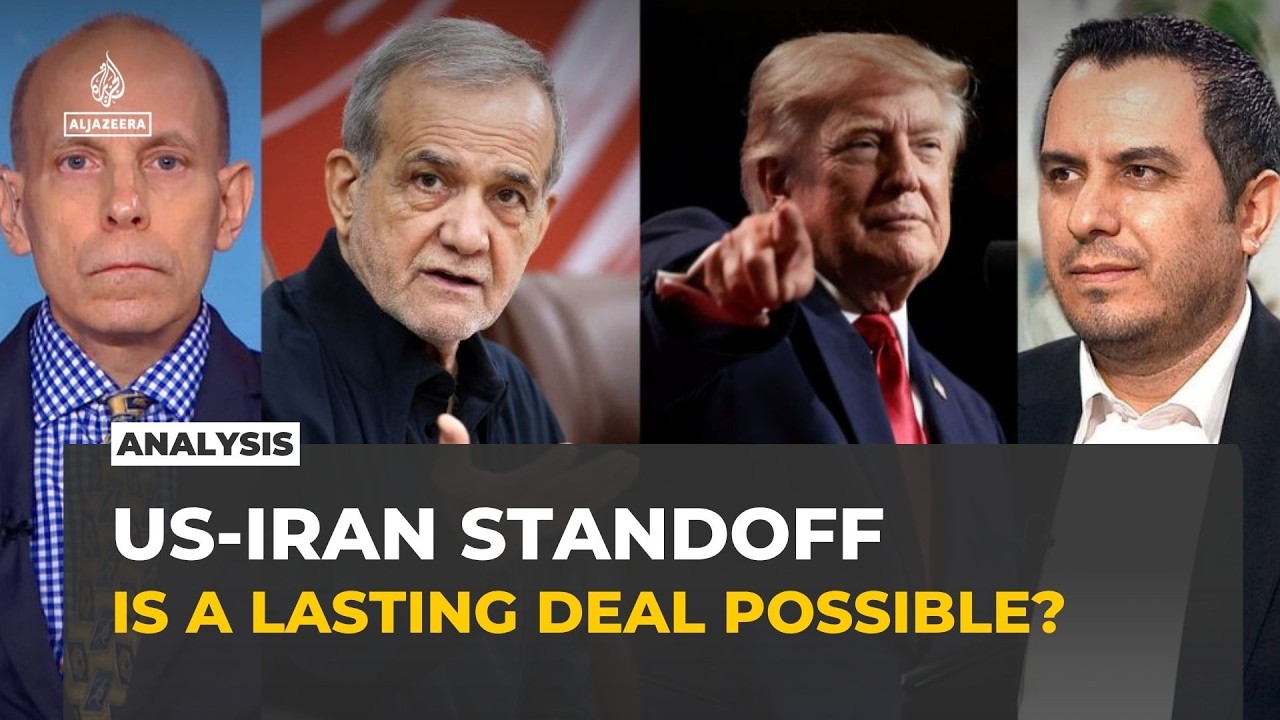
US-Iran standoff: Can a lasting deal reopen the Strait of Hormuz? Experts debate
Al Jazeera English
57,737 views • 1 month ago Save 6 min 4 min read
Video Summary
The standoff over the Strait of Hormuz has reached a volatile impasse, with Iran demanding financial reparations for U.S. military actions as a prerequisite for any lasting diplomatic resolution. While Tehran engages in technical talks with Oman to potentially revive a memorandum of understanding, the U.S. continues to apply "maximum pressure" through naval blockades and economic sanctions, creating a cycle of strategic uncertainty and mutual distrust that threatens regional stability.
Experts remain divided on whether a durable agreement is possible. While some argue that a highly detailed, enforceable framework could bypass the current lack of trust, others point to the contradictory signals from Washington—alternating between threats of total destruction and calls for diplomacy—as the primary obstacle to progress. With Iran asserting its military capability remains intact despite U.S. claims of decimation, the path to reopening the vital waterway remains stalled by competing demands and a fundamental disagreement over the legitimacy of transit corridors.
Short Highlights
- Iran has issued six demands for the U.S., including compensation for damages from recent military operations.
- Tehran is currently engaged in technical negotiations with Oman to potentially revive a memorandum of understanding regarding the waterway.
- The U.S. maintains a naval blockade in the region, which Iran characterizes as an attempt to force vessels through uncoordinated transit corridors.
- Experts suggest that any successful resolution requires a highly specific, enforceable agreement rather than a vague diplomatic framework.
- Iran contends that its military capabilities remain functional despite U.S. claims of having decimated its naval and air forces.
- A lasting solution is viewed as requiring the involvement of multiple stakeholders, including GCC states and major Asian and European economies.
- The U.S. strategy is criticized by Iranian officials for being unpredictable, alternating between threats of force and calls for diplomatic engagement.
Related Video Summary
Key Details
Diplomatic Tracks and the Strait [01:21]
- Iran and Oman are conducting technical talks to establish new arrangements for the Strait of Hormuz.
- Tehran views the current U.S. naval presence as an attempt to force vessels into uncoordinated corridors, which it deems unacceptable.
-
By the time that there is no new, let's say, agreement on the terms of the Article 5 of the MOU, so that will be the case.
The Challenge of Mutual Distrust [02:30]
- Experts argue that trust is not a prerequisite for negotiation but that a successful deal requires rigid, verifiable terms.
- A formal commission or body is suggested to resolve deviations from an agreed framework before they escalate to military levels.
-
I'm not one who puts a lot of faith in each side trusting each other. In fact, we wouldn't have these negotiations if they fully trusted each other.
Iran’s Demand for Reparations [03:36]
- Iran has publicly tabled an invoice for damages caused by recent U.S. military actions, signaling a shift in policy.
- Tehran aims to end the cycle of military engagement by inflicting tangible costs on the United States.
-
And what is Iran tabling at the moment is the invoice for the recent American aggression and invasions against the country.
The Complexity of Stakeholder Involvement [04:47]
- A bilateral deal between Iran and the U.S. is considered insufficient to resolve the crisis due to the interests of global stakeholders.
- Major Asian economies and European states are identified as critical parties that rely on the transit of the waterway.
-
It's a part of the puzzle, but it's not the whole solution.
Strategic Uncertainty and Future Outlook [05:27]
- Iran claims that contradictory U.S. rhetoric creates an unpredictable environment that hinders diplomatic progress.
- Despite economic pressure and sanctions, Iran maintains that it is seeking a diplomatic off-ramp to convert security threats into economic benefits.
-
For Iran, the priority is a diplomatic off-ramp. They wanted to do it.