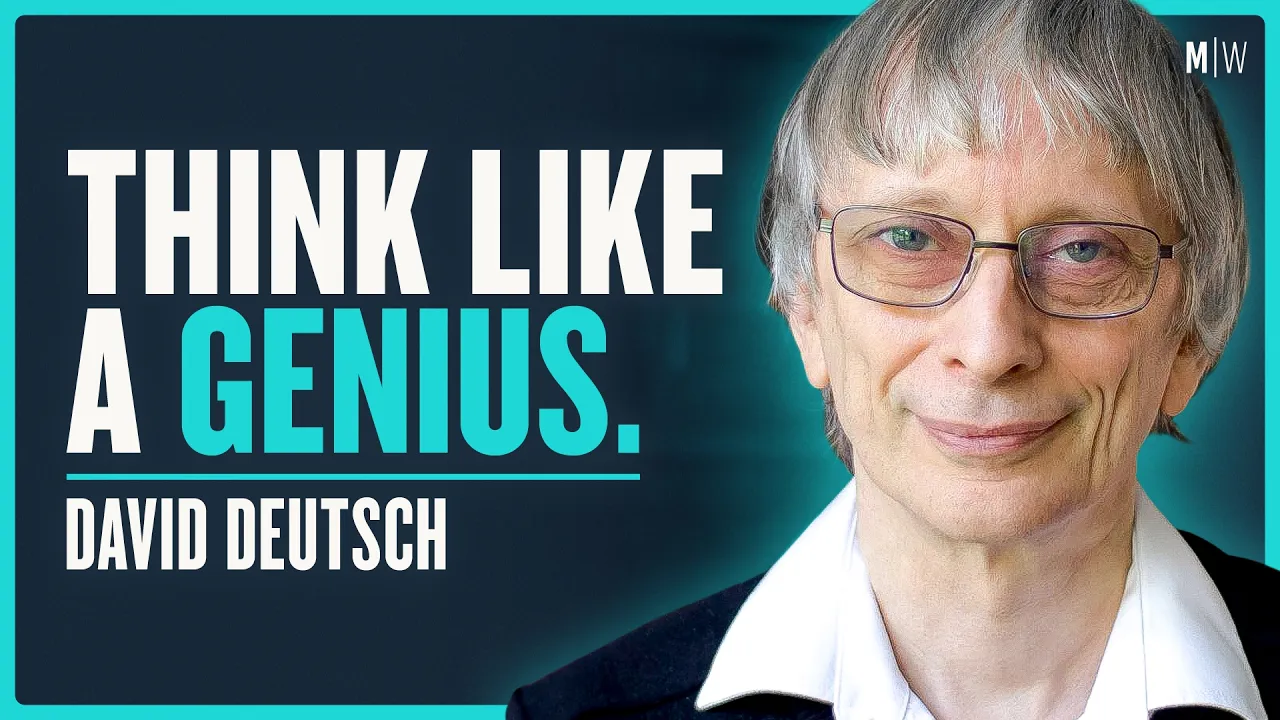
Father Of Quantum Computing: How To Think Like A Genius - David Deutsch
Chris Williamson
607 views • 22 hours ago Save 62 min 9 min read
Video Summary
David Deutsch, a proponent of Karl Popper's philosophy, argues that misunderstanding is the communicator's fault, not the learner's, because knowledge is created internally and must be guessed and tested. He contends that we are all "at the beginning of infinity" due to our "infinite ignorance," making certainty a poor guide to truth and authority a "power play." Deutsch advocates for embracing uncertainty and seeking to correct errors rather than striving for certainty, a stance he applies to societal issues like AI and climate change, viewing pessimism as a "cheat" in storytelling and a misunderstanding of progress.
Deutsch critiques the "bucket theory" of education, where knowledge is passively poured into students, advocating instead for a system that fosters genuine understanding and the ability to create new knowledge. He believes that true learning, like mountaineering or Formula 1 racing, involves embracing challenges and finding joy in difficult pursuits, rather than mere forced discipline. He sees progress as inherently involving destruction and emphasizes the importance of individual problem-solving and the pursuit of intellectual challenges as central to a good life, likening the process to finding and marrying a problem.
Short Highlights
- Knowledge Creation: Knowledge is created internally through guessing and testing, not downloaded. Misunderstanding is the communicator's fault.
- Infinite Ignorance: We are all "at the beginning of infinity" due to vast ignorance, making certainty unreliable and authority a power play.
- Embrace Uncertainty: Strive to correct errors and enjoy the sensation of being baffled; certainty is not a virtue.
- Optimism as Problem-Solving: Optimism means seeing failure as a lack of knowledge, not an insurmountable barrier.
- Critique of Pessimism: Pessimism is a "cheat" in storytelling and an unnecessary stance on issues like AI and climate change.
- Education Reform: The "bucket theory" of education is flawed; true learning involves embracing challenges and creating knowledge.
- The Good Life: A good life involves finding intellectual problems, falling in love with them, and pursuing them persistently.
Key Details
The Fault of Misunderstanding [00:00:00]
- Misunderstanding is the fault of the communicator, not the learner, because knowledge is created internally.
- We guess what others mean and test those guesses; if the process fails, the teacher hasn't pitched it correctly.
"So if that process goes wrong, it is because the teacher or the professor or the communicator has not pitched it to meet your problem situation."
Infinite Ignorance and the Limits of Authority [00:00:00]
- Following Karl Popper, we are all "at the beginning of infinity" due to "infinite ignorance."
- Holding oneself up as an authority is a "sociological mistake" and a "power play" rather than participation in knowledge growth.
"We may all know different things, different pieces of knowledge, but in our infinite ignorance, we are all alike."
The Sensation of Certainty vs. Truth [00:00:00]
- The subjective sensation of certainty is no guide to the truth.
- One should not rely on the extent of knowledge or ignorance to judge an idea; even an ignorant or malevolent person might hold the truth.
"So the only way to judge ideas is not by someone's authority, or by one's own authority, or by how sure one is, but only by the criterion of whether you have a good explanation for why that truth has had its errors corrected better than all the other truths you've heard or can think of."
Practical Application of Knowledge [00:00:00]
- We form theories about everyday situations (e.g., buying a sandwich) to avoid going back to first principles.
- We don't need to re-verify everything; we can rely on theories about how systems work, including those of experts.
"So you don't have to go through the whole thing because, in short, not only am I able to criticize ideas myself, I'm able to formulate and criticize ideas about other people."
Aspiring to Uncertainty [00:00:00]
- We should not aspire to certainty, but rather to uncertainty and the sensation of being baffled.
- Enjoying the state of conflict and thinking "now it looks like this is true, but it can't be true" is desirable for scientific research.
"No, we should aspire not to have any. Should we aspire to uncertainty then? Yes."
The Loss of Graceful Play with Ideas [00:00:00]
- The internet encourages quick criticism, punishing "playing gracefully with ideas" or "putting on a hypothetical hat."
- The "production and publication of ideas are one and the same on the internet," leading to a "slow increase in the seductivity of certainty."
"And I think in my world, which is significantly less salubrious than academia, but maybe just as cutthroat and as much backbiting, the internet is really quick to show its own smarts by pointing out the flaws of others."
Weaponized Uncertainty and Conjecture [00:00:00]
- Uncertainty is "weaponized" to dismiss thinkers, rather than seen as a sign of exploration.
- Platforms like Twitter/X are unsuitable for conjecture due to this phenomenon; one must "think twice and three times and four times" before posting.
"So I, I think twice and three times and four times before putting something on Twitter on X."
The Fermi Problem vs. Fermi Paradox [00:00:00]
- The Fermi problem is not a paradox but a mystery; we don't know if we are alone.
- It's easy to come up with explanations for why aliens aren't here; it's a "collision between one fantasy and another fantasy."
"But the Fermi problem is not really, it's really a collision between one fantasy and another fantasy. We just don't know. Get over it."
Optimism as an Explanation for Failure [00:00:00]
- Optimism is not a cheerful outlook but an explanation for failure: failure occurs because we lack the knowledge to succeed.
- Pessimism views failure as a barrier, whereas optimism sees it as a temporary state due to insufficient knowledge.
"Whenever something goes wrong, it's because we had not yet created the knowledge to make it go right. It's always a matter of knowledge."
Optimism and Personal Struggles [00:00:00]
- Optimism doesn't guarantee problem-solving but asserts that problems are not insoluble; reason always has access.
- Even in dire situations like terminal illness, the lack of knowledge might be the issue, not an inherent impossibility.
"So, uh, on the other hand, you can't say what, what you will solve. You, you, you, you might, you might, you might solve it, but the, the, in, in regard to what you do, you do not think this is insoluble."
Pessimism as Sophistication [00:00:00]
- Pessimism often masquerades as sophistication because writing unhappy endings is easier than creating realistic, positive resolutions.
- Both happy and sad endings "pulled out of a hat" are cheats; true enrichment comes from knowledge about life.
"So it's all a dream. For example. Yeah. That's another, that's another way of doing it."
Unnecessary Pessimism: AI and Climate [00:00:00]
- AI doom and climate catastrophe scenarios are examples of viewing problems as insurmountable barriers.
- It's arbitrary to pick these specific fears when the possibility of catastrophe has always existed.
"They are both examples of, uh, of, uh, looking at a problem and thinking of it as a barrier."
AGI and the Nuclear Analogy [00:00:00]
- Fears about AGI are not justified, similar to past fears about nuclear reactors, which led to the climate problem.
- Turning away from AI due to fear could be a "bigger catastrophe" than the turn away from nuclear power.
"So, uh, if we turn away from artificial intelligence, um, uh, because of a similar fiction, um, will it be? No, I was, I was going to say it might well be a bigger catastrophe."
LLMs and the Absence of Creativity [00:00:00]
- LLMs lack a module for creativity and cannot achieve AGI because they don't understand creativity itself.
- Their functionality is impressive but doesn't violate our best theories of knowledge creation.
"The LLMs do not have a module in them capable of creativity."
The Nature of Creativity [00:00:00]
- Creativity is the ability to create new knowledge; explanatory creativity, the human ability to explain why, is unique.
- Humans can imagine and create new concepts (like carrying a burning branch for protection), not just optimize for a given outcome.
"The thing that humans have, and that no existing other species has, although there were species in the past that had this, is explanatory creativity."
The Flawed "Bucket Theory" of Education [00:00:00]
- Current education is based on the "bucket theory," where knowledge is poured into passive students.
- This model wrongly blames the "bucket" (student) for failure and incentivizes teaching to tests rather than fostering understanding.
"In education, it's the other way around. We judge education by how well and how accurately you fill the bucket."
A Better Approach to Learning [00:00:00]
- Learning should be like mountaineering or Formula 1 racing: something you pay the price to do because you love it.
- Forced discipline for tasks one dislikes is bad; the goal is to improve situations and learn to enjoy them.
"So I think having discipline and forcing yourself could be a form of words that describes this mountaineer. And in that case, it is wonderful."
Prioritizing a Good Life [00:00:00]
- A good life requires diversity; there's no single formula for everyone.
- The key is to find an intellectual problem, "fall in love with it," and pursue it persistently, even if it means creating "delightful problem children."
"So I don't think there's a formula which applies to, to everybody."
Progress and Destruction [00:00:00]
- Progress often looks like destruction because both can involve significant change and disruption.
- What matters is whether the pursuit is joyful and leads to genuine knowledge, not just external perception or societal approval.
"I wonder why progress looks so much like destruction."
Upcoming Books [00:00:00]
- Deutsch is writing a textbook on quantum theory, a fiction book, and a third non-fiction book tentatively titled "Irrationality: How Thinking Works and What the Obstacles to It Are."
"So that's one thing. Another thing is I'm writing the third book in my sort of sequel to my first two books, Fabric of Reality and the Beginning of Infinity."