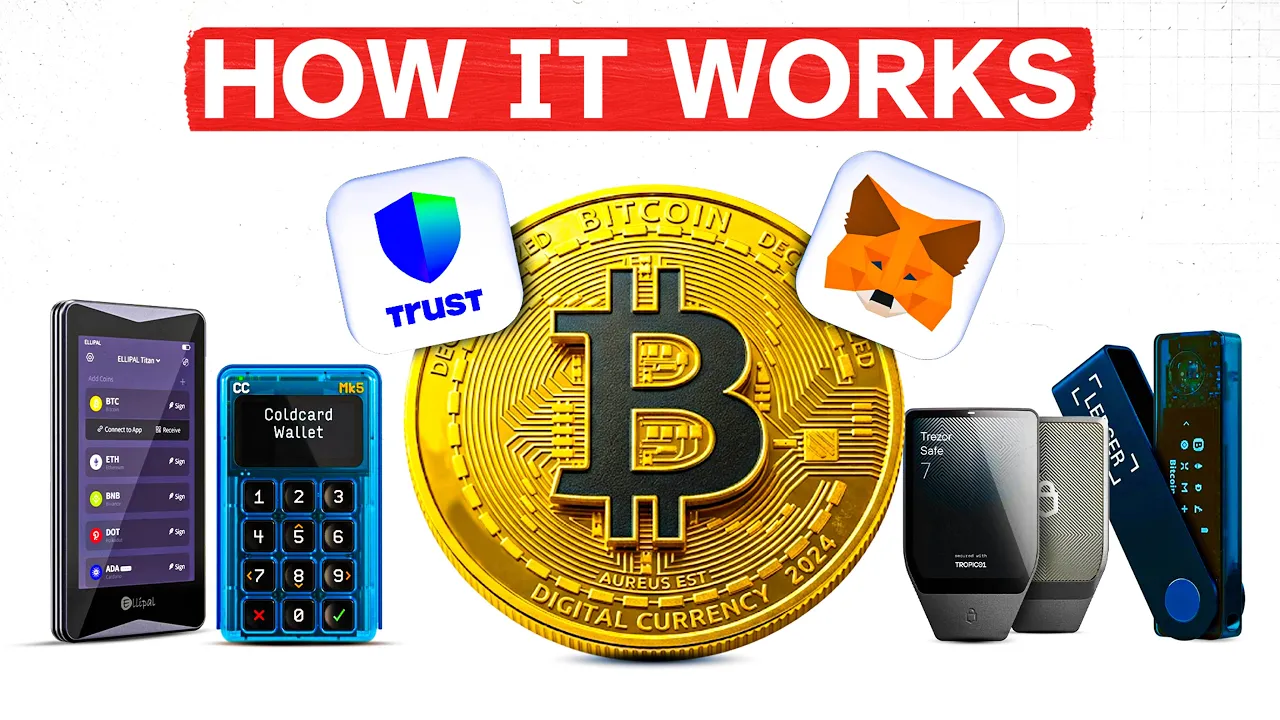
How Crypto Wallets ACTUALLY Work
Coin Bureau
279 views • 22 hours ago Save 8 min 5 min read
Video Summary
An IT engineer lost access to $670 million worth of Bitcoin after accidentally throwing away the hard drive containing his crypto wallet keys. The coins remain on the blockchain but are inaccessible, highlighting the critical importance of managing private keys.
The video explains that crypto wallets don't store coins but rather the private keys that prove ownership on the blockchain. Losing these keys means losing access to the associated cryptocurrency, as there's no central authority to help recover them. The explanation delves into how private keys generate public keys and addresses, the role of seed phrases for backup, and the distinction between 'hot' wallets (online, convenient but vulnerable) and 'cold' wallets (offline, secure but less convenient). It also emphasizes that most crypto losses stem from user error, such as falling for scams or losing seed phrases, rather than sophisticated hacking.
Short Highlights
- Crypto wallets hold keys, not coins: Your cryptocurrency always remains on the blockchain; the wallet stores the private keys needed to access and control it.
- Losing keys means losing crypto: If private keys are lost or inaccessible, the associated cryptocurrency becomes permanently stuck and unrecoverable.
- Private keys enable transactions: They are used to generate digital signatures, authorizing the movement of funds without revealing the key itself.
- Seed phrases are master backups: A sequence of words can regenerate all private keys, acting as a critical recovery mechanism but also a major security risk if compromised.
- Hot wallets are online and convenient: Apps and browser extensions offer ease of use for daily transactions but are vulnerable to online threats like phishing and malware.
- Cold wallets are offline and secure: Hardware devices store keys offline, significantly reducing the risk of remote theft, though they involve cost and extra steps for transactions.
- User error is the main cause of loss: Most crypto is lost due to scams, phishing, or mishandling seed phrases, rather than direct hacking of cryptographic security.
Key Details
The $670 Million Mistake [0:00]
- James Howells discarded a hard drive containing 8,000 Bitcoin in 2013, which he had mined in 2009.
- The drive ended up in a landfill, and the Bitcoin, now valued at approximately $670 million, remain on the blockchain but are inaccessible.
- This incident highlights the critical role of private keys in cryptocurrency ownership and the severe consequences of their loss.
"8,000 Bitcoin, out of reach"
What a Crypto Wallet Actually Holds [1:10]
- Cryptocurrency is always stored on the blockchain, a public ledger.
- A crypto wallet's primary function is to hold the private keys that prove ownership and authorize transactions.
- Losing these keys means the crypto is stuck, while gaining them allows anyone to access the funds.
"In other words, a crypto wallet is more like a keyring rather than an actual wallet."
The Mechanics of Crypto Keys [2:39]
- A private key, a large random number, authorizes spending.
- From the private key, a public key is derived using elliptic curve cryptography.
- The public key is then hashed to create a public address, which is shared to receive funds.
"So, getting from the private key to the address is easy, but going backwards is effectively impossible."
Seed Phrases: The Master Key [4:24]
- When setting up a wallet, a seed phrase (12 or 24 words) is generated.
- This phrase can be used to reconstruct all private keys on any compatible wallet, acting as a comprehensive backup.
- Anyone who obtains the seed phrase can gain full control of the associated cryptocurrency.
"Anyone who reads Sam's seed phrase doesn't need his phone or his password."
Hot vs. Cold Wallets [5:45]
- Hot wallets are connected to the internet (e.g., phone apps, browser extensions), offering convenience for everyday use but are vulnerable to online attacks.
- Cold wallets keep private keys offline, typically on hardware devices, providing enhanced security at the cost of convenience and an initial purchase price.
- Exchanges hold keys for users, creating an IOU; the mantra "Not your keys, not your crypto" emphasizes the importance of self-custody.
"Well, that is a cold wallet. A cold wallet keeps the keys offline."
Securing Your Crypto: Best Practices [10:24]
- Download wallets only from official sources, avoiding links in emails or ads.
- Write down seed phrases on paper or metal, never store them digitally or take screenshots.
- Send a small test transaction before transferring large amounts and consider restoring the wallet from the seed phrase to verify the backup.
- Use a hot wallet for spending money and a cold wallet for long-term storage.
"The first is to download the wallet from the official source only, typing the web address himself or using the official app store listing."
Common Crypto Loss Scenarios [14:01]
- Most crypto losses occur not from hacking but from user error, such as falling for fake support agents who request seed phrases.
- Lookalike websites can trick users into signing malicious transactions, draining their wallets.
- Forgetting or losing the seed phrase, especially after upgrading devices, can render crypto inaccessible, similar to the landfill scenario.
"And it's almost always just the victim being persuaded to hand something over. Or press a button that they shouldn't have."