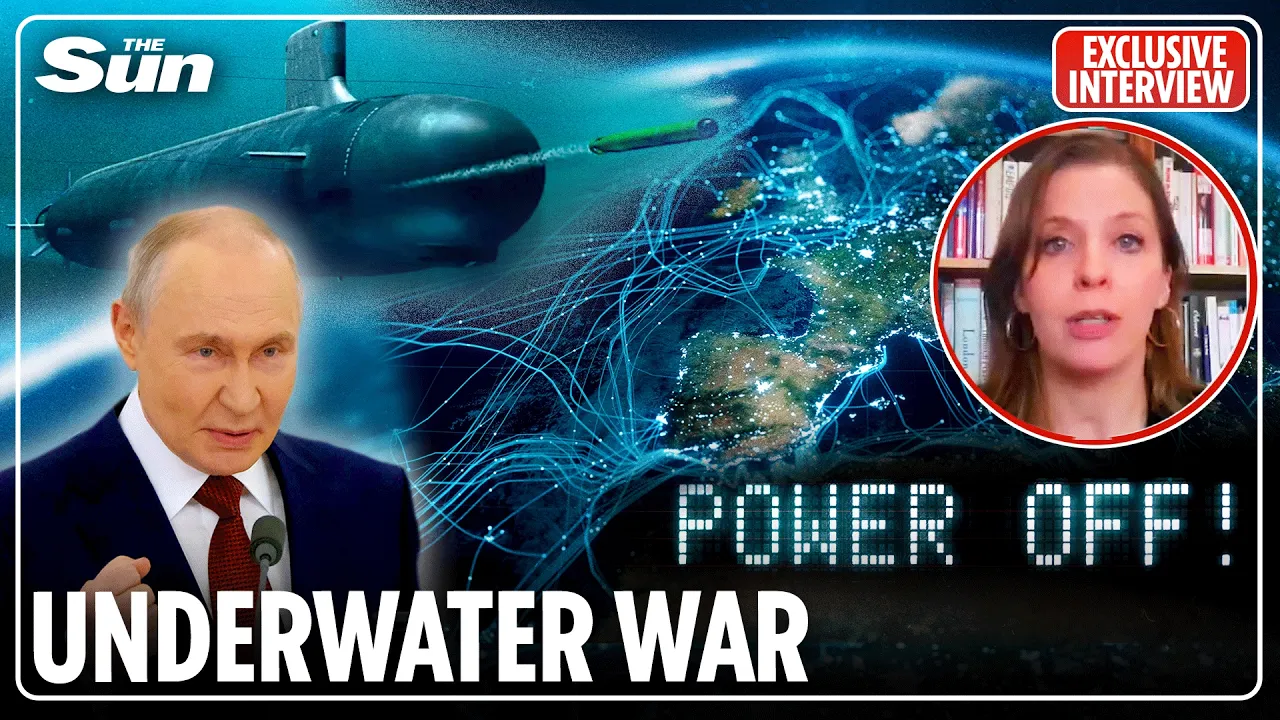
How Russia's new ‘super-subs’ and torpedoes could trigger chilling blackouts across Europe
The Sun
6,287 views • 21 hours ago Save 4 min 5 min read
Video Summary
Modern life teeters on the brink as deliberate sabotage of undersea cables and pipelines escalates, threatening global connectivity and energy independence. Recent suspicious incidents in the Baltic Sea and Taiwanese waters, coupled with a surge in Russian submarine capabilities and Western countermeasures, highlight a new era of "gray zone aggression." This strategy, employed by Russia, involves covert attacks on civilian infrastructure, such as recent drone incidents at Leipzig Halle Airport and sabotage at German power stations, aiming to instill fear and disrupt economies without direct military confrontation.
These "sinister attacks" on non-military targets, including commercial operations and power grids, represent a significant shift from past threats. While NATO remains strong against direct military assault, Russia's use of cowardly sabotage, as evidenced by the Leipzig drone incident attributed to Russia, exploits the ambiguity between war and peace. The financial and psychological toll on affected nations and companies is immense, with the perpetrators offering no accountability, underscoring the urgent need for robust defenses and a clear signal of resilience.
Short Highlights
- Undersea cables and pipelines are critical for modern economies, transmitting data and electricity.
- Russia is employing "gray zone aggression" through sabotage of civilian infrastructure.
- Recent attacks include suspicious incidents in the Baltic Sea and Taiwanese waters.
- Drone incident at Leipzig Halle Airport and power station attacks in Germany highlight the threat.
- Expansion of submarine fleets by Russia and Western countries increases underwater traffic and potential conflict.
- These attacks aim to frighten populations and cause financial disruption without direct military engagement.
Related Video Summary
- The Dumbest Metaphors In History | Norm Macdonald Stand Up
- Iran OBLITERATES US Army Barracks, War Enters Deadliest Phase | Seyed M. Marandi
- How Russia could bring Britain to STANDSTILL with wave of sabotage attacks
- EXPOSED: Inside Ukraine’s 200sq km counter-attack destroying Russia's strategy | Battle Plans
Key Details
The Criticality of Undersea Infrastructure [00:00:00]
- Modern economies are heavily reliant on functioning undersea cables and pipelines.
- Cables transmit vital data, impacting everything from personal connectivity to global commerce and government operations.
- Electricity-transmitting cables, or "interconnectors," are crucial for energy independence, especially from fossil fuel sources.
"The world's modern economies depend on the functioning of cables and pipelines, in particular on cables."
Escalating Suspicious Incidents [00:00:00]
- Recent years have seen a disturbing rise in suspicious incidents involving undersea cables and pipelines.
- These incidents have occurred in the Baltic Sea and, notably, in Taiwanese waters.
- The unusual behavior of ships in these areas adds to the concern and troubling nature of these events.
"What we have seen in recent years is a series of suspicious incidents involving undersea cables and pipelines in the Baltic Sea and, by the way, also in Taiwanese waters."
The Rise of Underwater Warfare and Surveillance [00:00:00]
- Western governments and NATO are increasing their use of underwater robots for surveillance.
- This expansion of robotic activity adds to the complexity and potential for conflict beneath the waves.
- Russia and other hostile nations are also acquiring and deploying robots, intensifying this underwater arms race.
"Western governments and NATO are thinking about getting a better picture of what's going on underneath the ocean surface is to use more underwater robots, which is a good idea."
Russia's Submarine Expansion and "Gray Zone Aggression" [00:00:00]
- Russia has shifted its focus from a surface navy to building a formidable submarine fleet.
- These modern Russian submarines are highly capable, marking a significant improvement over historical Soviet designs.
- This build-up, alongside Western submarine orders, means increased hostile traffic on the ocean floor, directly clashing with the need for secure undersea infrastructure.
"And so what Russia has done in recent years instead is focusing on submarines."
Sinister Attacks on German Civilian Infrastructure [00:00:00]
- Germany has recently experienced a series of shocking and sinister attacks on civilian targets.
- This includes a campaign against car exhaust pipes, initially blamed on environmental activists but later attributed to Russian agents.
- A drone incident at Leipzig Halle Airport, if successful, could have caused significant damage and casualties.
"These are really sinister attacks. And you have to remember Leipzig Halle Airport, like most other airports in the world, is a commercial operation. It's not a military installation."
Attacks on German Power Stations [00:00:00]
- In the days preceding the transcript, two separate attacks occurred at power stations connected to coal plants in Germany.
- Authorities and operators confirmed these were not technical faults but likely planned attacks.
- These attacks targeted essential civilian infrastructure, highlighting a new level of threat.
"And in both cases, the authorities and indeed the operators say it wasn't a technical fault. It was most likely a planned attack."
The Cowardly Strategy of Sabotage [00:00:00]
- Russia is employing sabotage against NATO countries as a "cowardly" tactic, avoiding direct military confrontation.
- This "gray zone aggression" allows attacks anywhere, anytime, with disregard for legality or ethics, primarily to frighten populations.
- Even unsuccessful attacks, like the Leipzig drone incident, achieve the goal of instilling fear and demonstrating vulnerability.
"So what Russia is doing instead is really cowardly, which is using sabotage against these countries, against the UK, Germany, Sweden, other countries."
Financial and Psychological Impact [00:00:00]
- Sabotage attacks on infrastructure like power plants and airports lead to operational suspensions and financial losses.
- The perpetrators, like Russia, do not bear the cost, making the strategy financially clever for them despite its unethical and illegal nature.
- The constant threat of attacks anywhere, at any time, creates widespread fear and uncertainty among the public and businesses.
"So if your facility, whatever it may be, your power plant, your airport is targeted and has to suspend operations for a while, or is damaged, then you lose money."