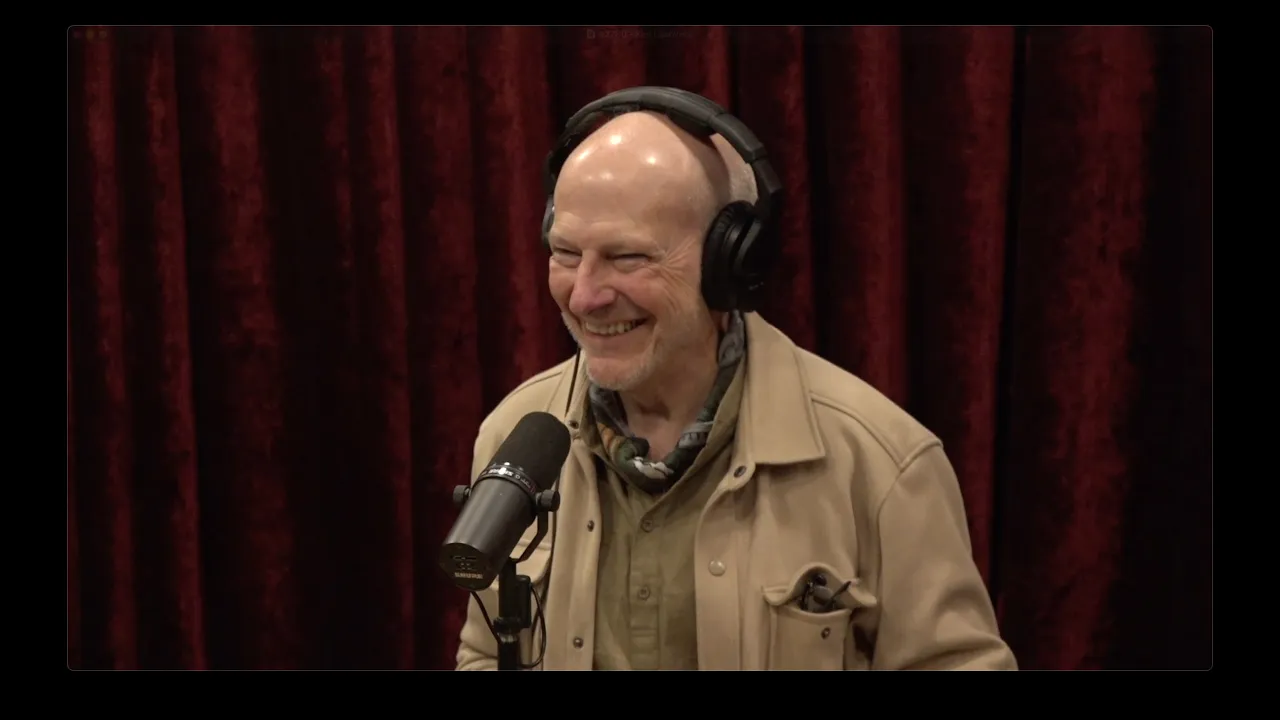
Joe Rogan Experience #2580 - Kenneth Lacovera
PowerfulJRE
7,861 views • yesterday Save 135 min 6 min read
Video Summary
Contrary to modern conspiracy theories, the existence of dinosaurs is a scientifically verified reality, not a hoax. Paleontologist Kenneth Lacovara explains that the fossil record, while incomplete due to the extreme rarity of preservation, provides a robust, testable timeline of life on Earth. Dinosaurs dominated the planet for 165 million years before a catastrophic asteroid impact 66 million years ago triggered a mass extinction, leaving only avian dinosaurs—modern birds—to survive.
Lacovara emphasizes that the Earth's history is vast, with non-avian dinosaurs appearing only in the final weeks of a metaphorical calendar year. Skepticism regarding their existence often stems from a misunderstanding of how fossils are reconstructed or a lack of knowledge about deep time. By examining geological strata and biological evolution, scientists can reliably predict where and when fossils will be found, proving that the dinosaur narrative is anchored in empirical evidence rather than fabrication.
Short Highlights
- Dinosaurs are a scientific reality, not a hoax, proven by testable geological predictions and millions of fossilized remains.
- Non-avian dinosaurs lived from the second week of December until the day after Christmas on a metaphorical one-year Earth calendar.
- The vast majority of dinosaur species remain undiscovered because fossilization requires specific, rare conditions like rapid burial in sediment.
- Birds are living descendants of dinosaurs, having survived the asteroid impact due to their ability to burrow or adapt.
- Paleontology relies on phylogenetic bracketing and modern biological analogs to reconstruct the appearance of extinct creatures.
- The "Bone Wars" between Cope and Marsh were a real, bitter rivalry in the 19th century, but the fossils they discovered were authentic.
- The Edelman Fossil Park and Museum in New Jersey offers a unique window into the final moments of the Cretaceous period.
Key Details
Scientific Evidence for Dinosaurs [0:01:28]
- Paleontology is a science of prediction and testing, not a belief system.
- Skepticism is healthy, but a global conspiracy to fake dinosaur existence across continents and eras is impossible to scale.
-
Science isn't a belief system, right? Right. Go outside and dig up some fossils for yourself.
The Calendar of Earth History [0:04:47]
- If Earth's history were one year, complex life starts at Thanksgiving.
- Dinosaurs appear in the second week of December and are wiped out the day after Christmas.
- Humans appear only 20 seconds before midnight on New Year's Eve.
-
And dinosaurs were just here. It's only 2% of earth history ago.
The Rarity of Fossilization [0:06:54]
- Most organisms decay; becoming a fossil is an unlikely event that only happens when repeated over vast time scales.
- Mountains are erosional, so dinosaurs living there rarely enter the fossil record.
-
Unlikely things are likely to happen when happening happens a lot.
Original Bone and Soft Tissue [0:08:44]
- Mineralization (per-mineralization) replaces bone with minerals, but original soft tissue can occasionally be preserved.
- Claims of dinosaur blood cells remain a subject of active scientific debate and rigorous validation.
-
Science has discovered trace of dinosaur blood preserved for 115 million years, shattering assumptions about how long biological molecules can survive.
The First Dinosaur Discoveries [0:13:30]
- Early discoveries in 19th-century Britain were named by Richard Owen, who misunderstood them as giant lizards.
- Folklore often attributed fossil findings to dragons or mythical creatures due to a lack of knowledge about deep time.
-
People do what people do, which is we make stuff up.
Hadrosaurus and New Jersey [0:16:15]
- The first nearly complete dinosaur skeleton was discovered in Haddonfield, New Jersey, in 1858.
- This discovery sparked "dinomania" and established New Jersey as a cradle of American paleontology.
-
England is the birthplace of dinosaur paleontology, but southern New Jersey is the cradle of dinosaur paleontology.
Reconstructing Dinosaurs [0:18:02]
- Artists use modern analogs, like hippos or birds, to guess how dinosaurs looked, acknowledging that color and soft tissue remain uncertain.
- Leonardo, a duck-billed dinosaur, provided rare 3D insights into skin texture and gut contents.
-
There's a lot we don't know about dinosaurs, but that's what keeps us in business, right?
Feathered Dinosaurs [0:21:40]
- Theropod dinosaurs, including T-Rex and Velociraptors, likely possessed feathers or feather-like structures.
- Velociraptors in reality were much smaller than their Hollywood counterparts, closer to the size of a turkey.
-
In the case of velociraptor, we can actually see the quill insertion knobs on its ulna.
The Massive Dreadnoughtus [0:26:15]
- Dreadnoughtus is one of the most massive dinosaurs for which scientists can confidently calculate weight (65 tons).
- Bone tissue analysis shows Dreadnoughtus was still growing rapidly at the time of its death.
-
You could probably fit, you know, two Dreadnoughtus brains in a pint glass.
Giant Crocodiles [0:30:25]
- Prehistoric crocodiles like Sarcosuchus and Deinosuchus reached sizes up to 35 feet and likely preyed on dinosaurs.
- Crocodiles exhibit indeterminate growth, meaning they can continue to grow throughout their long lives.
-
Crocodiles, who are the closest living relatives to dinosaurs, right? They're not dinosaurs. They're cousins.
The Asteroid Impact [0:37:35]
- The 66-million-year-old asteroid impact caused global temperatures to spike to oven-like levels.
- Non-avian dinosaurs were functionally extinct within a day because they lacked the ability to burrow or hide.
-
If you were here the day before that asteroid hit, you would look around and you would say, well, this is how it's always going to be.
Geological Laws [0:43:08]
- Nicholas Steno established the fundamental laws of geology, including that the oldest layers are at the bottom.
- James Hutton later proved the Earth was ancient by observing geological cycles at Siccar Point.
-
The Earth shows no vestige of a beginning, no prospect of an end.
Plate Tectonics [0:50:00]
- The theory of plate tectonics, established in the 1960s, explains how continents move via seafloor spreading.
- Magnetometers revealed magnetic stripes on the ocean floor, proving the Earth's magnetic field periodically flips.
-
It's almost like the discovery of DNA in biology. Like plate tectonics in geology just kind of makes everything make sense.
The Bone Wars [1:01:25]
- Cope and Marsh engaged in a bitter, unethical rivalry to name the most dinosaur species in the late 19th century.
- Despite their personal failings, their massive fossil collections remain essential to modern paleontology.
-
Cope challenged Marsh. He said, you know, when we die, let's donate our brains to science and see who has the bigger brain.
Museum Reconstructions [1:05:40]
- Museums often use replicas for large skeletons to protect original bones and allow for easier scientific study.
- Best practices involve coloring replicas differently so the public can distinguish them from real fossil material.
-
It's not great to mount the bones of a big creature because two things. One is that you have to do things to the bone.
Future Prospecting [1:07:30]
- Antarctica remains a prime, largely unexplored location for finding new dinosaur species from the Cretaceous period.
- North Africa's Tethys Seaway is another high-priority region for discovering unique aquatic and coastal dinosaurs.
-
There's got to be thousands and thousands of dinosaurs and new species under that ice cap, and we have no idea what's down there.