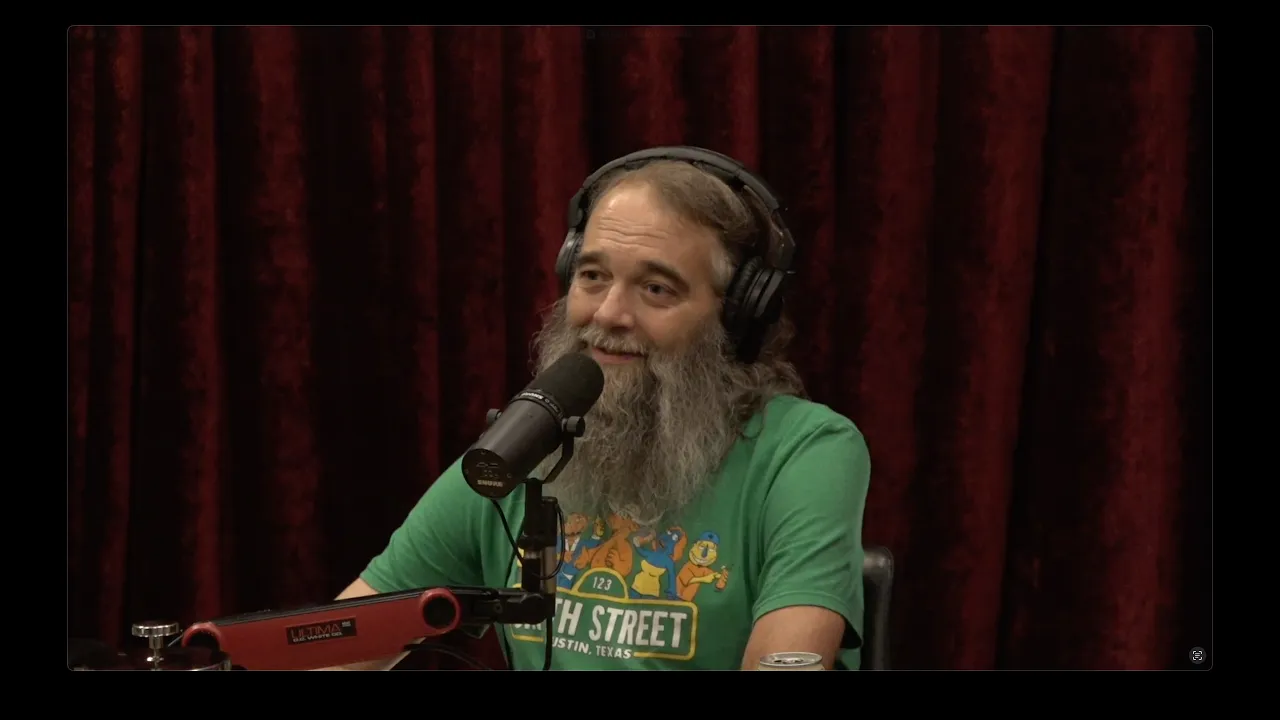
Joe Rogan Experience #2563 - Dan Richards
PowerfulJRE
15,069 views • 21 hours ago Save 161 min 7 min read
Video Summary
The discovery of thousands of artificially modified skulls, particularly in the Pacific Northwest and Peru, suggests a global history of cranial manipulation that may have been rooted in both social status and biological necessity. Evidence indicates that ancient cultures practiced head-binding to address issues like Chiari malformation and cranial pressure, potentially stemming from the interbreeding of early human lineages like Neanderthals and Denisovans. These practices, often dismissed or obscured by mainstream archaeology, hint at a sophisticated and interconnected ancient world that actively managed human genetics and physical traits.
Beyond cranial modification, the conversation highlights a growing conflict between independent researchers and institutional archaeology. The systematic disappearance of artifacts, the redaction of archaeological reports, and the aggressive labeling of alternative theories as "pseudoscience" suggest a deliberate effort to control the narrative of human history. By examining overlooked evidence like the Paracas Candelabra and the mysterious disappearance of giant skeletons, the discussion argues that our current understanding of ancient civilizations is incomplete and often protected by gatekeepers who suppress findings that challenge established timelines.
Short Highlights
- The majority of recorded elongated skulls were found in Washington State, where modification was a sign of freedom.
- Cranial deformation may have served as a medical treatment for Chiari malformation and skull-brain size mismatches.
- Archaeological institutions are accused of redacting data and "disappearing" artifacts, such as giant skeletons and unique skulls.
- The Paracas Candelabra and other ancient symbols may represent a global "family tree" of intermingled human bloodlines.
- Mainstream archaeology is criticized for functioning more like a protected belief system than an open, scientific discipline.
- Private collections and museums are suspected of hoarding rare artifacts that contradict established historical narratives.
Key Details
The Chinook Sign of Freedom [0:01:21]
- The majority of elongated skulls in recorded history were found in Washington State.
- Among the Chinook people, artificial cranial modification was a prerequisite for being a free person; those without it were considered slaves.
If you didn't have an artificially modified skull, you were a slave.
Neanderthal Brain Mismatch [0:03:00]
- Scientists suggest that Chiari malformation type one, which causes severe migraines, may result from a mismatch between human and Neanderthal brain cases.
- Neanderthals had larger brain capacities and distinct skull shapes, possibly optimized for motor skills and sensory perception rather than frontal-lobe-driven decision-making.
Neanderthal brain case, skull, not quite fitting.
The Dark Reality of Nature [0:06:50]
- Animal behavior, specifically among dolphins and bears, includes infanticide and cannibalism, challenging the human tendency to anthropomorphize nature as peaceful.
- These behaviors are often driven by biological imperatives to force breeding, which is described as "darker" than human morality.
They go into dens and pull out cubs and eat them. They don't care about me.
Polydactyly and Ancient Genetics [0:09:40]
- Recent studies link a gene variant found in Neanderthals and Denisovans to increased rates of polydactyly and cranial deformations.
- In some ancient cultures, these genetic variations were not viewed as defects but were honored and even actively bred.
That's in the Bible. They talk about the giant.
The War on Scientific Literacy [0:13:30]
- The COVID-19 pandemic highlighted a weaponization of "trust the science" rhetoric, which discouraged skepticism and marginalized alternative medical perspectives.
- True science is defined as a method of questioning, not a static body of knowledge that must be accepted without debate.
You don't get to call it science if it ain't science.
The Atlantis Debate [0:17:30]
- The criticism of researchers like Graham Hancock often relies on labeling theories as racist, which is rejected as an attempt to shut down legitimate inquiry into lost history.
- The focus on specific sites like Baalbek, which lack written records, demonstrates that the controversy is about historical documentation, not the race of the builders.
It has nothing to do with color. It has everything to do with written records.
The Rockefeller Connection [0:23:10]
- Historical records indicate that Rockefeller traveled to Peru and purchased several grave bundles containing elongated skulls, which subsequently disappeared from public view.
- There is a pattern of artifacts disappearing from museum shelves and being scrubbed from official databases, preventing independent verification.
Rockefeller gets wind, and history says flat out, he took an unexpected trip to Peru. He dropped $3,000 and walked back with four bundles.
The Candelabra of the Andes [0:27:00]
- The Paracas Candelabra, visible from 12 miles out to sea, is interpreted as a symbolic map for the mingling of different human bloodlines.
- Similar symbols appear on artifacts in Easter Island, suggesting a potential connection between these geographically distant, ancient cultures.
And here's a symbol of where we're doing it. Fucking doesn't—I mean, does that kind of look uncanny?
Trophy Skulls and Rituals [0:33:40]
- Ancient cultures in South America and Asia practiced ritualized collection of trophy skulls, which were often modified and displayed as symbols of status.
- These artifacts, including those with cleft lips, were considered holy and were prized by the elite.
They'd just drill a hole right in the fucking thing and hang it right on their belt.
The Suppression of Giants [0:37:30]
- Anthropologist Aleš Hrdlička is identified as a key figure who actively debunked reports of giant skeletons in the 1930s to uphold a specific racial narrative.
- Later reports of seven-foot-tall skeletons by museum officials were similarly dismissed or buried, preventing a complete understanding of ancient human stature.
He accuses people, some of these guys were really good at their job. And he'll accuse them of mis-measuring them and not knowing how to properly apply a tape measure.
Archaeology as Faith [0:42:00]
- Archaeology is argued to be more akin to theology than hard science because findings are often non-replicable and rely on the credibility of the individual excavator.
- The field is criticized for gatekeeping information and attacking amateur researchers who threaten the established academic consensus.
Fundamentally, archaeology cannot be scienced any more than theology.
The Problem with Redaction [0:50:30]
- Archaeological reports, such as those regarding the Gila cliff dwellings, contain suspicious redactions that obscure the nature of artifacts found or their current locations.
- This lack of transparency fuels speculation that valuable items are being sold on the black market or hidden to protect specific historical narratives.
It looks like reading a fucking Epstein list emails. It's just like black bar, black bar, black bar, black bar.
The Mummy Trade [0:55:00]
- From the 12th to the 18th century, mummies were consumed as medicine and later used as centerpieces for "unwrapping parties" among the wealthy.
- This macabre history reflects a disregard for the humanity of the remains, which continues today through the $3 billion black market for antiquities.
Soon even the pretense of medical research was lost. By now, mummies were no longer medicinal but thrilling.
The Baghdad Battery [0:58:00]
- The Baghdad Battery, a controversial artifact, is theorized to have been used for separating precious metals from runoff rather than for generating electricity.
- The object has since disappeared from public access, mirroring the fate of many other artifacts that challenge conventional historical timelines.
I think it was a way for them to, like- Separate? And I think that the discovery of this would be super easy.
The Grand Canyon Cave [1:04:30]
- A 1909 report claimed the discovery of an immense underground city in the Grand Canyon containing Egyptian-style artifacts, which was later dismissed as a hoax.
- The area remains restricted to the public, leading to persistent theories about what might be hidden within the canyon's inaccessible caverns.
It's right at the mouth of the Colorado River is where the Grand Canyon is like, from what I understand, is where you just can't go.
The Future of Human Evolution [1:10:00]
- The discussion concludes by questioning if humanity is a "bad design"—an evolved, tribal primate species now in possession of godlike technological power.
- The rapid advancement of AI and genetic engineering suggests that humanity is approaching a critical threshold that could lead to either transcendence or self-destruction.
You're dealing with, like, a weird hybrid of an evolved species. Like, an evolved species that still maintains this tribal, primitive behavior, but also has this incredible lust for innovation.