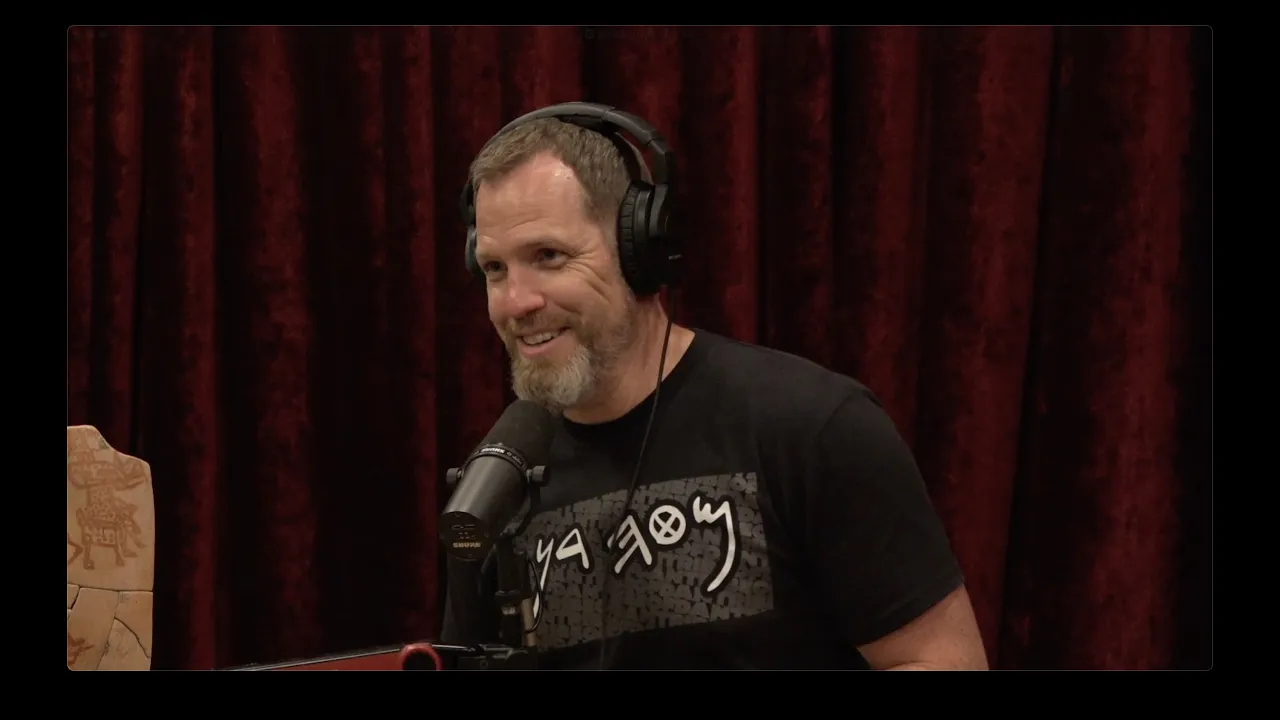
Joe Rogan Experience #2562 - Dan McClellan
PowerfulJRE
10,206 views • 21 hours ago Save 146 min 9 min read
Video Summary
Dan McClellan, a scholar of religion and biblical studies, discusses the complex origins and evolution of religious texts and concepts, challenging literal interpretations and highlighting the historical and cultural contexts that shaped them. He delves into the nature of scripture, the development of ideas about God and deities, and the influence of ancient Near Eastern literature on biblical narratives. McClellan emphasizes that texts were written to achieve specific purposes and that understanding genre and historical context is crucial for accurate interpretation.
McClellan also explores the cognitive science behind religious belief, the development of morality, and the human tendency towards in-group bias. He critiques the idea of a Christian nation and the performative nature of public piety, advocating for a focus on justice, mercy, and righteousness. The conversation touches on the challenges of objective interpretation, the influence of ideology, and the importance of data-driven understanding over dogma.
Short Highlights
- The Bible's texts are shaped by historical context and authorial intent, not literal divine dictation.
- Religious concepts like God, creation, and morality evolved over time, influenced by surrounding cultures.
- Cognitive science reveals how our brains are wired for religious belief and in-group bias.
- The interpretation of scripture is influenced by social, historical, and personal circumstances.
- Modern religious practices are often a blend of original teachings and later interpretations.
- The concept of hell evolved over centuries, with varying interpretations of punishment and salvation.
- Objective interpretation requires acknowledging cognitive biases and relying on data over dogma.
Key Details
The Nature of Scripture and Interpretation [00:00:00]
- Texts are not literal divine dictations but were written with specific purposes and to achieve certain goals.
- Understanding genre and historical context is crucial for accurate interpretation.
- Scholars analyze texts to understand the author's intent and the historical period in which they were written.
"And so scholars go to great lengths to try to figure out, well, what precisely would have been achieved by writing this down or by writing any of the texts in the Hebrew Bible or in the New Testament."
Ancient Near Eastern Influences on Biblical Narratives [00:06:00]
- Similarities between biblical stories and older Near Eastern myths, like the Sargon of Akkad and Moses narratives, suggest borrowing and adaptation.
- The story of Jesus in the New Testament reflects expectations of Greco-Roman emperors and god-men.
- Authors used existing traditions to make their narratives more relatable and to challenge rival traditions.
"And so in the New Testament, it's kind of a way to do both of those things, to say, we got one of those two, only ours did it better."
The Evolution of Religious Concepts [00:12:00]
- Creation stories, like the Egyptian and Sumerian accounts, predate and influence biblical narratives.
- The concept of long lifespans in early biblical texts mirrors similar traditions in Sumerian king lists.
- The flood story's inclusion in Genesis is likely a later addition, possibly influenced by earlier Mesopotamian flood narratives.
"And the same thing is in Genesis. And it happens in the, in the later versions of the story, they go from 10,000 years to just a few thousand years."
The Development of the Alphabet and Language [00:25:00]
- The alphabet likely originated from Egyptian hieroglyphs in the Sinai Peninsula around 1700-1900 BCE.
- Ugaritic, a precursor to Hebrew, was deciphered using linguistic analysis of its 30 cuneiform signs.
- Ancient languages required memorizing hundreds of signs, while alphabets offer a simpler system.
"And the sound is whatever sound is at the start of the word that the symbol represents."
The Study of Biblical Languages [00:30:00]
- Learning ancient Hebrew and Greek is essential for understanding biblical texts in their original context.
- Modern Hebrew speakers can read ancient Hebrew, but require knowledge of the differences between the two.
- Scholars use reconstructed pronunciations for ancient Hebrew, though modern pronunciations are often adopted.
"And so I started off not really having a narrow focus, but just, I want to try and get as much of it in as I could."
The Cognitive Science of Religion [00:45:00]
- Our brains are evolutionarily conditioned to be sensitive to agency, contributing to religious belief.
- Concepts like "Big Gods" and covert monitoring by deities help societies grow and maintain order.
- Costly signaling, like wearing a cross, signals in-group membership and trust.
"And anyone who's ever watched a horror movie and then has gone up the bed, the basement stairs and a little quicker than normal, or, you know, you don't close your eyes at night because you feel like there's something there."
Empathy, Ideology, and Social Division [00:55:00]
- Parochial empathy, limited to one's in-group, can lead to dehumanization and conflict.
- Ideologies and political divides exploit this tendency, making it difficult to empathize with opposing viewpoints.
- The story of Shanidar 1, a disabled Neanderthal, suggests early human societies had social support systems.
"And that is the empathy that others, someone else, and, and says, no, I, I care about my people and I dislike or, or am apathetic to someone who's not part of the in-group."
The Origins of Evil and the Concept of Hell [01:10:00]
- The origin of evil is debated, with traditions focusing on fallen angels (First Enoch) or Adam and Eve's disobedience.
- The concept of hell evolved over time, initially as a place of justice for the wicked, later becoming a threat for all who don't adhere to specific doctrines.
- Early biblical texts offer inklings of post-mortem punishment, but the idea of eternal conscious torment is a later interpretation.
"And so I think that up until the new Testament was written, that was probably the dominant tradition about where evil came from."
The Problem of Translation and Textual Criticism [01:25:00]
- Translating ancient languages is complex, with nuances often lost in modern versions.
- Textual criticism, using ancient manuscripts, helps reconstruct the earliest possible biblical texts.
- Passages in the King James Version were sometimes added later and are omitted in modern translations based on older manuscripts.
"And they imagine that because they have an English translation, uh, they, you know, have all the insights they need."
The Dead Sea Scrolls and Archaeological Discoveries [01:35:00]
- The discovery of the Dead Sea Scrolls provided invaluable insights into biblical texts and ancient Jewish life.
- Archaeological finds, like those at Qumran and Arad, reveal details about ancient Israelite worship and society.
- The "accident of preservation" means our understanding of the past is incomplete, relying on what has survived.
"And that is the fingerprint of whoever did this. They just happened to leave a fingerprint on it when they were creating this tablet and that is frozen in time."
The Nature of Faith and Public Piety [01:50:00]
- McClellan keeps his personal faith private to maintain professional objectivity and avoid performative piety.
- The prophetic critique in the Bible criticizes public displays of piety that mask private unrighteousness.
- True religion involves justice, mercy, and righteousness, not just outward rituals.
"And God is saying, I hate all the stuff I commanded you to do. And so scholars for a while have been like, well, why would God hate the rituals that God commanded?"
Systemic Issues and Societal Change [02:05:00]
- Societal problems like poverty and crime are often systemic, requiring root-cause solutions rather than addressing symptoms.
- The concept of meritocracy is flawed when individuals do not start from the same position.
- Political systems often prioritize maintaining power over addressing societal issues, fostering division.
"And the idea that saying like, well, let's, uh, let's cut the Pentagon's budget, but let's dump all this money into Detroit and Baltimore and, you know, fill in the blank."
The Enduring Nature of Anxiety and Change [02:15:00]
- Periods of rapid societal change and anxiety are not unique to the present but have occurred throughout history.
- Despite progress, human societies continually grapple with similar challenges, albeit with different manifestations.
- Understanding history and data is crucial to avoid ideological dogma.
"And like, this is constant. This, this never ends. Yeah. It's a slow sort of like two steps up, one step back, three steps up, two steps back."
The Importance of Critical Thinking and Objective Analysis [02:25:00]
- Critical thinking skills are essential for navigating complex information and avoiding indoctrination.
- Intuitive cognition often influences reflective reasoning, making objective analysis challenging.
- Recognizing cognitive biases and seeking data-driven understanding are key to informed decision-making.
"And that's where we have to get back. We have to get past the problem of, uh, the people in power are really there to be in power more commonly than they're there to fix problems."
The Evolution of the Bible and its Canon [02:35:00]
- The biblical canon evolved over time, with different traditions and interpretations emerging.
- The Ethiopian Bible retains texts like First Enoch, which were excluded from other canons.
- Textual criticism and manuscript analysis help scholars reconstruct the earliest versions of biblical texts.
"And so today, the earliest manuscript of any kind we have translated into Ge'ez, uh, the ancient Ethiopic languages or the Garima Gospels from fourth to sixth century CE."
The Nature of Human Cognition and Perception [02:45:00]
- Our perception of reality is mediated by our brains, which can create illusions and biases.
- The "corn sweet illusion" demonstrates how our minds interpret sensory input based on expectations and past experiences.
- Understanding these cognitive processes is crucial for objective analysis and avoiding faulty thinking.
"And so the, the part of our brain that is in charge of how we perceive things is saying, this does not compute."
The Role of Ideology and Power in Society [02:55:00]
- Ideologies can be used to maintain power structures and divide populations.
- Those in power may exploit societal divisions to avoid addressing systemic issues.
- The pursuit of power can overshadow genuine efforts to solve problems and improve society.
"And that's why the more we can paint somebody on the other side of the aisle as so other as to be evil."
The Search for Meaning and Understanding [03:05:00]
- Humans naturally seek explanations for the world around them, leading to the development of religious and philosophical ideas.
- The study of ancient texts and cultures provides insights into the evolution of human thought and belief.
- Acknowledging the complexity and uncertainty inherent in these studies is essential for genuine understanding.
"And the deeper we... The deeper we dig into the data, the more information we have to understand what was going on."