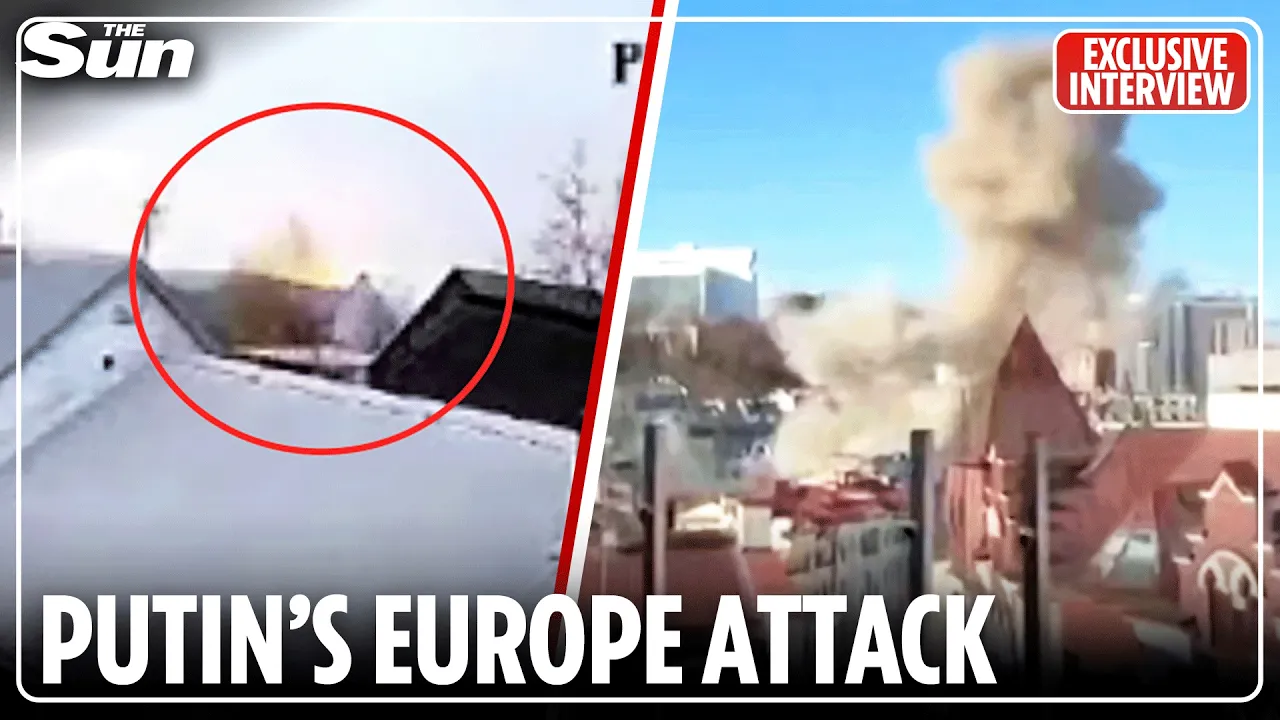
Russia fires a cruise missile into Poland… as British troops train nearby
The Sun
7,534 views • 20 hours ago Save 4 min 5 min read
Video Summary
As Russia unleashes a "hellish barrage" on Kyiv, two of Putin's missiles and a kamikaze drone crashed into Polish territory, prompting NATO jets to scramble. This escalation follows Putin's vow to pummel Ukraine after strikes on the Crimean Bridge. The incursions into Poland, while not unprecedented, highlight a growing boldness in attributing such breaches to Russia, moving beyond earlier explanations of electronic interference.
Europe is now more cautiously guarding its airspace, but the cost of scrambling fighter jets is immense compared to Russia's use of cheaper drones. This situation underscores a broader strategic tension: while Europe demonstrates resolve, it faces internal divisions on the threat of a direct Russian kinetic attack on NATO. Some officials believe Russia is too weak to attack, citing NATO's strong presence, while others are hesitant due to uncertainty over U.S. support, suggesting a growing concern that Putin, emboldened by recent international appearances, may indeed target Europe if unchecked.
Short Highlights
- Russian missiles and a drone breached Polish airspace, prompting NATO to scramble jets.
- The incursions occurred during a massive Russian barrage on Kyiv.
- Poland is becoming more assertive in attributing airspace breaches to Russia.
- Europe faces internal divisions regarding the likelihood of a Russian kinetic attack on NATO.
- Some believe Russia is too weak to attack NATO, while others fear escalation.
- Putin's recent international appearances have emboldened him on the global stage.
Related Video Summary
- It's only a matter of time before Putin’s state sponsored terrorism triggers mass casualty event
- Russia Puts The UK On Notice, AI Companies Call For Digital Safety, & IG Updates For Teens
- Russian $50M stealth jet DOWNED over Moscow is sign that Putin’s air defences are failing
- ANOTHER Russian general killed in Ukraine as Putin's corrupt army struggles to fill gaps
Key Details
Putin's Missiles Crash in Poland [0:00]
- NATO jets were scrambled after two Russian missiles and a kamikaze drone crashed in Poland.
- This occurred during a large-scale Russian attack on Kyiv.
- One missile reportedly crossed into Polish territory and crashed in a forest, with a second landing elsewhere and a drone found in another location.
As always, all of the drones and ballistic missiles and cruise missiles that are flying from Russia into Ukraine and from the Black Sea in this case as well, very often they fly into neighbouring countries.
Europe's Shifting Stance on Airspace Breaches [0:30]
- Air Force General Ireneusz Novak stated that 11 objects threatened Polish airspace, with three breaching it.
- Historically, incursions into Poland and the Baltics were often attributed to electronic warfare or mixed signals.
- Poland is now perceived as being "a little bit more bold" in identifying these incursions.
It's not just Poland, but also Baltics.
The Cost of Deterrence and Innovation [1:00]
- Poland has previously scrambled fighter jets after incidents where buildings were destroyed in Poland and Romania by Russian drones.
- The cost of scrambling NATO fighter jets is significantly higher than the cost of Russia's drones.
- There's a suggestion that Europe should consider adopting innovations seen in Ukraine.
So Europe, while it's showing a resolve and the will to protect its citizens, it should definitely start thinking of adopting some of the innovation from Ukraine.
Putin's Expanding Narrative and European Divisions [1:30]
- Putin's narrative has evolved from Ukraine's NATO aspirations to demands for NATO withdrawal to 1997 borders and Finland exiting NATO.
- There are conflicting views within Europe regarding the possibility of a direct Russian kinetic attack on NATO.
- Some officials believe Russia is too weak to attack NATO, citing NATO's strong forward presence.
And the views on that are mixed, just like they were on the full scale invasion in Ukraine.
Hesitation and Growing Concerns [2:00]
- Other European officials are tentative, with hesitancy stemming from uncertainty about U.S. support in case of an incursion.
- Concerns about Russia attacking a NATO country are growing, influenced by the example of Ukraine.
- Putin's participation in the APEC summit, after a long absence, is seen as a "win" and a legitimization on the international stage.
But others are a little bit tentative.
Putin's Vengeance and Strategic Goals [2:30]
- Putin is described as seeking vengeance, attacking civilians when unable to achieve military objectives or cut off supply lines.
- Attacks on bridges are aimed at paralyzing Ukraine's government by separating Kyiv's banks.
- The speaker argues that a decisive action at the war's outset could have prevented the current situation, comparing the need to defeat Putin's Russia to defeating Nazi Germany.
And as a true coward and a true bully, when he cannot withstand attacks on his military infrastructure, on courage bridges and other supply lines that go into Ukraine, when he cannot win anything on the battlefield, because Ukraine has won way more territory this year than Russia has in the east, he starts attacking civilians.
Transatlantic Tensions and European Self-Sufficiency [3:00]
- The relationship between Europe and the United States is described as tense, exacerbated by issues beyond Ukraine, including past U.S. actions like discussions of invading Greenland.
- There are disagreements regarding sanctions against Russia and weapon sales.
- Europe is determined to become self-sufficient, a process that will take considerable time.
The relationship between Europe and the United States has become very interesting in a way that it's quite tense.
The Need for Decisive Action Against Putin [3:30]
- The speaker criticizes the West for being too careful with Putin, suggesting that a more robust and decisive action early on could have de-escalated the conflict.
- The current focus should be on defeating Putin's Russia, akin to the defeat of Nazi Germany.
- Failure to do so is seen as an invitation for further aggression into Europe.
But I think those concerns are growing, having looked at Ukraine's example previously.