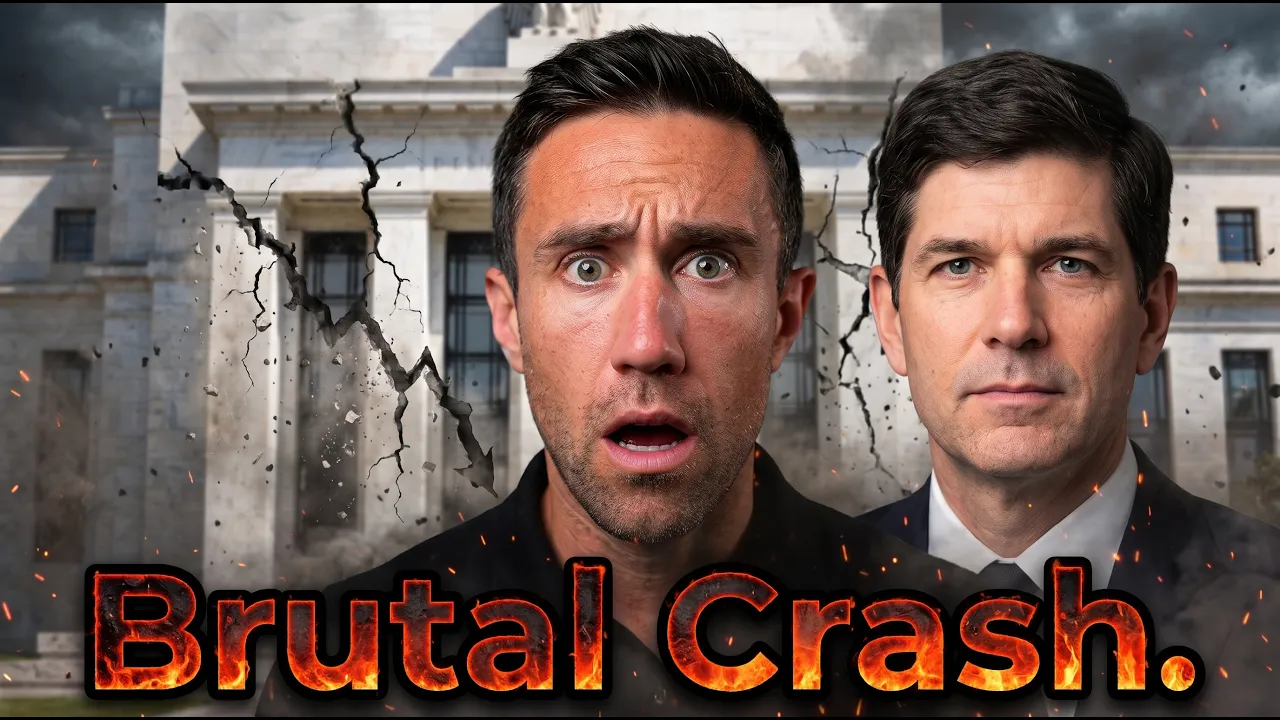
The Fed is Engineering a Total Stock Market Wipeout.
Meet Kevin
20,857 views • 20 hours ago Save 27 min 4 min read
Video Summary
The Federal Reserve may be intentionally engineering a stock market downturn to combat inflation, a strategy hinted at by Fed officials themselves. This approach, aimed at tightening financial conditions, could lead to rapid deleveraging and fire sales, especially given the increasing use of leverage in financial markets and the significant growth of off-balance sheet debt among major AI firms.
While the long-term promise of AI is acknowledged, a potential scenario involves AI boosting productivity but simultaneously causing a stock market crash. This could contract GDP through reduced investment and decreased consumer spending due to wealth loss. The Fed's commitment to further rate hikes, including a potential half-point increase, signals a determined effort to curb inflation, even at the risk of market instability.
Short Highlights
- The Federal Reserve is potentially engineering a market downturn to combat high inflation.
- Increased leverage and off-balance sheet debt in AI firms pose significant financial risks.
- AI's productivity gains could coincide with a stock market crash, impacting GDP.
- Fed officials signal a strong commitment to further interest rate hikes.
- A sharp market reversal could trigger rapid deleveraging and fire sales.
Key Details
Fed Officials Hint at Market Engineering [0:00]
- Federal Reserve officials have used language suggesting they might be intentionally engineering a market downturn to reduce inflation.
- This strategy involves fighting the Fed by buying dips while the Fed continues to raise interest rates.
"Is the Federal Reserve trying to crash the stock market?"
Risks of Deleveraging and Fire Sales [0:26]
- A sharp reversal in stocks could lead to rapid deleveraging and self-reinforcing fire sales.
- Increased leverage from prime brokerage services and periods of stock market volatility could cause spillovers.
"Uh-oh, those are not my words, folks. Those are words coming directly from the Federal Reserve."
AI as an Inflationary Risk [0:45]
- The Federal Reserve views the AI buildout as a "material source of inflation risk."
- There's a near-unanimous expectation for a rate hike in December, with some officials calling for a half-point hike to "shock people."
"Almost all officials are now calling for more hikes. We almost have a unanimous expectation for a rate hike in December."
Potential for Market Crash Despite AI Optimism [1:17]
- Federal Reserve Vice Chair Barr expressed optimism about AI's long-term promise but acknowledged a scenario where AI improves productivity while the stock market crashes.
- A rapid repricing of the stock market could lead to GDP compression due to falling investment values and reduced consumer spending.
"Now, after saying we're optimistic about AI, there is a possible scenario where AI ends up being transformative and it improves productivity, but the stock market crashes."
Growing Off-Balance Sheet Debt [2:04]
- Off-balance sheet debt for the largest seven AI firms has grown significantly, potentially reaching $800 billion by year-end.
- The total nominal value of these obligations could exceed $3 trillion, exacerbating stock market sell-offs when sentiment shifts.
"Off-balance sheet debt of the largest seven AI firms has grown significantly in 2026 and is expected to reach $800 billion before the year's end."
Leverage and Financial Complexity [2:47]
- Leverage at hedge funds and broader risk appetite are high, with increased leverage in equity strategies, leveraged ETFs, and options.
- While large banks are protected, spillovers could affect counterparty risk and potentially lead to bank failures.
"However, leverage at hedge funds and broader risk appetite is pretty high."
Chip Depreciation and Lease Rates [3:35]
- The potential for GPUs to depreciate as new technologies emerge is a concern, though current lease rates for older chips are rising due to AI demand.
- An oversupply of chips could lead to years of underutilization, similar to the dark fiber market in the 1990s.
"The opposite is happening right now, but they recognize that unfortunately, if we end up with an oversupply, it could take years for that to become useful, as was the case with dark fiber in the 1990s boom and bust cycle."
Fed's Goal: Tightening Financial Conditions [4:29]
- The Federal Reserve aims to crimp inflation expectations by tightening financial conditions, which occurs when the stock market falls.
- NVIDIA's reduced commitments for cloud services and investments in other companies' debt signal a company-level response to the Fed's desire to slow AI spending.
"The Fed wants tighter financial conditions. Tighter financial conditions reach artificial intelligence financing first, ideally."
Labor Market Disruption as a Risk [6:35]
- Kevin Warsh highlighted that increased research and AI spending haven't necessarily translated into real productivity gains, posing an inflationary risk.
- A potential risk is substantial labor market disruption due to widespread automation, which could increase unemployment even as GDP grows.
"A super intelligence driven expansion could bring substantial labor market disruption to where some jobs are displaced rather than complimented by AI."