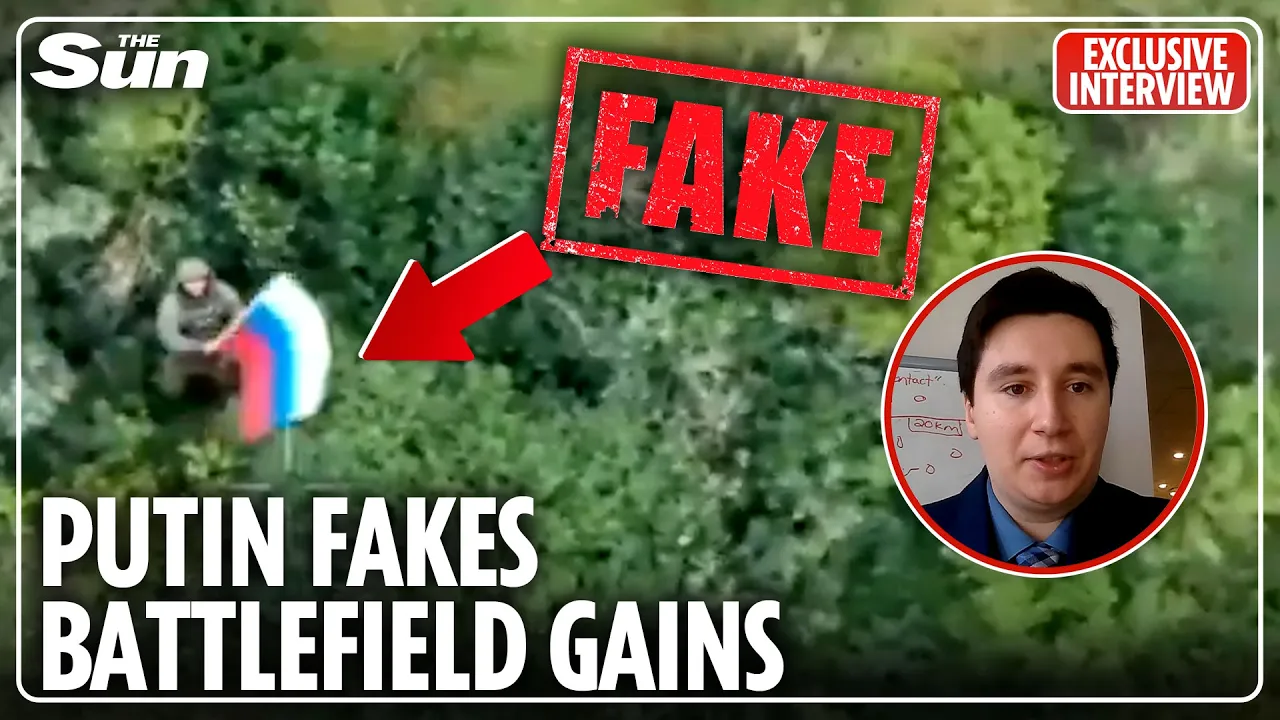
Fake Russian victory vids exposed as expert mappers reveal 'flag waving' propaganda stunts
The Sun
1,769 views • yesterday Save 3 min 5 min read
Video Summary
Russian forces are increasingly using AI-generated videos to falsely claim territorial gains, with over 30 instances of suspected or confirmed fabricated footage observed since June 1st. These manipulated videos often depict Russian service members waving flags in settlements they do not control, contradicting evidence from satellite imagery and Ukrainian reports. For example, one unit claimed to seize seven settlements in territory liberated by Ukraine, while another claimed control of Konstantinovka, a city still under siege and contested by ongoing fighting.
The Institute for the Study of War (ISW) employs a rigorous methodology combining open-source intelligence, including combat footage and satellite imagery, with U.S. Army manuals to assess front-line operations. Geo-referencing videos and analyzing impact craters from strikes help establish a chronological order of events. While Russian claims of territorial control are often exaggerated and outpace actual advances, the rise of AI-generated content presents a new challenge in discerning truth from fabrication, particularly when official Russian sources, including President Putin himself, assert false narratives.
Short Highlights
- Russia is increasingly using AI-generated videos to falsely claim territorial control, with over 30 instances of suspected or confirmed fabricated footage since June 1st.
- These fabricated videos often show Russian soldiers waving flags in areas they do not control, contradicting satellite imagery and on-the-ground reports.
- Analysts use geo-referencing and analysis of combat footage, satellite imagery, and official reports to verify claims.
- Russian claims of territorial gains often outpace actual advances and can be exaggerated.
- The use of AI in propaganda videos presents a significant challenge in assessing the true situation on the front lines.
Key Details
The Rise of AI in Russian Propaganda [00:00:00]
- Russian forces are increasingly using AI-generated videos to falsely claim territorial control.
- Since June 1st, over 30 instances of suspected or confirmed fabricated videos have been observed.
- These videos often depict Russian service members waving flags in settlements they do not control.
"the russians published a choreographed video montage of different scenes of russian service members waving flags several of those scenes were detected with ai"
Open Source Intelligence Methods [00:00:00]
- Organizations like ISW use a plethora of publicly available sources, including combat footage from Russian and Ukrainian units.
- Geo-referencing videos and finding anchor points with real-world imagery help determine the location of events.
- Analysis of video content and tactical tasks provides insight into front-line operations.
"these videos are sometimes done to aggrandize themselves other times it's tied to a fundraising effort nonetheless these videos exist in open source domain"
Verifying Claims with Satellite Imagery and Manuals [00:00:00]
- ISW uses U.S. Army manual 3-90 on offensive and tactical operations as a foundation for assessments.
- Satellite imagery, especially from commercial partners, helps verify the likely date of strikes by examining impact craters.
- This mosaic of evidence helps build a chronological order of events along the front line.
"satellite imagery especially through commercial partners can verify the likely date the strike occurred by looking at the impact craters"
Deconflicting Narratives and Exaggerated Claims [00:00:00]
- Russian claims of seizing settlements often take days or weeks to verify independently.
- Sometimes, Ukrainian forces report that Russian narratives are false, and they still maintain positions.
- Russian claims typically outpace the ongoing offensive or are exaggerated, especially regarding flag-raisings.
"the narrative portrayed by russian sources with what more authoritative sources such as the ukrainians might say"
Specific Cases of Fabricated Claims [00:00:00]
- One unit claimed to have seized seven settlements in territory liberated by Ukrainian forces, which was false.
- In the case of Konstantinovka, a city in central Ukraine, Russian forces had not seized it despite claims.
- President Putin asserted that Russian forces had seized Konstantinovka, which was untrue as the city was under siege with ongoing fighting.
"russian sources excuse me russian forces never reached anywhere near those particular settlements in olex and driven cut direction"
Geo-referencing for Building a Mosaic [00:00:00]
- Geo-referencing allows for assessments down to the individual building level, identifying occupation by either Russian or Ukrainian forces.
- This creates a mosaic of contested cities like Kupyansk or Konstantinovka.
- It reveals pockets where Ukrainian forces maintain positions bypassed by Russian infiltrators or vice versa.
"we can make assessments down to the individual buildings being occupied by either russian or ukrainian forces"
Increasing Use of AI Since June [00:00:00]
- Since the beginning of June, Russian sources have increasingly used AI videos to show fabricated Russian service members in claimed settlements.
- This trend highlights a growing reliance on AI for propaganda purposes.
- The challenge lies in discerning truth from these increasingly sophisticated fabrications.
"especially with the rise of ai we've noticed that since probably the beginning of june that russian sources have been increasingly using ai videos"
Source Veracity and Reliability Chart [00:00:00]
- Analysts build a veracity and reliability chart to understand source characterization.
- Pro-Russian sources can be relied upon to tell pro-Russian narratives, even if they are misinformation from their perspective.
- This method applies to authoritative, less authoritative, and open-source domain sources.
"we build out a veracity and reliability chart understanding the source characterization"