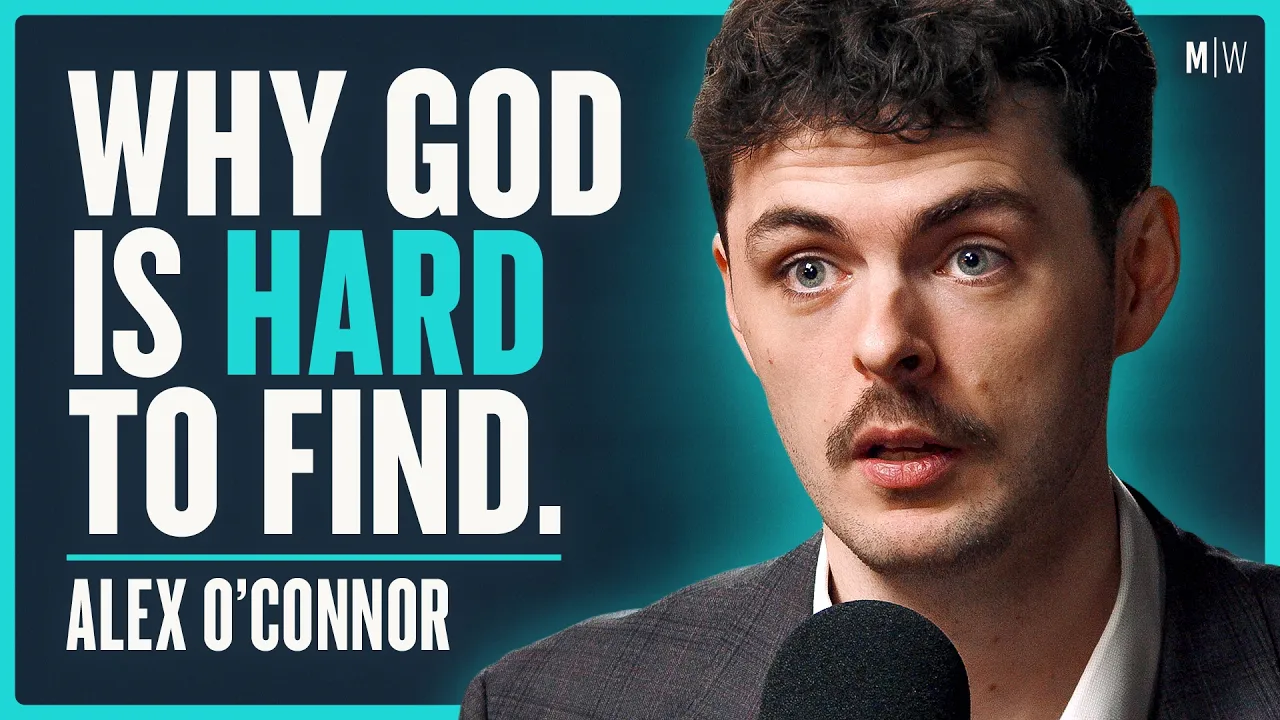
Why Atheists Keep Finding God (in everything) - Alex O’Connor (4K)
Chris Williamson
3,597 views • yesterday Save 109 min 7 min read
Video Summary
Alex O'Connor, known for his philosophical rigor, reflects on his transition from a 'mean debate bro' persona to a more empathetic communicator. He argues that while he remains skeptical of religious truth claims, he has moved away from militant atheism, recognizing that the foundational questions of existence—consciousness, God, and morality—remain unresolved and deeply experiential. O'Connor posits that science, while powerful at describing how the universe behaves, is fundamentally limited in its ability to explain what the universe is.
Central to this discussion is the nature of consciousness, which O'Connor describes as the tool through which we investigate reality, making it impossible to define or observe objectively. He critiques the materialist view that consciousness is merely an emergent property of complex matter, suggesting instead that consciousness might be foundational. O'Connor concludes that because science and philosophy are distinct enterprises, the search for meaning often leads individuals toward mystical or experiential realizations that transcend mere intellectual debate.
Short Highlights
- Consciousness is the fundamental tool of investigation, making it impossible to define or observe from an objective, third-person perspective.
- Materialism fails to account for the 'is-ness' of reality, as science only describes how things behave, not what they fundamentally are.
- The 'hard problem' of consciousness suggests that subjective experience cannot be reduced to or predicted by physical brain activity.
- Religious and mystical experiences are often experiential realizations of unity that transcend intellectual categorization.
- Emergence is a flawed concept when applied to consciousness because all examples of emergence are themselves conscious experiences.
- Prayer and ritual are best understood as tools for personal alignment and gratitude rather than attempts to manipulate an omniscient deity.
Related Video Summary
- Essentials: How Emotions & Social Factors Impact Learning | Dr. Mary Helen Immordino-Yang
- What Humans, Animals and Plants Tell Us About Consciousness | Michael Pollan
- Muslim Refutes Inconsistent Atheist Criticizing The Actions Of God! Muhammed Ali
- Nvidia's Historic Quarter, SaaS Comeback, Bessent vs Druck, America's Debt Crisis, Cancer Vaccine
Key Details
The Persona Shift [00:01:21]
- O'Connor discusses moving away from a 'mean debate bro' persona toward a more compassionate approach to philosophical discourse.
- He notes that while people value strong defenses of important views, his confidence in his own positions has tempered over time.
It would be foolish to think that my confidence should approximate anything like a closeness to truth that warrants a kind of forthright exposition.
The Agnostic Position [00:02:22]
- O'Connor now identifies as agnostic, finding it difficult to claim that the universe is purely material given the weirdness of consciousness.
- He expresses a genuine openness to the possibility of God, noting that he does not celebrate the conversion of others to atheism.
I have always said that I'd love for Christianity to be true or I'd love for a number of religious traditions to be true.
The Role of the Barrister [00:05:07]
- He views his role as a 'barrister' for various positions, maintaining his criticisms of unsound arguments regardless of his own personal beliefs.
- He argues that many people hold beliefs for non-robust reasons, comparing religious dogmatism to flat-earth conspiracy theories.
I'd still have all of the same criticisms that I have today. It's not like I'm suddenly going to think that arguments that are unsound are now sound.
The Limits of Physics [00:06:21]
- O'Connor uses the example of time travel and relative motion to illustrate the complexity of our universe.
- He notes that even if we understand motion, the foundational nature of reality remains elusive.
There's literally no way that you can make sense of that. It's not like, oh, isn't it interesting that from our perspective, you know, everything's moving.
Philosophy vs. Science [00:09:05]
- He argues that philosophy does not progress like science because it is an experiential phenomenon rather than a consensus-based one.
- He cites Thomas Aquinas and Blaise Pascal as examples of thinkers who abandoned intellectual philosophy after profound religious experiences.
Everything is like straw compared to what I've seen.
The Modern Concept of Religion [00:13:30]
- O'Connor suggests that 'religion' as a separate box is a modern invention; in the ancient world, it was simply the ocean of daily life.
- He notes the shift toward a more empathetic tone in modern discourse, contrasting it with the 'four horsemen' era of new atheism.
Religion is just like the ocean that you're swimming in. There is no religion. It's just how you live your life.
Divine Hiddenness [00:16:15]
- He discusses the 'problem of divine hiddenness,' noting that both theistic and atheistic theories often predict the same data.
- He distinguishes between 'God' (a singular, foundational reality) and 'gods' (characters within the created order).
It's clear that there's like a religious impulse that's somewhat intrinsic to human beings.
The Nature of Consciousness [00:20:05]
- O'Connor argues that consciousness is the foundational question of philosophy because all knowledge is mediated through it.
- He asserts that it is impossible to define consciousness because the definition process itself relies on conscious experience.
It's like trying to point a flashlight at the flashlight. It's like trying to point at your own finger.
Science and Description [00:24:20]
- He contends that science is a descriptive enterprise focused on regularities and mathematics, not a search for the 'thing in itself.'
- He uses Newton's theory of gravity to show that describing how things move does not explain why they exist or what they are.
Science like describes things mathematically, it describes regularities.
The Subjectivity Problem [00:27:15]
- O'Connor argues that science moves toward objectivity, whereas consciousness is inherently subjective.
- Therefore, the more objective a description becomes, the further it moves from the nature of conscious experience.
The project of science is to move away from subjectivity and towards objectivity.
The Impenetrability of Reality [00:32:05]
- He reiterates that science cannot explain its own presuppositions, such as the laws of logic or the existence of other minds.
- He suggests that at the bottom of reality, there is an emptiness or an irreducible substance that science cannot access.
You don't start with science and then get experience. You start with experience through which you do science.
Non-Dual Awareness [00:36:20]
- He explores why meditators often converge on non-dual experiences, suggesting meditation helps strip away conceptual 'patterns' of perception.
- He compares this to the way painters see light and color more accurately by ignoring the labels their brains apply to objects.
The biggest thing that gets in the way of like understanding the oneness of everything and the foundational nature of consciousness is like our concepts.
The Noumena and the Will [00:43:05]
- Drawing on Schopenhauer, he discusses the distinction between the phenomenon (how things appear) and the noumena (the thing in itself).
- He suggests that the only thing we know from the inside is our own 'will' or consciousness.
I only have access to the phenomenon of the table, the phenomenon of the cup, the phenomenon of the microphone.
Emergence and Consciousness [00:50:20]
- O'Connor critiques the idea that consciousness 'emerges' from complex matter, calling it a circular argument.
- He argues that all examples of emergence cited by materialists are simply examples of conscious experience.
They're saying, oh, consciousness emerges just like all these other conscious experiences that emerge.
The Idealist Hypothesis [00:54:15]
- He suggests that if consciousness is foundational, the universe might be best understood through idealism—where everything exists within a great mind.
- He compares the physical world to a dream, where distance and size are appearances rather than fundamental truths.
I prefer to think that if this view has any legs, as it were, it would be a view pointing to something called idealism.
Prayer and Alignment [00:56:05]
- O'Connor concludes that prayer is not for God, who is already omniscient, but for the individual to align their will with a greater purpose.
- He reflects on the 'agony in the garden' as a moment where Jesus aligns his human desire with the divine will.
Prayer is an opportunity to align yourself with the will of God.