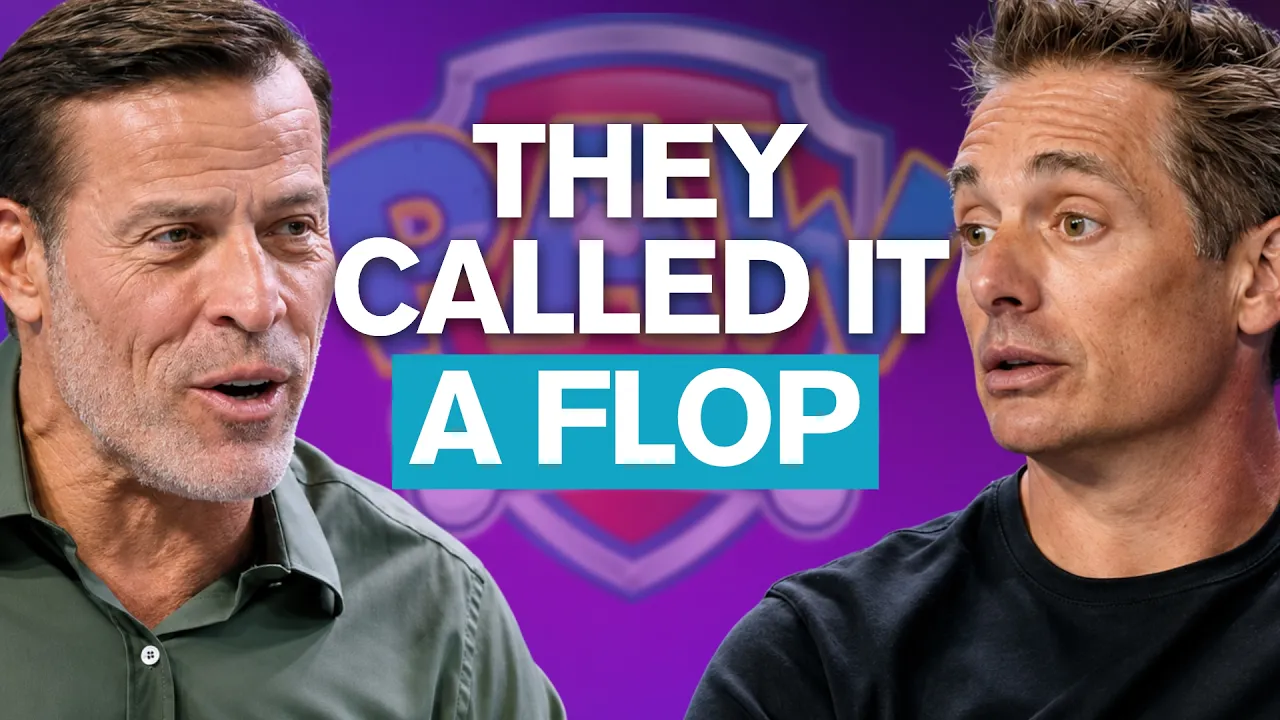
How an $11M Failure Led to PAW Patrol’s $15 BILLION Empire
Tony Robbins
838 views • yesterday Save 41 min 5 min read
Video Summary
Anton Rabie, co-founder of the $2 billion toy giant Spin Master, argues that the very traits labeled as 'weird' or 'eccentric' in childhood are actually the keys to professional success. By embracing neurodivergence and a 'low-fear' mindset, Rabie transitioned from a struggling student to a leader who treats failure as a necessary, data-rich step toward innovation. His philosophy centers on the idea that when you stop hiding your differences, they become your greatest competitive advantage.
Central to this growth was the radical decision to prioritize deep, collaborative partnerships over traditional 'work-for-hire' models. By aligning financial interests with inventors and partners, Spin Master successfully scaled global franchises like Paw Patrol and Bakugan, even after suffering devastating losses. Rabie’s journey underscores that true leadership requires the humility to accept harsh feedback and the discipline to pivot when a business model hits a wall.
Short Highlights
- Embrace your differences as your primary professional advantage and 'superpower.'
- View failure as a data-gathering exercise rather than a personal or professional end.
- Prioritize the 'who' over the 'what' when building a business.
- Utilize 360-degree feedback to identify and correct leadership blind spots.
- Scale through deep partnerships that align long-term financial interests for all parties.
- Build a company culture around giving to increase employee engagement and purpose.
- Focus on 'unique ability' by delegating tasks that do not align with your core strengths.
Key Details
The Power of Difference [00:00]
- Anton Rabie was labeled 'weird' and 'eccentric' as a child due to his intensity and lack of inhibition.
- He realized in his late 20s that these traits, including his ADHD, were not flaws but his greatest professional assets.
I didn't realize until I was in my late 20s that my difference was my advantage.
Early Sales Lessons [05:40]
- Rabie learned the art of influence by selling advertising and fertilizer door-to-door.
- He discovered that he could handle intense rejection without it affecting his persistence.
I learned more in that situation every day in my life, because people were drunk, people were angry. Some people brought you in for entertainment.
The Shrine of Failure [07:20]
- Spin Master maintains a physical showcase of failed products at their headquarters to capture learnings.
- Rabie believes that reframing 'failure' as 'testing' allows for a healthier, more productive mindset.
I don't even think people should use the word failure. I agree with you. Like testing, there's so many other words people could use instead of failure.
The Tech Deck Live Lesson [08:30]
- The company lost $11 million on a failed digital game called Tech Deck Live after two and a half years of development.
- The primary failure was a lack of domain mastery among the project leaders.
The biggest mistake that we made from Tech Deck Live was we didn't, we never, the leaders of Tech Deck Live didn't have domain mastery.
Creating Paw Patrol [10:05]
- To create a preschool hit, they identified the best creators in the industry and partnered with experts like Keith Chapman.
- They combined toy design with storytelling early in the process to ensure the product and show were integrated.
We took the designers who, who only spent their whole career designing toys and we put storytellers together sitting. This was before they even came up with the show.
Founding Spin Master [12:30]
- The company was founded on the 'who, not the what' principle, focusing on the partnership between Rabie, Ronan, and Ben Verity.
- The founders had opposite skill sets but identical core values, which provided the necessary balance for success.
The founding of Spin Master was about the who, not the what.
Radical Inventor Partnerships [15:10]
- Spin Master differentiated itself by treating toy inventors as partners, offering them retreats and a seat in the design process.
- This approach ensured that top inventors brought their best ideas to Spin Master first.
We paid the inventors a little bit more. We treated them better than anyone.
Scaling Through Alignment [17:15]
- The Bakugan partnership involved sharing royalties across all stakeholders, including the animation studio and toy manufacturers.
- This financial alignment ensured all parties remained motivated to grow the brand long-term.
Everyone was financially, every single body was lined up financially with the same interest long term.
The Challenge of Reoccurring Revenue [19:15]
- The toy industry is prone to short product life cycles, making it difficult to maintain revenue.
- Strategic acquisitions and content-led brands like Paw Patrol are used to create stability and reoccurring revenue.
The only way to get out of aging is to innovate. That's how you get back.
Strategic Acquisitions [22:30]
- Half of Spin Master's revenue comes from 35 acquisitions, often targeting smaller companies without investment bankers involved.
- Rabie prefers dealing directly with entrepreneurs to understand their personal motivations and legacy goals.
I love when I can sit across from the entrepreneur and really understand what motivates them. Meet their needs at a whole different level.
The 360 Feedback Turning Point [25:00]
- A 360-degree review at age 28 gave Rabie a humbling 'six out of 10' rating, highlighting poor listening and communication skills.
- He used this feedback to hire coaches and commit to a lifelong process of self-improvement.
If I don't, if I don't show up differently as a, I should not be the co-CEO of this company.
Giving as Culture [29:45]
- Integrating charitable work, such as the 'toy movement' in refugee camps, energizes staff and provides a sense of purpose.
- Rabie views his current mission as mentoring others to help them find and embrace their unique abilities.
I want all of you to get more crisp and clear about your difference.