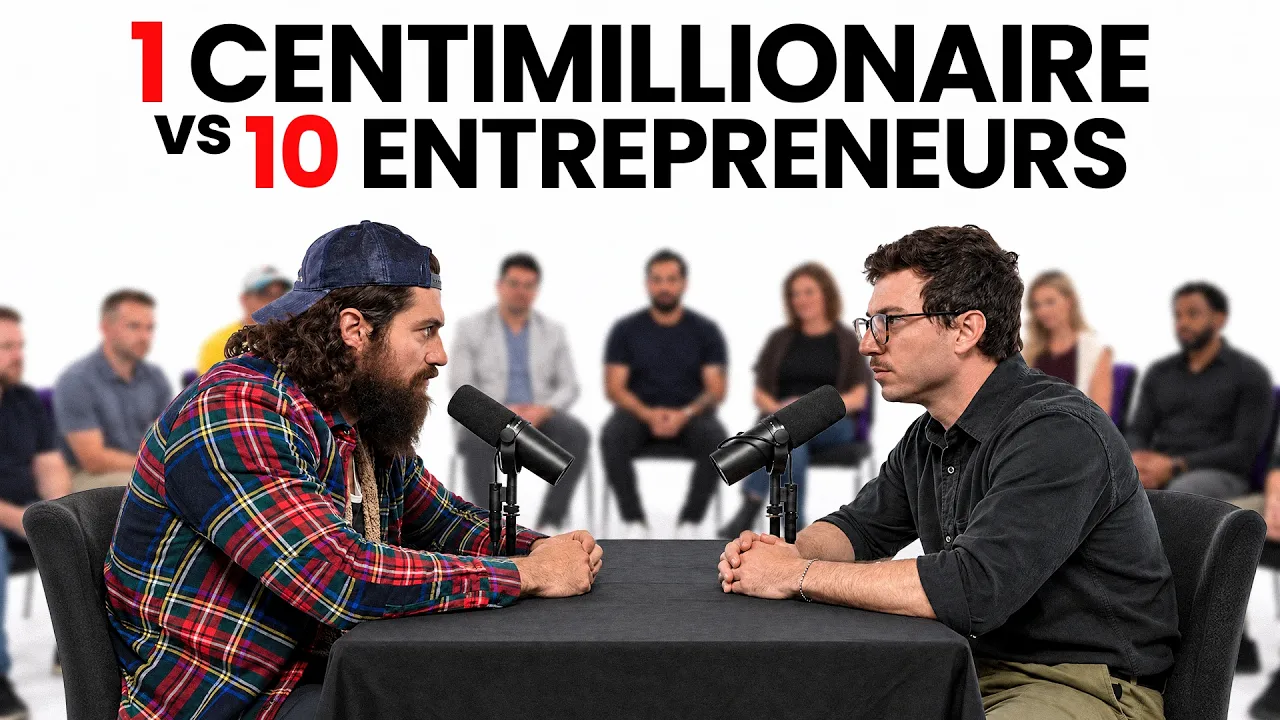
Alex Hormozi vs 10 Entrepreneurs
Alex Hormozi
280,245 views • 2 days ago Save 35 min 7 min read
Video Summary
A debate on entrepreneurship's core tenets reveals starkly different philosophies on work, success, and personal fulfillment.
Alex Hormozi, a seasoned entrepreneur, argues that "profit is overrated" and challenges conventional wisdom, advocating for relentless work ethic and strategic focus. He contends that a "weekend is a modern invention" and that true success requires an obsessive dedication, pushing back against what he perceives as a generation softened by "self-care maxing." His perspective is met with counterarguments emphasizing the necessity of balance, the value of rest, and the potential for building lasting brands without sacrificing personal life. The discussion highlights the tension between aggressive growth strategies and sustainable, fulfilling careers, ultimately questioning the definition of success and the trade-offs individuals are willing to make.
Short Highlights
- The "Weekend" Debate: The concept of a weekend is a modern invention, and true success requires work you don't need a break from, challenging the notion of a mandatory weekend for productivity.
- Hiring Strategy: Hire one "A player" and pay them what you'd pay two "B players" for better results and cost savings.
- Targeting Customers: "Sell to the rich until you have enough money to sell to all the poor people," focusing on higher profit margins.
- Commitment Over Options: "Options only have value when they are used, not stored." Making a trade and going all-in is crucial for progress.
- The "Game" of Business: The craft and product are underrated, while the "game" of business itself is overrated. Entrepreneurs should focus on the core value exchange.
- Work-Life Balance: Nobody who has preached work-life balance has built anything memorable, though exceptions like Patagonia and Chick-fil-A exist.
- Profit's Role: Profit is overrated; the biggest opportunities are often hidden, and focusing solely on short-term profit can be detrimental.
Key Details
The Weekend Debate: Work vs. Rest [0:00]
- Alex Hormozi challenges the necessity of weekends, framing them as a modern invention that can soften entrepreneurs.
- He argues that true success comes from work you don't need a break from, pushing back against what he calls "self-care maxing."
-
"What you really need is work that you don't need a weekend from."
The Trade-Off of Work Schedules [1:30]
- Hormozi asserts that choosing to have a weekend is a trade-off, not a necessity, and often points to a dislike for one's work.
- He believes hyper-successful individuals often work weekends, gaining a significant advantage in speed and output.
-
"The person who with the same skill is just working more gets 104 more work days per year."
Hiring "A Players" [3:30]
- The strategy is to cut two "B players" to hire one "A player" and pay them more, leading to greater savings and profits.
- However, it's acknowledged that in early stages, businesses may not afford "A players" and must work with what they have.
-
"Pay better people better and it will cost you less than paying poor people poorly."
Selling to the Rich [4:50]
- The advice is to "sell to the rich until you have enough money to sell to all the poor people."
- Examples include real estate in low-income housing and construction, where government subsidies and regulations create market exceptions.
-
"It's irrelevant where the money comes from. It could come from the Pope, from Obama or from the Martians in outer space."
The Value of Commitment [7:00]
- The concept of "options only have value when they are used, not stored" is presented, advocating for commitment.
- Constantly keeping options open can lead to never committing and closing all doors.
-
"I'm strongly encouraging people to knowingly make trades. And I think that almost all the best parts of life come on the other side of commitments."
Options as a Focusing Tool [8:30]
- While advocating for commitment, it's acknowledged that options can serve as a filter to help focus on what is truly desired.
- An analogy is used where too many restaurant choices paralyze a decision, but presented options help narrow it down.
-
"The options were only useful to help her focus and pick what she actually wanted."
The "Game" vs. The "Craft" [10:00]
- Hormozi posits that the "game of business is massively overrated" and the "craft, the product, the service" is underrated.
- He questions if entrepreneurs are driven by the love of the game or the actual business itself.
-
"Are people distracting from finding meaning through the business and they're just doing meaning in the game, in the searching and the growth of business?"
Entrepreneurial Stages and Missionaries vs. Mercenaries [12:00]
- Entrepreneurs evolve through stages, from simply "don't be broke" to higher goals.
- "Missionary" entrepreneurs, those driven by a core purpose, tend to make more money long-term than "mercenaries" focused solely on profit.
-
"The business owners who are missionaries, not mercenaries always end up making the most money in the end because they can think on the longest time horizon."
Priorities vs. Information [14:30]
- The argument is made that most people lack priorities, not information, to achieve their goals.
- A hypothetical scenario illustrates that with extreme motivation (e.g., loved ones kidnapped), people can achieve seemingly impossible business goals with existing information.
-
"You lack priorities, not information."
Mediocrity and Hiring [17:00]
- A provocative statement suggests that if employees are mediocre, the leader probably is too.
- This is debated, with the idea that hiring less skilled people can be a valuable learning experience.
-
"If your employees are mediocre, you probably are too."
The Compulsive Drive of Success [19:30]
- Successful people "don't know how to stop," driven by a compulsion or obsession with their craft.
- This contrasts with the idea that rest is productive and necessary for sharpening one's "ax."
-
"Lazy people don't know how to start. Weak people don't know how to finish. Successful people don't know how to stop."
Work-Life Balance and Memorable Brands [21:30]
- Hormozi's tweet claiming "nobody who's ever preached work-life balance has ever built anything memorable" is challenged.
- Examples like Patagonia and Chick-fil-A are presented as brands built by leaders who advocated for work-life balance.
-
"I would argue that taking Sunday off his work-life balance as like the preaching. I would say that he's sticking to his kind of religious stuff."
Defining Your Own Scoreboard [25:30]
- The ultimate scoreboard is subjective and defined by the individual.
- It's crucial to define your own goals and ensure you're playing a game where the prize is something you truly desire.
-
"You have to define your own scoreboard and then make sure that you are playing a game whose prize you want to win."
The Dilemma of Conflicting Priorities [32:00]
- Balancing business ambitions with family life, health, and other life components creates conflicting priorities.
- It's acknowledged that one cannot be "10 out of 10" in every area, leading to necessary trade-offs.
-
"We will always live in a life, live a life of deprivation around not having done all of the things, 10 out of 10."
The Winner and Final Thoughts [37:30]
- The $10,000 prize is split, with one half awarded for challenging the "never" in the work-life balance statement and the other for reminding about the audience's drive for exceptionalism.
- The discussion concludes by emphasizing that there's no single "right way" to build a business or live life, encouraging individuals to make their own trades and avoid judgment.
-
"I definitely am not in the, like, you must, I don't must anything. Yeah. Do whatever you want."