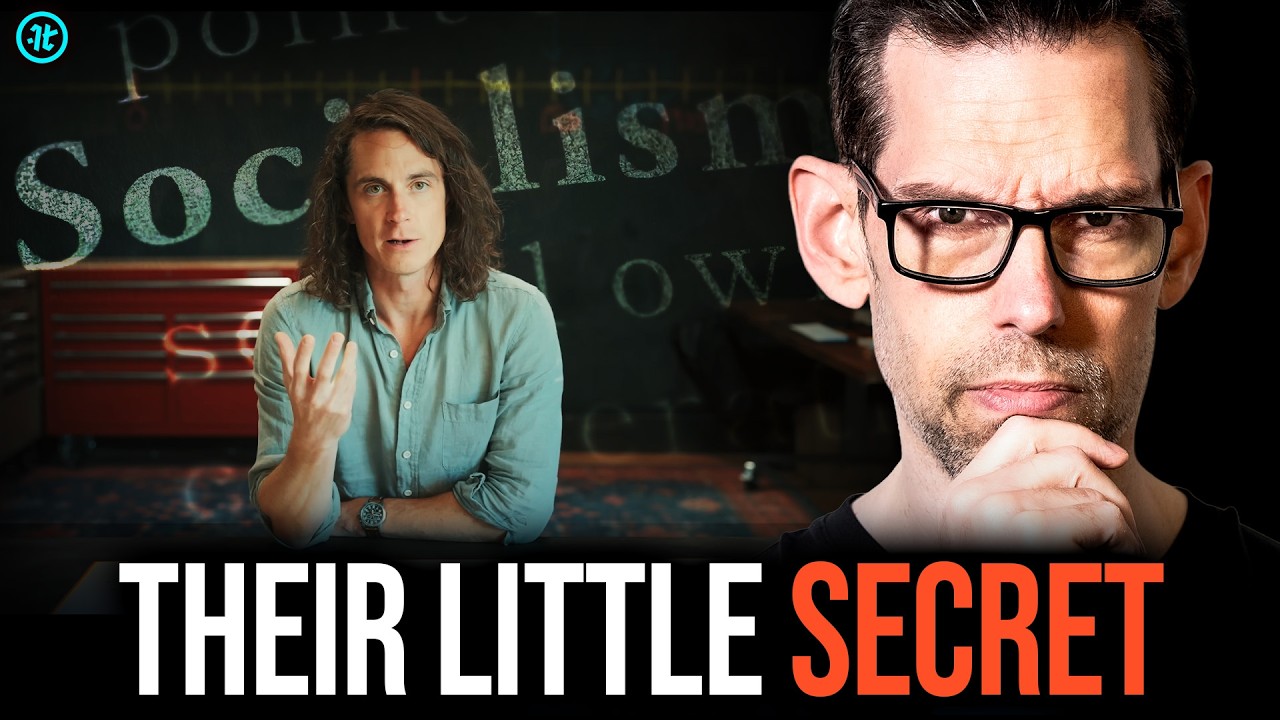
The One Question To CRUSH The DSA
Tom Bilyeu
41,964 views • 1 month ago Save 42 min 13 min read
Video Summary
The video explores the fundamental drivers of economic systems, centering on scarcity and ownership, and traces the historical evolution from tribal societies to modern capitalism. It highlights how the need to accumulate resources for survival led to the desire for ownership, which in turn fueled conflict and the development of systems like feudalism and eventually capitalism. The transition to capitalism, marked by the ability to accumulate capital and overproduce, is presented as a monumental shift from millennia of tradition, enabling societal progress but also creating immense wealth and misery.
The latter half of the video delves into the origins and critiques of socialism, particularly through the lens of Karl Marx's "Das Kapital." It examines the historical context of industrialization, the harsh realities faced by workers, and Marx's theory of profit as unpaid labor. The video contrasts planned economies, exemplified by East Germany, with free markets, using the Berlin Wall and grocery stores as stark illustrations of their respective successes and failures in resource allocation and individual freedom. Ultimately, it posits that while true socialism has yet to be successfully implemented on a large scale, the fundamental question of resource management and ownership in the face of scarcity remains a defining challenge for humanity.
Short Highlights
- Scarcity as the Foundation: The fundamental driver of all human economic systems is the scarcity of resources, leading to the development of ownership as a means of survival and accumulation.
- Evolution of Systems: Societies progressed from tribalism to feudalism and then capitalism, each evolving based on how land and resources were owned and managed.
- Capitalism's Rise: The accumulation of capital and the ability to overproduce became central to capitalism, enabling societal growth but also creating significant disparities.
- Socialism's Emergence: Karl Marx's critique of capitalism, particularly "Das Kapital," arose from observing the exploitation of labor and the concentration of wealth, proposing collective ownership as a solution.
- Planned vs. Market Economies: Historical examples, like East and West Berlin, demonstrate the stark differences in resource distribution, innovation, and living standards between planned and market-driven economies.
- The "Freeloader Problem": A core challenge for socialist systems is managing incentives when individuals may not be rewarded for their productivity, leading to inefficiency and potential conflict.
- Modern Interpretations: Contemporary "socialist" systems, like those in Nordic countries, often blend free-market capitalism with robust social safety nets funded by high taxation, differing significantly from Marxist ideals.
Related Video Summary
Key Details
The Core of Scarcity [00:00:00]
- Human economic systems are fundamentally driven by the scarcity of resources on a finite planet.
- The desire to accumulate scarce resources, like food and shelter, is an evolutionary imperative for survival.
-
"scarcity and who owns what drives the thinking behind every system humans have come up with"
From Survival to Ownership [00:01:30]
- Early humans gathered resources directly, but population growth led to competition and the concept of ownership through conflict.
- Women were among the first scarce resources acquired through violence, highlighting the violent origins of ownership.
-
"one of the most precious things uh scarce resources that you could um kill the other tribe and take from them was women."
The Feudal Structure [00:03:00]
- As kingdoms grew, rulers granted land to lords in exchange for military service, creating a hierarchical system.
- Lords, in turn, granted land to workers who produced food, establishing a system of protection in exchange for labor.
-
"hold this land as your own defend it in return you'll send me your knights when i need them"
The Dawn of Capital Accumulation [00:05:00]
- Increased travel and trade led to the concept of land ownership for profit rather than just subsistence.
- The ability to accumulate capital beyond personal production allowed for scaling up ventures, like building larger ships and cities.
-
"the accumulation of capital the accumulation of capital is really important when you can aggregate more capital than you're able to make by yourself"
Shifting Demands: From Knights to Coin [00:07:00]
- Rulers began demanding monetary tribute (taxes) instead of military service from lords.
- Lords, in turn, demanded profit from those working their estates, incentivizing overproduction and market sales.
-
"forget your knights i'll build my own army from now on you pay me taxes gold silver coins or goods i can trade to other kingdoms"
The Birth of Modern Property [00:08:30]
- The focus shifted from land control through force to economic acquisition, allowing more people to own land.
- This marked a significant break from tradition, where land ownership was previously exclusive to the elite.
-
"this marked the beginning of where we are today it's a huge break from thousands of years of tradition"
Violence and Economic Acquisition [00:10:00]
- While economic acquisition didn't end violence, it offered an alternative to conquest for acquiring resources.
- Historical examples like the Dutch East India Company and Columbus's actions show the brutality that persisted.
-
"this is laying the seeds for the thing that becomes the modern world where we all agree that okay we're gonna make money"
Capturing the Value of Time [00:11:30]
- The concept of money allowed individuals to capture the value of their time by becoming good at something others valued.
- This enabled the building of personal surplus and the ability to purchase needed goods rather than stealing them.
-
"by getting good at something i can now say well we all have the same 24 hours in the day but if i can do something that you guys really value then i can make more money from my time"
The Enclosure Movement and Worker Dispossession [00:14:00]
- The enclosure of common lands and the shift to profitable farming left many peasants landless.
- These individuals were forced to move to towns and cities, seeking work in factories under harsh conditions.
-
"commons fence for sheet pay a fee to work my strip or wool folded into the big man's profitable fields progress they said"
The Rise of Socialism [00:16:00]
- The brutal working conditions, low pay, and lack of safety nets during the Industrial Revolution fueled the development of socialist ideas.
- The core concept was that the collective group, not wealthy individuals, should benefit from their labor.
-
"that the people as a group not rich individuals should get the fruits of their labor"
Karl Marx and "Das Kapital" [00:17:30]
- Karl Marx's "Das Kapital" critiqued capitalism, arguing that profit stems from unpaid labor.
- Marx observed a system where only the wealthy could afford to start businesses due to the risk of personal financial ruin.
-
"this is going to be another really important piece of the story is you have to understand carl marx as a product of his time"
The Limited Liability Corporation [00:20:00]
- The introduction of the Limited Liability Corporation (LLC) in 1855 allowed businesses to operate with limited downside risk.
- This innovation enabled more people to start businesses, a development Marx did not fully anticipate.
-
"the downside is going to be limited and so this is the birth of the limited liability act which passed in 1855"
Marx's Legacy and Resentment [00:22:00]
- Marx's ideas gained traction after his death, fueled by resentment over wealth inequality.
- Despite living in poverty, Marx was philosophically opposed to engaging directly in the capitalist economy.
-
"this by all accounts this was a very smart person and so the question becomes why was he not doing that and that is what i think people miss is this resentment"
The Critique of Capitalism [00:25:00]
- Marx argued that profit is essentially unpaid labor, where capitalists benefit from the surplus value created by workers.
- He proposed that the means of production should be owned by the people collectively to escape this system.
-
"profit is unpaid labor when you walk into a store you see prices on the shelves you don't see the workers who made the product"
The Price Signal Problem [00:28:00]
- A key critique of planned economies is the absence of a price signal, making it difficult to determine what to produce and in what quantities.
- Market economies use consumer choices to signal demand, guiding production and resource allocation.
-
"the death knell to why socialism isn't going to work it came from a guy named ludwig von missus and he was trying to explain to people why the markets in a socialist system they always end up collapsing"
The Berlin Experiment [00:33:00]
- Post-WWII Germany, particularly Berlin, became a real-world experiment comparing capitalism and socialism.
- The Berlin Airlift demonstrated the West's commitment to supporting a capitalist West Berlin against Soviet pressure.
-
"the free world had called russia's bluff in the high stakes poker game of international politics"
The Wall and Economic Disparity [00:36:00]
- The construction of the Berlin Wall physically separated the two systems, highlighting their contrasting outcomes.
- East Berlin's grocery stores offered far fewer items than West Berlin's, and car ownership was severely limited.
-
"by the time the berlin wall came down the wait time for either of the two cars you could buy was over 10 years"
Life Expectancy and Unification [00:39:00]
- East Berliners had a significantly shorter life expectancy than West Berliners.
- Within a decade of reunification, this gap in life expectancy was erased, suggesting the impact of economic and social systems on health.
-
"those in east berlin had a life expectancy two and a half to three years shorter than west berlin"
Velocity Made Good and Entrepreneurship [00:41:00]
- Entrepreneurship is likened to "velocity made good," the ability to navigate challenges and harness momentum towards a goal.
- Successful entrepreneurs, like Steve Jobs, excel at orchestrating disparate talents and resources toward a unified vision.
-
"velocity made good is the ability on a ship to go okay i'm trying to get you know over there which is let's say due north but the wind is blowing due east or due west"
The Freeloader Problem in Utopias [00:46:00]
- Utopian socialist experiments, like New Harmony, failed due to the "freeloader problem," where those who don't contribute benefit equally.
- This disincentivizes hard work and leads to inefficiency and resentment, ultimately causing the system's collapse.
-
"it is something known as the free loader problem you will inevitably get to the point where some people are very good at what they do and they're out there and they're working hard"
Nordic Model: A Hybrid Approach [00:50:00]
- Nordic countries operate as free markets with high taxes to fund extensive social safety nets, not as true socialist states.
- They intentionally avoided the Soviet model, demonstrating a blend of capitalism and social welfare.
-
"the nordic countries intentionally set themselves up like this they watched what happened in the early part of the russian revolution we're like no we're not going to do that"
The Incentive Structure of Power [00:53:00]
- Centralized planning creates perverse incentives, where managers and planners are rewarded for meeting quotas rather than for meeting consumer needs.
- Concentrated power leads to a lack of accountability, paranoia, and the suppression of bad news.
-
"the manager of the east berlin grocery store has no reason to care what customers actually want if the store runs out of milk by 10 a.m the manager doesn't lose a dime"
Abundance and Human Nature [00:57:00]
- A world of absolute abundance could potentially negate the need for markets, prices, and power structures.
- However, until such abundance is achieved, humanity must grapple with scarcity and the question of ownership.
-
"if there isn't scarcity socialism and even communism seems almost likely there would be no reason for markets prices and power structures"
The Defining Question [01:00:00]
- Both capitalism and socialism are human attempts to solve the problem of managing scarcity and ownership.
- The future likely involves a continuous balancing act between collective security and individual freedom.
-
"all of this might be moot once ai comes along i do think people have to be honest though about is there something in us that yearns to breathe free"
The Role of AI [01:02:00]
- The potential of AI to manage economies raises questions about whether it could solve the problems of central planning.
- However, the human desire for freedom and choice may still create friction, even with AI-driven systems.
-
"i think people will give up a lot much to my dismay if you like this conversation check out this episode to learn more"
The Entrepreneurial Orchestrator [01:05:00]
- Entrepreneurship involves orchestrating diverse elements to create value, a process that requires vision and decision-making.
- This role of the "orchestrator" is crucial for success and is something Karl Marx, focused on labor, may have underestimated.
-
"was you're a tremendous instrument player you're the best in your row but i play the entire orchestra"
Debating Profit Sharing [01:08:00]
- A valid debate exists on whether companies capture too much profit and should share more with employees to foster a strong middle class.
- However, the fundamental need for orchestration and value creation by entrepreneurs remains.
-
"there's a very worthy debate to be had about are companies doing themselves a disservice by capturing too much of the profits"
The Failed Utopias [01:10:00]
- Numerous utopian socialist communities in America failed due to inherent flaws like the freeloader problem and lack of effective organization.
- These failures underscore the difficulty of implementing socialist ideals in practice.
-
"there was uh the most famous one was founded by this guy named robert owen he was a wealthy welsh industrialist who founded the famous but extremely ill-fated cooperative commune of new harmony"
The Incentive Problem in Central Planning [01:13:00]
- Central planning systems often fail because incentives are misaligned, leading to inefficiency and a lack of responsiveness to consumer needs.
- The concentration of power at the top prevents problems from being addressed effectively.
-
"the basic rule of incentives is you get what you reward for a center that decides where everything goes"
Monopoly of Power [01:16:00]
- In centrally planned systems, power becomes concentrated in a few hands, leading to monopolies on violence and production.
- This unchecked power is prone to corruption and self-preservation, rather than serving the populace.
-
"the result has been one person and a tiny group of trusted advisors consolidate control of two things the military and the means of production"
The Future of Scarcity and Ownership [01:18:00]
- The fundamental question of who owns what and how resources are distributed will continue to drive societal development.
- The balance between collective needs and individual freedoms will likely remain a central tension.
-
"because of that the question of who owns what it's not going to go away"
The Defining Questions of Our Time [01:20:00]
- The video concludes by emphasizing that the debate between different economic systems is one of the defining questions of our era.
- The potential of AI to reshape these systems is acknowledged, but the human desire for freedom remains a significant factor.
-
"this is going to be one of the defining questions of our time and i don't hear a lot of people that are able to really articulate what's actually going on very well"