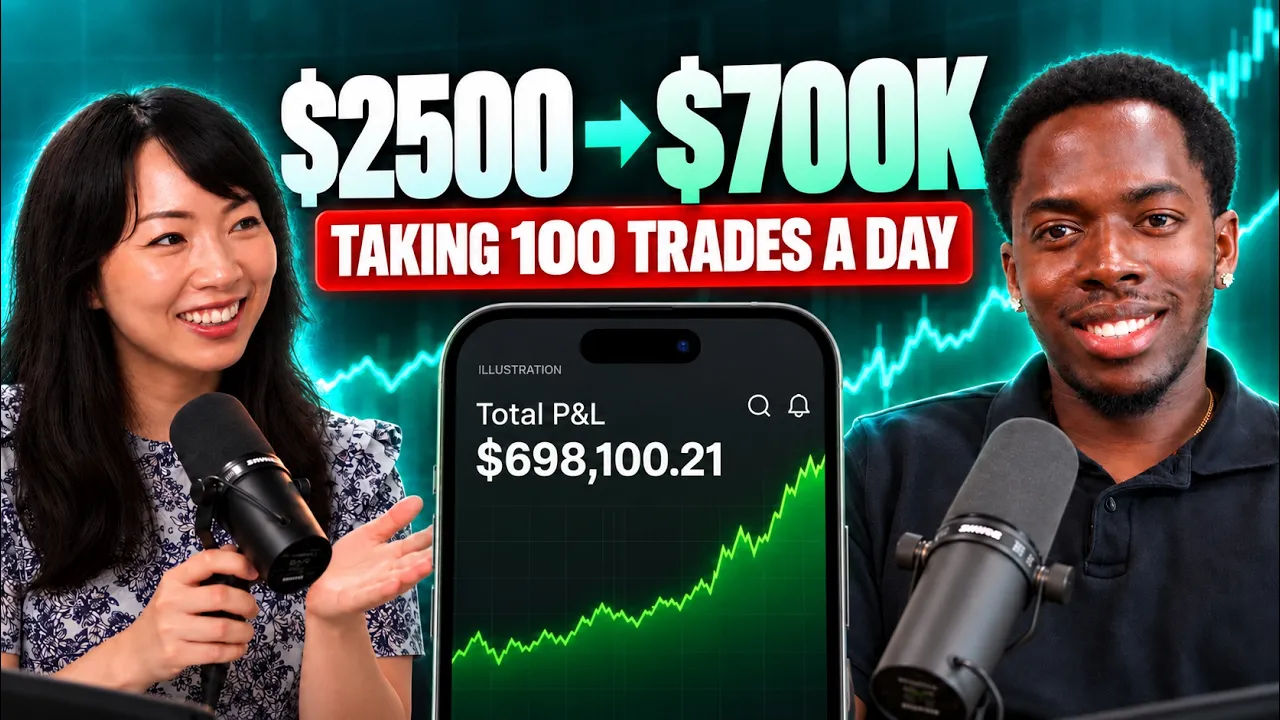
Trader Made $700K Scalping Stocks With Just a 48% Win Rate
Humbled Trader
573 views • yesterday Save 42 min 12 min read
Video Summary
Tariq, known as Relentless Trader, transformed a $2,500 trading account into over $700,000 by mastering hyper-scalping, a high-speed trading style. His journey was marked by a near-catastrophic loss seven years ago, an event that served as a pivotal moment, reinforcing his commitment to discipline and self-mastery over market fluctuations. This experience, described as an out-of-body episode where he felt powerless to stop his own mistakes, led him to vow never to lose control again.
Tariq's hyper-scalping strategy involves entering and exiting trades within seconds or minutes, executing hundreds or even thousands of trades daily. This approach contrasts with traditional strategies, focusing on accumulating small gains through high frequency rather than chasing large profits. Despite the intense pace, he emphasizes that discipline and risk management are paramount, allowing him to maintain profitability even with a 50% win rate by keeping losses minimal.
Short Highlights
- Tariq, aka Relentless Trader, grew his trading account from $2,500 to over $700,000.
- His strategy is hyper-scalping, involving hundreds or thousands of trades daily.
- A near-account blow-up in his simulator was a critical turning point.
- He emphasizes discipline and self-mastery over market knowledge.
- His win rate is 50%, with small wins and tight losses being key to profitability.
- He previously studied accounting at Rutgers University.
- His sibling provided significant financial support, including credit cards.
Key Details
The Hyper-Scalper's Rise [0:00]
- Tariq, known as Relentless Trader (RT), has grown a $2,500 account to over $700,000 through hyper-scalping.
- His trading style is one of the fastest-paced in the market.
- A significant loss seven years ago, where he broke his own rules, was a turning point.
- He described this loss as an out-of-body experience, feeling unable to stop his mistakes.
"I'm sure a lot of traders watching this can relate to that moment as well, because I've definitely been through that myself."
Defining 'Relentless' [1:19]
- Tariq believes in working hard, being persistent, disciplined, and motivated.
- He views trading as a daily battle requiring persistence to avoid being "eaten alive."
"Trading is a very vicious world, a very vicious atmosphere. And if you don't have that persistent bone in your body, you can be eaten alive."
The Simulator Nightmare [1:56]
- Early in his career, around 2019, Tariq faced a day where he almost blew up his simulator account.
- He entered the day with a good mindset but ended up over-trading and compromised.
- A final trade led to a moment of self-doubt in his backyard.
"And I remember vividly going into my backyard on a hammock. And I was asking myself, am I capable? Am I going to be able to do this thing?"
A Turning Point in the Backyard [3:00]
- This low point forced him to dig deep and question his capability.
- He realized he was breaking his own rules and needed to win the internal battle.
- The experience motivated him to push forward, even through tears.
"Because we hear it and it's a bit cliche, you versus you. But it's really true. If you can become a better version of yourself and ask yourself, is that version of me capable of doing this?"
Life-Changing Profits [4:32]
- Since that day, Tariq has not experienced another blow-up moment.
- His all-time profits are around $700,000, a figure he is proud of.
- This financial success has drastically changed his life, removing the need to constantly think about money.
"An example would be going to the grocery store and not even checking the receipt or the bill. It's been life changing."
From Accounting to Trading [5:44]
- Before trading, Tariq studied accounting at Rutgers University, achieving straight A's and making the Dean's list.
- He didn't particularly enjoy accounting but pursued it for job security and to help his family.
- An older sibling introduced him to trading with a video about making $10,000 in a day.
"Hey, here's someone who's saying they made $10,000 in one day in the stock market."
The Pivot to Trading [6:49]
- He and his sibling downloaded trading apps and discovered the reality of making money in the market.
- While in business school classes, Tariq found himself looking at charts and videos, realizing he needed to pursue trading.
- He decided to pivot from the traditional path of education and employment.
"And I think that was a day I really knew that I think I needed to pivot and actually pursue trading rather than just follow the status quo of like, go to school, do something good, get a good job."
The Birth of Hyper-Scalping [8:31]
- Tariq's trading style is called hyper-scalping, involving trades lasting seconds to minutes.
- Unlike others who might take a few good trades, his strategy allows for recurring opportunities multiple times an hour.
- This results in 500 to 1,500 trades per day.
"Our strategy in our edge was reoccurring a course of five minutes, 10 minutes, multiple times throughout the day."
Strategy Evolution [10:01]
- Initially, Tariq gravitated towards a long bias and holding trades longer.
- He found that stocks often consolidated or moved against him after initial gains, leading to stop-outs before reaching profit targets.
- This led him to adopt a strategy of taking small, consistent gains whenever they appeared.
"And so I essentially told myself, you know what, why not every time that I'm in and I'm seeing that gain of that $20, you know, whatever it might be for each particular trade, why not just take it and get back in again if I need to?"
Personality Alignment [11:31]
- Hyper-scalping fits his personality, particularly his discomfort with stocks moving against him.
- The strategy allows him to exit quickly if a trade turns unfavorable, aligning with his preference for not holding through losses.
"Because for me, I think one of the bigger issues that I have is not wanting stocks to go against me."
Win Rate and Risk/Reward [12:33]
- Tariq has a 50% win rate.
- He aims for a minimum two-to-one risk-to-reward ratio, but often cuts trades early if they go against him, sometimes resulting in break-even or small losses.
- His average winning trade is around $50-$60, while average losing trades are $10-$20.
"About, so if I take a hundred trades, about 50 of them are winners, about 50 are losers."
The Power of Tight Losses [13:46]
- Profitability comes from risk management and cutting losses quickly.
- He never averages down or holds against a stop loss, prioritizing cutting losses immediately.
- This discipline is crucial, as he always pre-determines potential profit targets and stop losses.
"The, one of the biggest things for us is to all, before we even get into the position, what is my potential profit target? And what is my stop loss if this thing goes against me?"
Broker Challenges [16:01]
- Tariq's previous broker, Charles Schwab, banned his account without a clear reason.
- He speculates this was due to his high trading frequency, which may not align with traditional broker models for retail traders.
- This led him and others in his community to adapt and use other platforms.
"Pretty much in our community, we say our accounts got banned."
Platform and Strategy Requirements [17:39]
- As a hyper-scalper, Tariq needs platforms that are quick, have minimal fees, and allow trading of stocks that move a high percentage in a short time.
- He looks for stocks with breaking news, low float (for supply/demand dynamics), and tight spreads.
- Small-cap stocks with significant daily percentage moves are ideal.
"And I would say almost every single day that I show up to trade, there's at least one stock in the small cap land that is able to do between 40% and a hundred percent every single day."
The Perfect Watchlist Setup [20:07]
- An ideal setup includes breaking news, high volume, and tight spreads.
- Technical analysis, including Level 2, candlesticks, chart patterns, and EMAs, is used to determine entry points.
- He looks for about 20 different patterns or edges, including familiar ones like bull flags and bear traps.
"So first, if it has breaking news, that's great, right? That's giving, that's giving the stock a legit reason as to why it should be moving."
Trading Breakouts and Upside [22:37]
- Tariq often trades breakouts, looking for aggressive, instant upward moves.
- He scales out of positions, selling half and holding the other half to capture extended moves.
- Sometimes, indicators or intuition suggest exiting early, even if there's potential for more upside.
"So one, I'd say we find that the best breakouts are instant, very vicious and aggressive going up. And then two, we try our best to scale out."
Market Environment and Adaptability [25:30]
- Market conditions influence his trading; in hot markets, he might chase entries with more risk.
- He emphasizes that this is only advisable for experienced traders.
- He also engages in swing trades and longer-term investing to diversify income.
"And so for us, you know, with, with who we are as a community and myself, it's, it's been, you know what, this is the car that we've been dealt. Let's make the most of it."
Identifying a Trading Day [27:21]
- Tariq looks for aggression and viciousness in a stock's movement, along with range confirmation.
- Stocks need to prove their momentum after news or at market open.
- He avoids stocks that spike and immediately reverse, which he calls a "Christmas tree."
"So for us, there's a lot of aggression and viciousness in how a stock moves when it's an obvious stock."
Pre-Market vs. Market Open [29:10]
- In the past, market open was dominant, but recent years have seen more "trickery" and traps.
- He now prefers pre-market trading for smoother action, though some community members prefer market open.
- He limits screen time to about five hours daily, typically from 7 a.m. to 11 or 12 p.m. market time.
"But nowadays, when it comes to market open, I believe that there's a little bit more trickery, a little bit more traps when it comes to how stocks are moving."
The Genesis of the $2,500 Account [31:25]
- Tariq started with $2,500 of his own money, supplemented by debt, including credit cards and funds from siblings.
- One sibling gave him $16,000 from a credit limit, expecting the money to be lost.
- He considers his true starting capital to be $2,500 because he vowed to stop and repay borrowed funds if he lost his own money.
"I had 2,500 of my own buying power, my own money out of my own pocket and the rest of it was debt."
Early Trading Success and a Setback [34:37]
- He went live on May 1st, 2020, making $16,000 by year-end, followed by $45,000 in 2021.
- A significant setback occurred when he funded a sibling's account instead of paying off debt, leading to the sibling blowing up the account and incurring interest.
- This forced Tariq to take a job at Amazon and save to pay off the debt before trading full-time.
"So, you know, that's where I would say things really got difficult because when he went live, he didn't have the same smooth experience I did."
Exponential Growth and Risk [37:58]
- After paying off debt and entering a hotter market in 2023, his growth became exponential.
- He finished 2022 with $58,000 and jumped to approximately $175,000 in 2023.
- This growth felt life-changing, especially before inflation significantly impacted prices.
"And I believe 2022, I finished up with 58,000. So 16, 45, 58. And then I made a jump from 58 to about 175 in 2023."
The Goal of Progress [39:30]
- Tariq's only goal is progress, not a specific monetary target.
- He learned from a past mistake of setting monetary goals, which added pressure.
- He believes focusing on becoming a better version of oneself will naturally lead to improved profits.
"I always tell people, you know, that my only goal is progress."
The 'Out-of-Body' Experience Revisited [41:29]
- The near-blow-up day was intensely personal, making him question his fundamental capability.
- He has not experienced a similar loss of control since, attributing it to the profound impact of that event.
- This experience reinforced his commitment to risk management to prevent such situations.
"You know, it's kind of even like my eyes is even getting a little watery because that moment for me was so intense, you know, that if I wasn't able to get a grasp on who I am deep down, I would never be able to make it anywhere."
Discipline Outside Trading [45:07]
- Tariq practices discipline through consistent gym workouts, viewing it as a lifestyle.
- Physical activity helps relieve stress and trains the mind alongside the body.
- He emphasizes that "the gym" can be any form of challenging physical activity, like hiking.
"The gym is my home away from home when it comes to getting outside of trading, because so much of it requires that consistency, that dedication, that drive, that discipline to stay focused."
Tips for Aspiring Traders [47:27]
- Track trades meticulously, record screen activity for review, and join a supportive community.
- Treat trading like a business with a routine: sleep early, wake up on time.
- Upgrade equipment (laptop, internet, monitors) to gain a competitive edge.
- Understand that trading is highly competitive, involving self-discipline, algorithms, and institutions.
"Do the little things, track your trades, record your screen, join a community because, you know, community without a community, man, I think I'd still be making 200 bucks a day only."