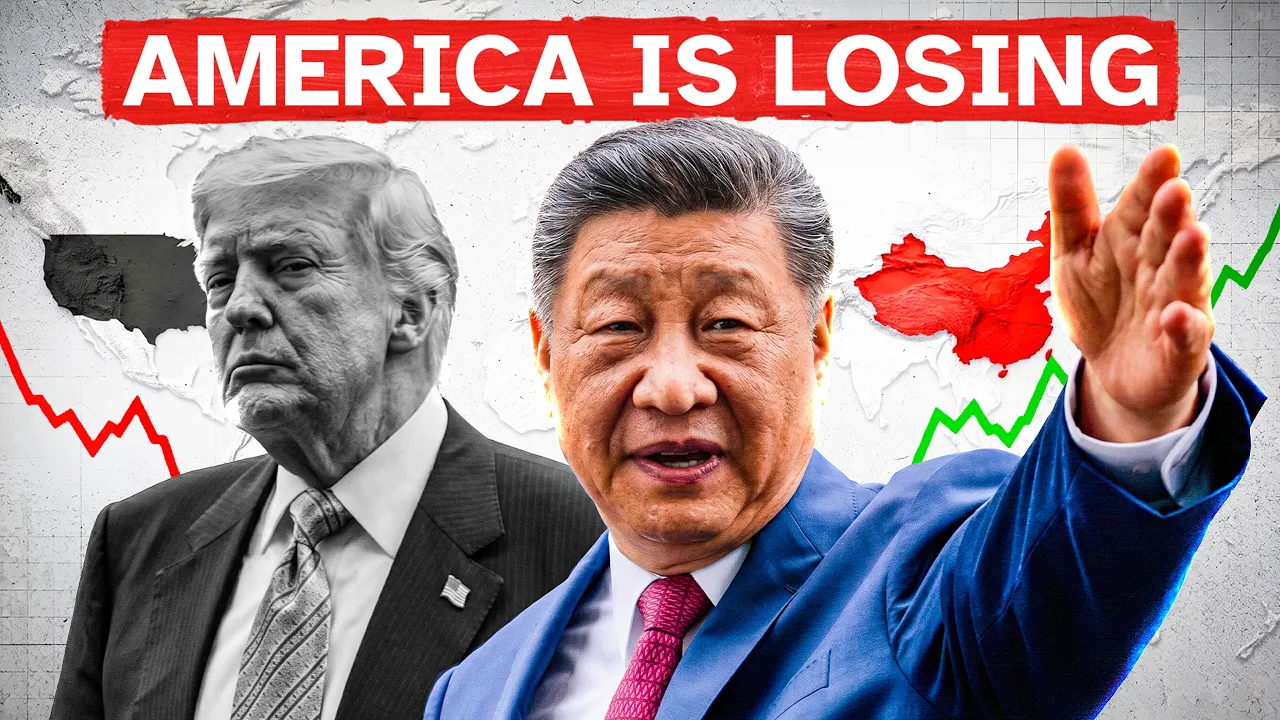
China is OVERTAKING America.
Coin Bureau
856 views • yesterday Save 10 min 6 min read
Video Summary
While the U.S. lags, China is surging ahead in critical global sectors like electric vehicles, AI, and infrastructure, dominating manufacturing and technological innovation.
China's electric car brands are rapidly expanding worldwide, with exports soaring and new models appearing in European showrooms. Beyond cars, China leads in building essential infrastructure like high-speed rail and ports, and crucially, manufactures the machinery, like tunnel-boring machines, that other nations rely on. Chinese companies are at the forefront of battery technology and AI development, releasing models that developers globally utilize. This dominance is fueled by an unparalleled manufacturing ecosystem, intense domestic competition, and strategic government support for key industries. Tariffs and tech bans have paradoxically spurred China to develop its own advanced technologies, further solidifying its global position and impacting everything from consumer prices to job markets worldwide.
Short Highlights
- China's Global Dominance: China is significantly ahead of the U.S. in cars, technology, infrastructure, and trade.
- Electric Vehicle Surge: Chinese EV brands are rapidly expanding globally, with exports increasing dramatically.
- Infrastructure Leadership: China consistently completes major infrastructure projects like high-speed rail and ports, while similar plans elsewhere stall.
- Manufacturing Ecosystem: China's integrated supply chains and rapid prototyping allow for unparalleled speed in product development and production.
- Tech Innovation: Chinese companies lead in crucial sectors like batteries (CATL, BYD) and AI, releasing models used worldwide.
- Strategic Industrial Policy: Government support and long-term investment in key sectors like batteries and EVs have paid off, while Western counterparts faltered.
- Resilience to Sanctions: Tariffs and tech bans have pushed China to develop domestic alternatives, further strengthening its self-sufficiency and global position.
Related Video Summary
- China dominates global matcha supply but can Japan protect its premium edge? | CNA Correspondent
- HORMUZ CLOSED TILL SEPTEMBER: U.S. ECONOMY ABOUT TO IMPLODE – w/ Financial Journalist David Lin
- Is China's economic success creating a domestic paradox? | CNA Correspondent
- China's AI-powered pushーNHK WORLD-JAPAN NEWS
Key Details
China's Lead in Global Markets [0:00]
- The U.S. is falling behind China in key areas like cars, technology, infrastructure, and trade.
- Chinese electric cars are being exported globally in massive numbers, and new brands are appearing in European markets.
- China's infrastructure projects, including rail lines, bridges, and ports, are completed at a rapid pace.
"America still calls itself the world's leader, but in cars, technology, infrastructure, and trade, there's one country that's way ahead — China."
Global Reach of Chinese EVs and Infrastructure [1:05]
- Chinese EV brands are rapidly increasing their presence in Europe, with significant growth in registrations.
- China exported over 7.1 million passenger cars in the first nine months of the year, a substantial increase from the previous year.
- China consistently finishes infrastructure projects like high-speed rail and metro systems, contrasting with delays in other countries.
"China exported more than 7.1 million passenger cars in the first nine months of the year. That's up more than 70% on the same stretch of 2025."
Manufacturing the Tools of Global Development [2:38]
- China manufactures critical machinery, such as tunnel-boring machines, essential for infrastructure projects worldwide.
- Recent export controls on these machines by Beijing have led to delays in projects in countries like India.
- This highlights China's control over key components of global development and construction.
"This month, Beijing announced export controls on these machines, taking effect in mid-November."
Leading in Next-Generation Technologies [3:19]
- The gap is widening fastest in batteries and AI, two sectors crucial for future products.
- Chinese companies CATL and BYD dominate the electric car battery market.
- Chinese AI labs are releasing models that are widely used and built upon by developers globally.
"So, in the two industries that decide what the next generation of products can actually do, Chinese companies are already at the front."
China's Massive Trade Surplus and Evolving Exports [4:05]
- China reported a trade surplus of $938 billion in the first nine months of the year.
- The nature of Chinese exports has shifted from cheap goods to high-value items like chips, batteries, cars, and machinery.
- Global supply chains increasingly start with Chinese suppliers, impacting manufacturing worldwide.
"In other words, the world bought nearly a trillion dollars more from China than China bought back."
The Integrated Chinese Manufacturing Ecosystem [5:05]
- China's manufacturing advantage stems from highly integrated regional supply chains, allowing for rapid product development and iteration.
- Proximity of suppliers, from mold makers to battery producers, enables swift changes and production cycles.
- Years of experience assembling products for global brands have built a deep pool of skilled engineers and managers.
"The speed comes from everything a product needs being in the same region."
Intense Competition and Strategic Government Support [7:07]
- Intense domestic competition, termed "involution," forces companies to innovate and cut costs at a rapid pace.
- Government initiatives like "Made in China 2025" strategically targeted and supported key industries like batteries and EVs.
- This long-term commitment, including financial support during lean years, allowed Chinese companies to be ready when global demand surged.
"Under plans like Made in China 2025, Beijing focused on things like batteries, solar, and electric vehicles as industries it intended to lead."
Innovation in Battery Chemistry and AI [8:33]
- Chinese companies favored Lithium Iron Phosphate (LFP) batteries over NMC, leading to cheaper production costs.
- BYD's "blade battery" is built around LFP chemistry, contributing to competitive pricing.
- In AI, Chinese labs developed efficient models using "Mixture of Experts" and released them as open weights, fostering widespread adoption.
"Cheaper chemistry made for cheaper battery packs."
Control Over Raw Material Refining [9:49]
- China refines a vast majority of the world's critical raw materials, including rare earths, graphite, and cobalt.
- This control gives China significant leverage over global manufacturing, as most industries rely on these refined materials.
- China has implemented licensing requirements on rare earths, impacting supply chains outside the country.
"China handles 90% of the world's rare earth refining, and the bulk of refining for graphite, cobalt, and gallium as well."
Tariffs and Tech Bans Backfire [11:06]
- U.S. tariffs led Chinese manufacturers to shift final assembly to countries like Vietnam and Mexico, while components still came from China.
- This strategy maintained China's supply chain dominance despite altered shipping routes and labels.
- U.S. chip bans prompted China to accelerate its development of domestic AI chips and manufacturing processes.
"So, restrictions designed to slow China down pushed it to build its own alternatives sooner."
Impact on Global Markets and Jobs [12:37]
- Chinese EVs are becoming more competitive globally due to lower costs and advanced features.
- The cost of many consumer products is influenced by China's manufacturing and refining capabilities.
- Chinese companies are establishing new factories and R&D centers in various countries, creating jobs and transferring technology.
"The phone in your pocket. The charger on your desk. The solar panel on a neighbor's roof."
The Next Frontier: Robots and Drones [13:34]
- China is leading in the installation of industrial robots, with a significant portion sourced from domestic suppliers.
- Chinese companies are showcasing advanced humanoid robots and developing next-generation batteries for various applications.
- The same factors that drove China's success in EVs are now being applied to robots, drones, and future energy technologies.
"In 2025, China installed 354,000 industrial robots, according to the International Federation of Robotics."