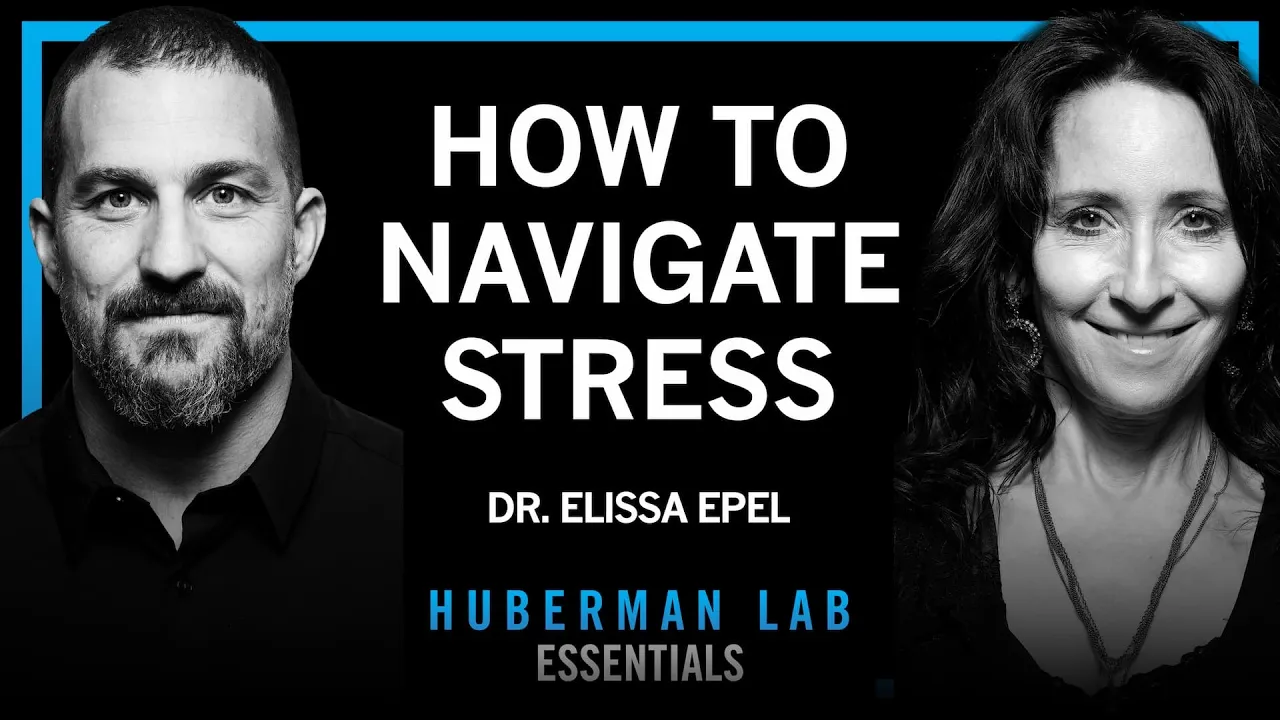
Essentials: Manage Stress & Build Resilience | Dr. Elissa Epel
Andrew Huberman
29,837 views • 21 hours ago Save 23 min 7 min read
Video Summary
In a discussion on "Huberman Lab Essentials," Dr. Alyssa Eppel distinguishes between beneficial and detrimental stress, emphasizing that our response, not the stressor itself, determines its impact. She outlines three key strategies for managing stress: top-down cognitive approaches, body-mind interventions, and environmental changes. Eppel highlights that chronic stress can accelerate aging and diminish mitochondrial health, leading to exhaustion and negative mood.
Eppel introduces the "challenge response" versus the "threat response" to psychological stressors. The challenge response, characterized by an "I can do this" mindset, leads to better physiological outcomes, including reduced inflammation and potentially slower aging, compared to the threat response, which triggers a more severe stress reaction. She advocates for "stress shields"—positive self-talk and reframing—to cultivate the challenge response. For uncontrollable stressors, Eppel champions "radical acceptance," likening it to "dropping the rope" attached to an unmovable brick wall to conserve energy and reclaim mental space. This approach, alongside embracing uncertainty and cultivating positive daily moods, is crucial for mitigating the harmful effects of chronic stress and even thriving despite difficult circumstances.
Short Highlights
- Understanding Stress: Stress is defined as feeling overwhelmed when demands exceed resources, with both acute and chronic forms existing. While unavoidable, our response is key.
- Managing Overthinking: Strategies include cognitive awareness, body-mind interventions (working stress out of the body), and changing the environment to include safety signals.
- Forms of Stress: Stress can be short-term, medium-term (requiring daily restoration), or chronic (lasting years, often uncontrollable).
- Stress and Aging: Chronic stress can accelerate cell aging, while engaging in challenges, like tutoring, can promote growth and even hippocampal expansion.
- Challenge vs. Threat Response: The "challenge response" (seeing stressors as opportunities) leads to better health outcomes than the "threat response" (feeling overwhelmed and endangered).
- Radical Acceptance: For uncontrollable stressors, accepting the situation without constant problem-solving frees up mental and physical resources.
- Embracing Uncertainty: Cultivating comfort with uncertainty and adopting a receptive, curious stance can reduce anxiety and improve recovery from stressful events.
Related Video Summary
Key Details
Forms of Stress [00:00:58]
- Stress is technically defined as feeling overwhelmed when demands exceed resources.
- It encompasses both "good" and "bad" stress, as well as acute and chronic forms.
- The focus should be on the stress response and recovery, rather than solely on the stressors themselves.
"So there's good and bad stress, there's acute and chronic stress."
Managing Overthinking [00:01:49]
- Awareness of how one's mind works is crucial to avoid being subject to unhelpful thought patterns.
- Overthinking and ruminating can keep the stress response activated unnecessarily.
- Society has become accustomed to daily stress, often not noticing the tension held in the body.
"We're so used to feeling daily stress from our urban and modern life that we don't notice it."
Three Buckets of Stress Management [00:02:36]
- Top-down strategies: Utilizing awareness, beliefs, and mindsets to release or use stress positively.
- Body-mind strategies: Actively working stress out of the body through physical means to achieve relief and change brain activity.
- Change the scene: Modifying the environment or incorporating safety signals like pets, pictures, or music to create a calming effect.
"And those are the set of strategies that you tend to use the most, right? We're working stress out of the body. We're metabolizing it. We're burning it up and we get relief."
Recognizing Stress Types [00:03:51]
- Stress can be recognized through subjective feelings, bodily responses (nervous system vigilance), and physiological markers.
- Chronic sympathetic nervous system dominance, even without conscious awareness of stress, can lead to exhaustion due to high energy expenditure.
- Moderate stressful events may take days or months to cope with, highlighting the importance of daily restoration.
"And that's particularly important and interesting because that's how stress gets under the skin. And we might not be aware, we don't report stress, but we're still holding tension and being much more sympathetically dominated."
Chronic Stress and Aging [00:05:45]
- Chronic, uncontrollable stressors, such as caregiving, can accelerate cell aging.
- There is significant individual variation in how people cope with chronic stress, with some showing resilience and others accelerated aging.
- Optimal aging is contrasted with typical and accelerated aging, with the latter being measurable through biological markers.
"I mean, I study chronic stress and how it accelerates cell aging, and I can tell you there's so much variance between people."
Stress as a Catalyst for Growth [00:07:10]
- Complete absence of stress can mean a lack of engagement with life's challenges and opportunities.
- Engaging in challenging, generative activities, like tutoring at-risk students, can lead to purpose, growth, and even hippocampal growth in older adults.
- This suggests that challenging oneself can foster brain growth and well-being at any life stage.
"And what happened to them is they went from feeling maybe safe and understressed to feeling challenged but generative."
Psychological Stressors and Resilience [00:09:30]
- Short, repeated physical stressors (like HIIT) build "stress fitness," enhancing resilience.
- Psychological stressors can also build resilience if managed well, leading to less rumination, depression, and anxiety.
- The "challenge response" to stressors, driven by thoughts like "I can do this," leads to healthier physiological outcomes than the "threat response," which is associated with feeling endangered.
"So we could call this kind of a, to be really simplistic, two types of psychological stress response, feeling threatened, like you're going to fail, you're embarrassed, that social pain response, we know, well, that feels terrible."
Cultivating the Challenge Response [00:12:08]
- Finding personal "strength statements" or "stress shields" that resonate and are believed is key.
- Examples include telling oneself "I got this," "I can do it," or "I have what it takes."
- Reframing the stress response as empowering and helpful, rather than a sign of danger, can shift the body's reaction.
"Be the lion instead of the gazelle. So the lion and gazelle are both, you know, high blood pressure, high stress, and the lion's chasing the gazelle."
Mitochondrial Health and Mood [00:15:05]
- Chronic stress can dampen mitochondrial activity, reducing energy production and increasing exhaustion.
- Caregivers under chronic stress often exhibit lower mitochondrial activity compared to those with typical children.
- Positive daily moods, especially in the evening, are correlated with better mitochondrial function and predict better long-term health outcomes, including less depression and heart disease.
"And in this study of young mothers who were, who had either typical children or children with autism, we found that the caregiving moms had significantly lower or dampened mitochondrial activity."
Radical Acceptance and Uncertainty [00:19:27]
- For uncontrollable stressors, radical acceptance involves acknowledging the situation without wishing it were different, reducing chronic stress.
- Metaphorically, it's like "dropping the rope" attached to an unmovable brick wall, freeing up energy.
- Comfort with uncertainty is a resilience factor, reducing anxiety and improving recovery from stressful events by adopting a receptive, curious stance.
"So just even taking that first kind of step back to get perspective on what are the situations in my life that stress me out? And, and which of these can I circle those that I can't change?"
Narrative and Purpose [00:24:14]
- Creating a coherent narrative of one's life experiences is critical for making sense of events and finding meaning.
- Interpreting and responding to events, rather than just what happens, defines the stress experience.
- A narrative of purpose, informed by the ability to project into the future and understand one's place in life, distinguishes humans and helps them rise above basic survival instincts.
"So narrative is kind of everything, right? In stress research, it's, it's not what happens to us. It's how we're interpreting it and how we're responding to it."