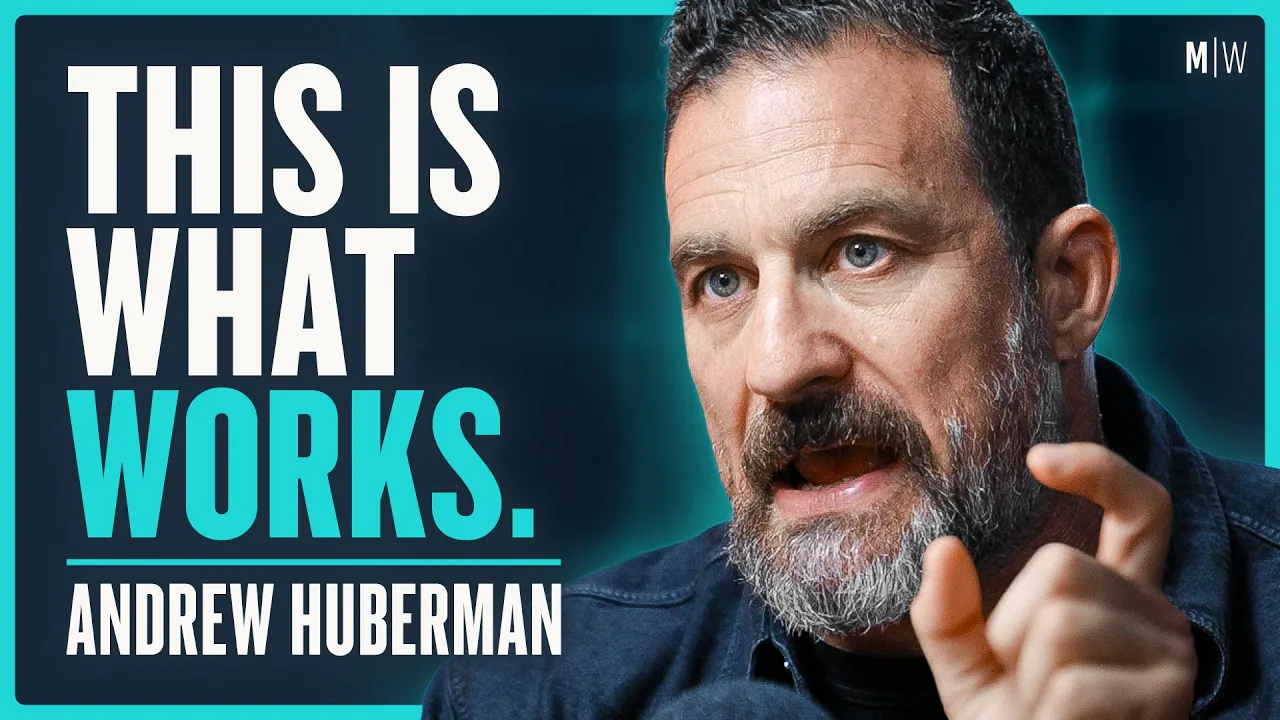
“This Is The Culmination Of Everything I Know” - Dr Andrew Huberman
Chris Williamson
2,030 views • 19 hours ago Save 139 min 13 min read
Video Summary
Andrew Huberman, a neuroscientist, shares his strategies for optimizing health and performance, emphasizing the critical role of cortisol regulation. He advises a high-cortisol morning and low-cortisol evening to improve mood, focus, and stress resilience. This is achieved through bright light exposure, hydration, and exercise in the morning, and dimming lights and reducing screen time at night.
Huberman also delves into the concept of "top-down" versus "bottom-up" influences, explaining how strengthening the prefrontal cortex's ability to suppress impulses is key to effective human functioning. He highlights the importance of "micro-sucks"—small, deliberate challenges throughout the day—and learning to discern true taste from social acceptability, a skill he believes many people fail to develop. The conversation touches on stress management, memory, focus, and the neuroscience of presence, offering practical tools derived from his extensive research.
Short Highlights
* * Cortisol Regulation: * Aim for high cortisol in the first hour of the day and low cortisol in the last hour. * Morning strategies: bright light (sunlight or 10,000 lux), hydration, caffeine, exercise. * Evening strategies: dim lights, reduce screen time, red light/candlelight, limit caffeine, avoid exercise unless necessary. * Top-Down vs. Bottom-Up Influences: * "Top-down" is the prefrontal cortex suppressing impulses. * "Bottom-up" are impulses driven by deep brain structures. * Strengthening top-down control is crucial for effective human functioning. * "Micro-Sucks" for Willpower: * Deliberately choose the harder option in small, daily tasks. * Examples: picking up trash, replacing toilet paper, making your bed. * Builds circuits for suppressing impulse and overcoming friction. * Developing Taste: * Differentiate between what you like and what is socially acceptable. * True taste involves discerning good from not-good, independent of popularity. * Many people confuse social trends with personal taste. * Improving Memory and Focus: * Brain fog is an inability to focus, often linked to catecholamine systems. * Key steps: good sleep, exercise, learning through genuine errors, self-testing. * Dopamine, norepinephrine, and epinephrine are critical for focus and learning. * Stress Management Protocols: * Deliberate, long exhales (physiological sigh) slow heart rate and increase calm. * Increase Heart Rate Variability (HRV) through breathing exercises and exercise. * Resonance breathing can induce a state of calm and improve HRV. * The Neuroscience of Presence: * A wandering mind is an unhappy mind; happiness correlates with present-moment awareness. * Practice presence by asking trivial questions about your immediate physical environment. * Use this heightened awareness to direct your thoughts and actions intentionally.
Related Video Summary
- High Cortisol Wakes You Up at 3AM (Do This to Fall Back Asleep FAST)
- Andrew Huberman: My Exact Routine To Optimize Brain & Body, I Do All Of These Every Day!
- The Scientist Who Scans Fathers' Brains: Parenthood Shrinks Your Brain, And Drops Testosterone 25%!
- Tap These 3 Spots for 30 Seconds — Feel What Happens to Your Body | Dr. Mandell
Key Details
The Cortisol Cycle: Morning High, Evening Low [0:01:28]
- Morning cortisol is crucial for elevated mood, focus, and alertness throughout the day.
- Low nighttime cortisol is essential for quality sleep.
- Failure to spike morning cortisol leads to a "high flat cortisol curve," reducing stress resilience and learning capacity.
"High cortisol in the morning sets you up for elevated mood focus and alertness all day long, allows you to buffer stress better, and it makes sure that your nighttime cortisol is going to be low."
Strategies for Cortisol Management [0:02:18]
- Morning: Bright light (sunlight or 10,000 lux artificial light) within 30 minutes of waking, hydration, caffeine, and exercise (ideally within the first three hours).
- Evening: Dim lights, reduce screen brightness, use red light or candlelight, limit caffeine, and avoid intense exercise.
- Eating, even fasting, can spike cortisol, as it's a pro-arousal activity.
"Bright light, especially from sunlight or 10,000 lux artificial light, and especially in the first 30 minutes after waking, hydration, caffeine, if you like caffeine, exercise in the first three hours of your day if you can, right?"
Top-Down vs. Bottom-Up Influences [0:05:45]
- Bottom-up influences are impulses driven by deep brain structures (e.g., wanting a cookie, endless scrolling).
- Top-down influences involve the prefrontal cortex suppressing these impulses (e.g., the marshmallow test, teaching a dog to wait).
- Developing effective human functioning relies on strengthening top-down control circuits.
"These are impulses that are driven by hypothalamic and other deep brain structures. Then we have, thankfully, we have top-down influences. This is your prefrontal cortex suppressing impulses."
The Power of "Micro-Sucks" [0:08:43]
- Choosing the harder option in small, everyday tasks builds willpower and self-control.
- This principle, advocated by Andy Stumpf, counters the natural inclination towards ease and pleasure.
- Examples include picking up small pieces of trash or replacing a toilet paper roll.
"Throughout your day, when given the option between the easier thing and the harder thing, do the harder thing that there's tremendous value in that."
Building Top-Down Circuits [0:10:05]
- Two primary ways to build top-down circuits: intense effort (e.g., "ass to chair" writing) or consistent small actions.
- The "Grease the Groove" method (Pavel Tsatsouline) involves frequent, low-intensity practice (e.g., two pull-ups every time you pass a doorway).
- Both methods train the same circuits, enhancing impulse suppression and self-control.
"There are advantages to that or doing the hard workout that you do not want to do. There's also a building up of the same circuits, those top-down suppression of impulse through the little things all day long."
The Dynamic Tension of Life [0:13:00]
- Life effectiveness stems from the tension between top-down and bottom-up influences.
- This dynamic is key to being non-reactive, avoiding procrastination, and making adaptive decisions under stress.
- It's not about eliminating stress, but about managing it effectively.
"But the top-down bottom-up tension, this dynamic tension between those two is so much about what being non-reactive is about."
Developing True Taste [0:18:30]
- Many people confuse social trends with genuine taste, following what's popular rather than what they truly like.
- True taste is the ability to discern quality and goodness in and of itself, independent of external validation.
- This skill is crucial for navigating life effectively and avoiding the pitfalls of chasing fleeting trends.
"Most people don't develop a sense of taste. They confuse what they like and don't like with what feels socially acceptable and what feels so different that it's uncomfortable to them."
Brain Fog, Focus, and Catecholamines [0:24:00]
- Brain fog is an inability to focus, often stemming from issues with the brain's catecholamine systems (dopamine, norepinephrine, epinephrine).
- While stimulants can temporarily boost these chemicals, quality sleep is equally effective for improving attention.
- Focus can be learned and improved by managing the threshold to access these crucial neurochemicals.
"People with severe clinical grade ADHD can focus if they're doing something they really like. Tells you something. It means the dopamine, norepinephrine, epinephrine, we call these the catecholamine systems of the brain and body that are involved in many things, but focus among them are there."
The Science of Learning [0:27:00]
- Learning requires alertness, which is supported by foundational elements like sleep and exercise.
- Exercise increases catecholamines, enhancing alertness and focus for 4-6 hours post-workout.
- Learning occurs by identifying the "error" between current ability and desired skill, which signals neurons to change.
"Exercise makes you better at learning for two reasons. One, it increases the catecholamines, dopamine, epinephrine, and norepinephrine. So in the four to six hours after exercise, you are more alert and you can focus better unless you exercise to exhaustion."
Closing the Learning Gap [0:28:30]
- The "agitation" felt from errors during learning is a chemical tag that helps synapses rearrange during sleep.
- Self-testing is crucial for consolidating learning and retaining information.
- Regularly retesting yourself on learned material combats the Ebbinghaus forgetting curve.
"The error between what you currently do and what you're trying to do, the error, is the signal that the neurons, the nerve cells need to change."
Stress Management Through Breathing [0:32:00]
- Deliberate, long exhales slow heart rate via the vagus nerve, tipping the autonomic nervous system towards calm.
- The "physiological sigh" (two big inhales followed by a long exhale) is a rapid and effective way to reduce stress.
- This practice also increases Heart Rate Variability (HRV), a marker of good health and resilience.
"When you exhale, deliberately, this is the key, deliberately. I don't think I've ever described it this way. You slow your heart rate down significantly. You offload carbon dioxide and your level of autonomic arousal, meaning sympathetic alert versus parasympathetic calm, balances."
Resonance Breathing and HRV [0:33:00]
- Resonance breathing, often guided by devices, synchronizes breath with heart rate to maximize HRV.
- Practicing resonance breathing for over 12 minutes can lead to "trait change" (lasting improvements).
- It offers a powerful tool for managing stress and enhancing overall well-being.
"It's got a 100 hertz sensor in it. So it's detecting your HRV all the time. And as it vibrates up and down, you breathe in time with it. And it modulates to maximize that arrhythmia."
The Neuroscience of Presence [0:38:00]
- A wandering mind is an unhappy mind; happiness is strongly correlated with present-moment awareness.
- Presence is cultivated by asking trivial questions about the immediate physical environment, anchoring attention.
- This practice shifts the brain away from future/past thinking and towards direct sensory perception.
"A wandering mind is an unhappy mind. I'm sure you're familiar with the data. You ping people throughout the day, you ask them what they're doing and how present they are to it. Turns out happiness is really about being present, having your attention, what's called present tethered awareness."
Controlling Your Thinking [0:42:00]
- The brain operates in "dynamic attractor states," where repeated thoughts strengthen neural pathways.
- To be present, focus on immediate sensory input rather than internal thoughts or memories.
- Controlling your thinking and bringing it back to the present is key to high agency and happiness.
"The brain works in what are called dynamic attractor states, which is nerd speak for. If I take a ball bearing and I put it on a, on a plate, it essentially can move in any direction."
The Four Steps to Personal Development [0:46:00]
- Acknowledge: Face difficult truths and past traumas directly.
- Feel: Fully experience the emotions associated with difficult events in a safe environment.
- Uncouple: Recall the event with less emotional load, separating the memory from the intense feeling.
- Transmute: Transform the painful experience and the journey through it into beauty or contribution.
"Acknowledge the bad thing. You can't just deny it anymore. You can't suppress it. What are you suppressing? You need to acknowledge this happened. This sucks."
The Role of Purpose and Family [0:56:00]
- For many, family and raising children provide a profound sense of purpose and satisfaction.
- This can be a powerful antidote to existential questions about one's role in the world.
- The energy often directed towards ambitious pursuits could alternatively be channeled into building a family.
"I think a lot of your, I don't really know what my purpose is. I don't feel like I'm contributing more largely to the world. All of these questions that people have, like, why am I here? It's like, well, a lot of this, I think has kind of been solved throughout time, which is like, you, you do the golden retriever thing and the family thing."
The VO2 Max vs. Zone 2 Debate [1:07:00]
- Both high-intensity interval training (like Norwegian 4x4) and lower-intensity, longer duration cardio (Zone 2/3) offer distinct benefits.
- Zone 2/3 builds aerobic base, capillary networks, and mitochondrial health.
- High-intensity training (e.g., Airdyne bike intervals) pushes the cardiovascular system to its limits, improving maximal oxygen uptake.
"I think my read of the data is you need some volume of cardio training to get that quote unquote aerobic base that can be very beneficial."
Core Strength and Mobility [1:10:00]
- Strong core muscles (abs, lower back) are crucial for overall strength, injury prevention, and good posture.
- Exercises like pikes (hanging leg raises) and back hyperextensions are vital for core and spinal health.
- Maintaining mobility through simple daily movements (squatting, hip flexor stretches, shoulder extension) is essential for long-term physical function.
"You want strong abs, you want strong midsection, and you want strong lower back muscles. I mean, I, I noticed that basically all injuries for me, nagging injuries completely disappear."
The Loneliness of Diligence [1:14:00]
- Committing to health and self-improvement can lead to a "lonely chapter" where one's social circle shifts.
- This period, described as the "empty elevator," involves outgrowing old social dynamics without yet establishing new ones.
- Strength of character is required to maintain beneficial habits despite potential social isolation or temptation to revert.
"There is a period where you are so developed that you don't resonate with your old set of friends, but not yet sufficiently developed that you built your new one and you keep looking back and you're tempted."
Octopus Intelligence and Sadism [1:17:00]
- Huberman shares his experiences with octopuses, noting their intelligence and capacity for mimicry.
- He also observes a disturbing "sadistic" playfulness in how they interact with their food, contrasting with the perceived benevolence of dogs.
- This highlights the often-uncomfortable realities of the animal kingdom.
"Cephalopods are motherfuckers. I, I like cephalopods. I like cuttlefish. I had those for years, kept those alive for a long time, by the way."
The Book's Core Message: Principles Over Tools [1:20:00]
- Huberman emphasizes understanding underlying principles rather than just isolated tools.
- Knowing the "why" behind interventions (e.g., cortisol regulation, neuroplasticity) allows for more effective and flexible application.
- The goal is to build a robust system for health and performance that is adaptable to individual circumstances.
"Once you understand a bit of the principles that organize the mechanisms, you're in a great position to be truly strong of mind and body because you can organize information."
Overlooked Interventions: Eye Movements and Journaling [1:21:00]
- Wacky Eye Movement: A simple, free technique to aid sleep by confusing the body's awareness of limb position.
- Journaling for Trauma: 15 minutes of writing daily for four days about difficult experiences (Pennebaker method) can help process and uncouple emotions from memories.
- These interventions are often skipped due to perceived difficulty or lack of immediate gratification.
"The wacky eye movement thing to fall back asleep. Oh, we talked about that last time that we were together. Yeah. Yeah. I think people would think it's too crazy, but it's, but it costs nothing and it works."
The Importance of a "Spiritually Chinless" Mindset [1:24:00]
- Huberman and Williamson discuss the value of respecting and being respected by admirable individuals.
- The concept of being "spiritually chinless" (borrowed from Adam Mastroianni) implies a lack of core conviction or integrity.
- Authenticity and genuine character are key to earning respect from discerning people.
"I like that person. I think they've got good taste. I think they're noble. I don't think that they're spiritually chinless and they spiritually chinless."
Life Energy Allocation and Peaks [1:26:00]
- Some individuals possess a naturally high "life energy" that can be channeled into various pursuits.
- The goal is not to live a low, slow life, but to strategically "put your foot on the gas" during peak periods.
- Avoiding premature death (like the "27 club") while maximizing impactful periods is key.
"Some people just have that extra gear. Some people don't, and they need to take their, whatever they've been allocated and do maximize with that. And some people just have a tremendous amount of life energy."