Why Putin’s new £1billion air defences around palace is a gift to Ukraine | Former Military Advisor
The Sun
4,119 views • 15 hours ago Save 16 min 7 min read
Video Summary
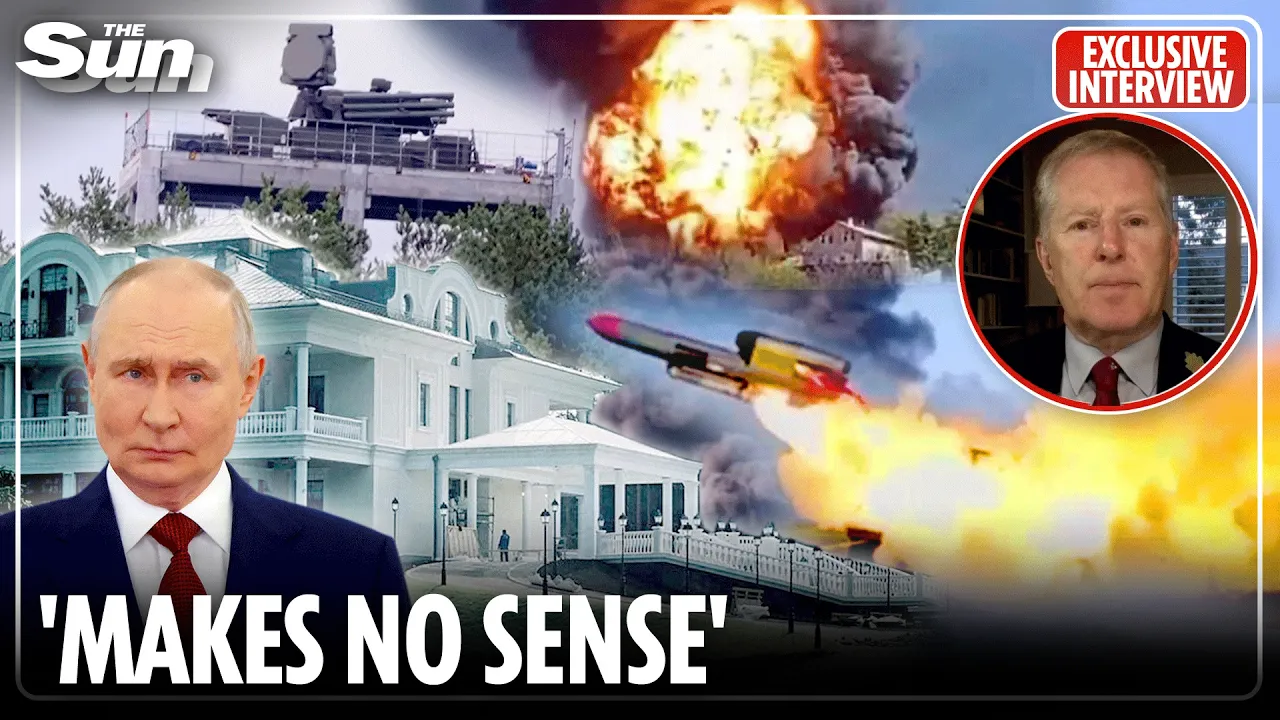
Vladimir Putin has installed a sophisticated, multi-layered air defense system around his Valdai dacha, an estimated £1 billion investment, signaling deep-seated fears for his personal safety. This extensive network, featuring S-400s, TOR, and Pantsir systems, aims to counter threats from drones to ballistic missiles, and even electronic warfare. The sheer scale of this defense, with over 50 positions for a rural area, starkly contrasts with Moscow's allocation, highlighting Putin's status as a VVIP and high-value target.
This immense security expenditure raises questions about resource allocation, potentially diverting critical assets from national infrastructure defense. While the system aims to protect Putin, it creates vulnerabilities elsewhere, which Ukraine may exploit. The situation underscores a broader tension: the leader's security versus the state's broader defense needs, with Ukraine strategically targeting Russian weaknesses. Putin's actions, fueled by fears of both external threats and internal dissent, reveal a leader increasingly isolated and concerned about his legacy and survival.
Short Highlights
- Massive Air Defense Network: Putin's Valdai dacha is protected by an integrated, layered air defense system costing an estimated £1 billion.
- Layered Systems: The defenses include S-400s for long-range threats, TOR for medium-range, and Pantsir for short-range, alongside electronic warfare capabilities.
- High-Value Target: The extensive security measures reflect Putin's status as a VVIP and a high-value target, fearing both external enemies and his own people.
- Resource Allocation Imbalance: Over 50 air defense positions guard the Valdai area, significantly more than allocated to Moscow, indicating a skewed priority.
- Strategic Vulnerabilities: The focus on protecting Putin's assets may create weaknesses in defending critical national infrastructure, offering opportunities for Ukraine.
- Ukraine's Strategy: Ukraine aims to exploit these vulnerabilities by targeting Russian weaknesses, as seen in attacks on chemical plants.
- Putin's Fears: Putin's pronouncements and actions suggest a deep-seated fear of political failure leading to his demise, either by external forces or internal betrayal.
Related Video Summary
Key Details
Putin's Valdai Dacha Fortified [0:13]
- New satellite imagery reveals extensive air defenses being installed around Vladimir Putin's dacha in Valdai.
- The estimated cost of this integrated air defense system is £1 billion.
-
"You've got around Valde, one of his largest dachas, is an integrated air defence system."
Layered Air Defense Systems [0:31]
- The Valdai dacha is protected by a layered air defense system designed to counter all threats.
- This includes long-range S-400s for ballistic and cruise missiles, TOR systems for shorter ranges, and Pantsir for very short-range threats like drones.
-
"So, at the highest level, we've got S-400s. That's a very long-ranged interceptor that's there to try and catch ballistic missiles and cruise missiles."
Strategic Priorities and Vulnerabilities [1:10]
- Protecting a leader with such advanced defenses, even if he doesn't visit often, highlights a significant allocation of strength.
- This focus on protecting Putin's assets may create weaknesses elsewhere, such as in critical national infrastructure.
-
"And it's therefore for Ukraine to apply their strength against weakness."
Ukraine's Strategic Approach [1:30]
- Ukraine's strategy involves applying its strength against Russian weaknesses, avoiding direct confrontation with heavily defended targets.
- Recent attacks on chemical plants producing fuel components demonstrate this approach.
-
"So, that's why Ukraine is able to do what they do."
Russian Security Apparatus [1:55]
- The Federal Protective System (FSO) is responsible for protecting all high-level Russian leadership, with Putin's security being a sub-element.
- There's a trade-off between protecting individuals and protecting critical national infrastructure.
-
"If you want to protect a coterie of people, then, you know, you're protecting people, but you're not necessarily protecting critical national infrastructure."
Putin's Fears and Rhetoric [2:25]
- Putin is considered the VVIP in Russia and a high-value target, necessitating his protection.
- His recent pronouncements, including the use of "Novorossiya" language, suggest a desire to reclaim historically Russian territories, which is viewed as ahistorical.
-
"He is the BVIP in Russia, and he's a high-value target."
Integrated Defense and Dacha Significance [3:30]
- The air defense systems are integrated through software, surveillance, and radar, similar to Israel's layered defense model.
- Valdai, in the Novgorod region, is a location Putin has invested in and has a fondness for, akin to a country house.
-
"The integration comes by the software of the layering between the systems, where you have both satellite and other types of surveillance, which would alarm at various levels and distance, so that you can defeat the target with the appropriate system."
Geopolitical and Economic Considerations [4:30]
- Wars are fought for political objectives, not economic ones, and geo-economic theories are outdated.
- Putin is a political identity player, not a market optimizer, focused on regaining lost territory and spheres of influence.
-
"And as I think I said six months ago, geo-economic theories went out of the window about 30 years ago."
Putin's Paranoia and Political Survival [7:00]
- Putin may be descending into paranoia, fearing death by those around him if he fails to achieve political success in the war.
- He fears both external threats from Europe and America, and internal threats from his own people.
-
"If he doesn't have a political success in the war, he may well be killed by those around him."
Operation Spider's Web and Drone Defense [8:30]
- Anti-drone netting has been observed near Putin's dacha, indicating concern about novel attack methods like "Operation Spider's Web."
- This extreme measure reflects a desire to leave no chances, even for low-probability, high-impact attacks.
-
"And this is an indication that they're worried about another potential Operation Spider's web happening."
Allocation of Air Defense Systems [9:10]
- The Russian Armed Forces, not the FSO, allocate air defense systems, aligning with Putin's perceived threats.
- There's a concern that top-tier hardware defending private villas could impact military morale or availability for other fronts.
-
"It's not the Federal Protective Service, the FSO, which allocates those systems. It's the Russian Armed Forces."
Impact on Military Morale [10:30]
- The military's morale is more likely affected by basic needs like food and evacuation, rather than the specific air defense priorities at Putin's dacha.
- Prolonged combat is expected to lead to significant mental health issues on both sides.
-
"They really worry more about whether they're going to get fed, whether they're going to get watered, whether they're going to get evacuated if they're wounded."
War Crimes and Targeting Leaders [12:00]
- Targeting a leader like Putin is not considered a war crime, and decapitation operations are historically precedented.
- An ICC warrant exists for Putin for war crimes committed by Russian forces.
-
"So I don't think it is a war crime to target the leader."
Potential for Internal Change [13:30]
- The war could end if the military walks off, elites defect, or there's a population uprising, though these are not currently seen as likely.
- The war is also changing the ethnic composition of Russia, with casualties disproportionately affecting ethnic minorities.
-
"And all wars do finally end. It's just how and when they're likely to end."
Defense of Private vs. National Assets [11:10]
- Putin has stated he won't allow oligarchs to solely rely on their own defenses, implying state responsibility.
- However, the defense of private assets like dachas may come at the expense of critical national infrastructure.
-
"No, that's one of the things Putin has said that he won't do, that that becomes a, you've got to protect your own assets."
Economic Impact and Targeting Refineries [11:40]
- American aid to Ukraine has been selective, targeting high-value assets and seemingly impacting Russia, as Putin acknowledges sanctions are hurting.
- Ukraine's attacks on refineries are also noted as having an impact.
-
"So there are now over 50 air defence positions guarding a rural area, with a population fewer than 100,000, which is roughly half the entire defence network allocated to Moscow's 20 million people."