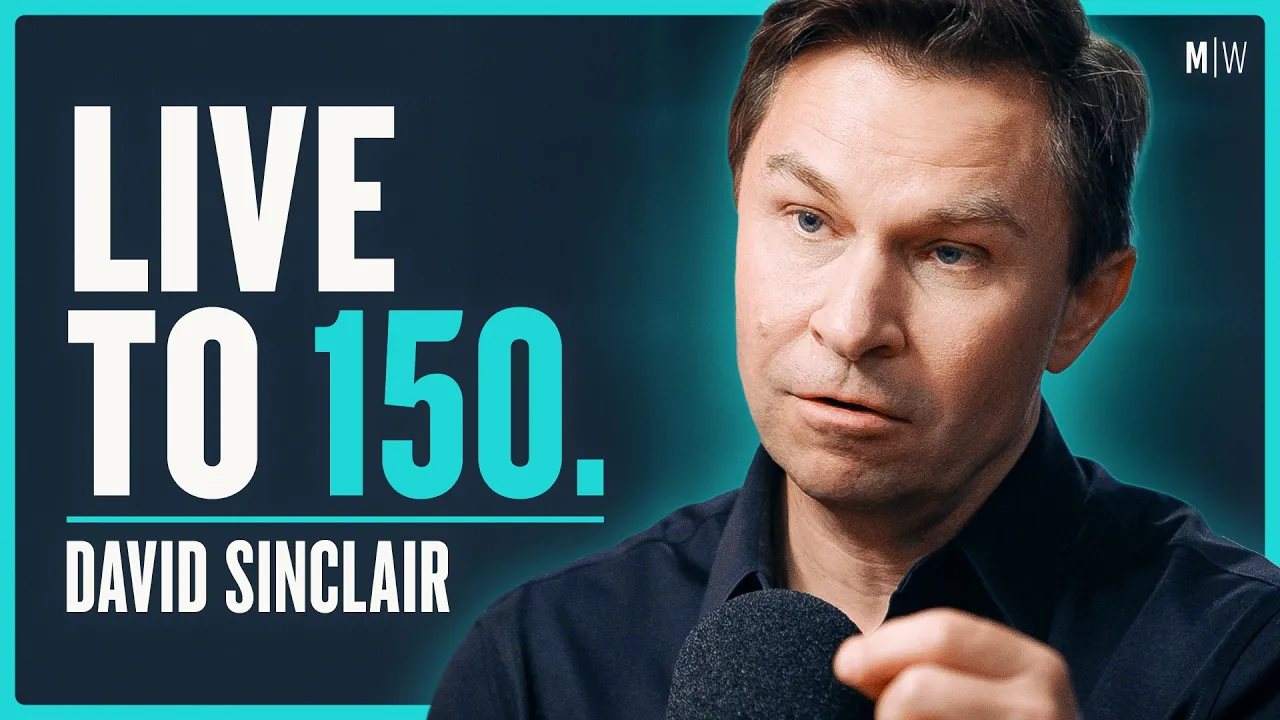
“Age Reversal Is Coming.” Everything You Need To Know - Dr David Sinclair
Chris Williamson
179,039 views • 1 month ago Save 104 min 21 min read
Video Summary
Dr. David Sinclair, a leading longevity researcher, reveals groundbreaking advancements in reversing aging, detailing how his lab's work has progressed from safely reversing aging in mice to human trials. He explains the science behind their approach, which involves reprogramming cells using a subset of Yamanaka factors, and discusses the potential of their drug, ER100, to treat age-related eye conditions like glaucoma and macular degeneration, with theoretical applications extending to other diseases and injuries.
Sinclair also discusses the future of longevity, including the possibility of a "longevity escape velocity" and the development of an oral pill for age reversal. He emphasizes the importance of lifestyle factors like diet, exercise, and stress management, while also highlighting the potential of emerging technologies like AI in accelerating research and drug discovery. The conversation touches on controversial topics like supplements, NAD+ and resveratrol, and the potential of GLP-1 drugs, offering a glimpse into a future where aging is treated as a disease.
Short Highlights
- Age Reversal Breakthroughs:
- Safely reversed aging in mice and cured blindness in 2020, published on Nature's cover.
- Successfully replicated in different animals and tissues, now in human trials for vision restoration.
- Developed ER100 (Epigenetic Reversal 100) drug, potentially the first true age-reversal drug for humans.
- Mechanism of Action:
- Uses a subset of Yamanaka factors delivered via virus-like particles, focusing on epigenetic reprogramming.
- Compares aging to corrupted software on a CD or old phone, with the epigenome controlling the DNA.
- The process involves resetting the epigenome, similar to what occurs in embryos.
- Therapeutic Potential:
- Successfully treated blindness, glaucoma, and macular degeneration in animal models.
- Theoretically applicable to any disease or injury, including liver damage, neurodegenerative diseases (ALS), and joint repair.
- Future of Longevity:
- Anticipates a "longevity escape velocity" where technology extends life faster than we age.
- Working on developing an oral pill for age reversal, showing rejuvenation in mice.
- AI is revolutionizing drug discovery and research, accelerating progress exponentially.
- Lifestyle and Interventions:
- Emphasizes fasting, plant-focused diets, exercise (weightlifting and aerobic), and stress management.
- Discusses supplements like resveratrol and NMN, and the importance of purity.
- Considers GLP-1 drugs as potentially the closest thing to a longevity drug currently available.
Related Video Summary
- I asked ChatGPT how to live to 140!
- FULL INTERVIEW: Elon Musk on AI, Robots, Tesla, China, Trump and Mars With Larry Fink at WEF | AI1G
- No.1 Performance Psychologist: The Secret to High Performance and Excellence
- Essentials: How to Optimize Female Hormone Health for Vitality & Longevity | Dr. Sara Gottfried
Key Details
The Dawn of Age Reversal: From Mice to Humans [0:00]
- Recounts the first podcast recording in 2019, highlighting the evolution of longevity research.
- Emphasizes the progress made in making the biology of reversing aging a mainstream conversation.
- Mentions key areas of focus: Yamanaka factors, NAD, and resveratrol.
"I wish everyone could come visit. The highlights would be, so in 2020 we published on the cover of Nature magazine that we could reverse aging safely in an animal for the first time, a mouse. We cured its blindness. That was pretty big."
Reversing Aging Safely: The Nature Cover Story [1:20]
- Details the 2020 Nature publication on reversing aging in mice, specifically curing blindness.
- Highlights the reproducibility of these findings in other labs and different animal models, including monkeys.
- Notes that the treatment is effective across various tissues, not just the eye.
"Cover of Nature, it's what most scientists dream of in their lifetime. So that was a pretty big high."
Human Trials: The Next Frontier [2:15]
- Announces the progression into human trials, aiming to reverse age-related vision loss.
- Discusses the significance of this step, as many believed the field was further behind.
- Mentions that the discovery of the core mechanism dates back to 2016-2017.
"Suddenly there are people now getting what could be the world's first true age reversal drug."
The Eye as a Starting Point: Safety First [3:00]
- Explains why the eye was chosen for initial human trials: safety due to its enclosed nature.
- Clarifies that the Yamanaka factors used are a subset, as the full set can be dangerous.
- Recounts the initial student's hesitation to target blindness, preferring an easier target like the liver.
"And the safest way to deliver a virus-like particle into a human is to go into a space that's enclosed. It's not going to spread. And the eye is where it's most been tested."
ER100: A Potential Age Reversal Drug [4:30]
- Introduces ER100 (Epigenetic Reversal 100) as the drug being used in human trials.
- Highlights its effectiveness in animal models for various eye conditions, including glaucoma and macular degeneration.
- Suggests theoretical applications for a wide range of diseases and injuries beyond the eye.
"Even macular degeneration, glaucoma, the two leading causes of blindness in the world, both of them are really, really easily treated by this new mechanism."
The Information Theory of Aging [6:00]
- Explains the concept of aging as corrupted software, distinct from the DNA (genome).
- Uses the analogy of a CD or phone software to illustrate the epigenome's role in controlling DNA.
- Presents the theory that the pattern of DNA folding (epigenome) gets corrupted over time, leading to aging.
"So an old person still has information there. It's just that it's been corrupted, the software. We call that the epigenome."
Embryonic Reset: Nature's Own Age Reversal [7:30]
- Reveals the fact that very young embryos undergo an epigenome reset, effectively reversing their age.
- Explains that this reset is crucial for development and involves compacting DNA to form different cell types.
- Notes that disrupting these loops and bundles in mice led to aging and loss of cell identity.
"No way. It's a fact. It's shocking, but true. Young, very young embryos are old and then they get reset."
Aging as a Disease: A Paradigm Shift [9:00]
- Argues for viewing aging as a disease rather than an inevitable part of life.
- Believes this perspective is crucial for developing preventative and treatable approaches.
- Highlights the potential for slowing down aging, even starting early in life.
"So we can call aging whatever we want, but I prefer to think of aging as a disease because otherwise we're not really treating it."
The Future: Longevity Escape Velocity [10:00]
- Discusses the concept of "longevity escape velocity," where life expectancy increases faster than time passes.
- Compares this potential turning point for humanity to the singularity in AI.
- Predicts significant investment and acceleration in the field once aging is proven reversible in humans.
"When we show, and it's a matter of when, not if, that aging is reversible in humans, because it works in all these other animals. It'll work in us."
Towards a Whole Body Reset: The Pill Revolution [11:30]
- Explains the progression towards treating multiple tissues and organs, aiming for a whole-body reset.
- Reveals a breakthrough in developing an age-reversal pill for mice, showing rejuvenation in memory and skin quality.
- Acknowledges that the exact mechanism of the pill is still under investigation, but likely involves epigenetic changes.
"Over the last five years, we've made breakthroughs in turning it into a pill. That's the next big thing that'll come out of my lab."
The TET Enzymes and Epigenetic Reset [13:00]
- Introduces TET enzymes, which strip chemicals off DNA and are key to epigenetic reset.
- Explains that inhibiting these enzymes with chemicals can mimic the reset process.
- Provides evidence that the age-reversal pill works through this epigenetic mechanism, not just by stressing cells.
"There are genes called TETs, which make proteins that strip away chemicals off DNA. These are key to the epigenome reset in embryos as well as in our bodies."
The Upper Limit of Human Life: No Limit? [14:30]
- Posits that there may be no inherent upper limit to human lifespan, citing ancient bonsai trees as an example.
- Believes humans can control their biology beyond evolutionary constraints.
- Suggests the first person to live to 150 is likely already alive.
"So biology doesn't have limits. It's just a question of what our genome encodes and our epigenome."
Preventing Reversion to Infancy: The Breakthrough [15:30]
- Addresses the concern of age reversal leading to an embryonic state or cancer.
- Explains the critical discovery of using a subset of three Yamanaka genes (OSK) instead of all four.
- Highlights that leaving out one specific gene (M) prevents cells from reverting completely to stem cells, stopping at about 75% reversal.
"And my student, Wan Cheng, famously almost quit the project. He was doing his PhD. He was in his last year and nothing was working."
The Longevity Expert's Secret Beliefs [17:00]
- Suggests that many longevity experts privately believe the field is more powerful than publicly acknowledged.
- Notes that scientists are often cautious due to their profession, leading to a reluctance to make bold claims.
- Identifies himself as an outlier for speaking his mind and sharing his beliefs openly.
"I think most aging researchers, I can say for a fact behind the scenes, say this is going to be much bigger and more powerful than we expected."
Why Sinclair is an Outlier [18:00]
- Attributes his outsider status to his lab's access to unpublished information and his mission-driven approach.
- States his life's goal is to positively impact as many lives as possible, stemming from his grandmother's WWII experiences.
- Expresses a lack of concern for criticism, prioritizing his mission above personal reputation.
"I'm not doing this to be a scientist. I'm doing this because I'm on a mission and my life is irrelevant."
Longevity Buckets: Lifestyle, Drugs, and Supplements [20:00]
- Categorizes longevity interventions into lifestyle, drugs, and supplements.
- Emphasizes the importance of focusing on current interventions to bridge the gap until future technologies are available.
- Encourages proactive engagement with longevity research for oneself and loved ones.
"For every day that I live, there's more days that I can hopefully live. So in the interim, those are the buckets, right?"
Fasting and Diet for Longevity [21:30]
- Reiterates the benefits of calorie restriction and intermittent fasting, consistent with his book "Lifespan."
- Advocates for eating one meal a day, viewing three meals plus snacks as marketing.
- Shares personal experience with extended fasting (up to two weeks) and its positive effects on energy and clarity.
"I think three meals a day plus snacks is marketing. Humans are not built to eat that consistently."
The Science of Extended Fasting [23:00]
- Explains the molecular process of chaperone-mediated autophagy (CMA) during fasting.
- Describes feeling energized and mentally clear after three days of fasting.
- Advises caution for those who are underweight or elderly.
"And after those three days, you know, I start to feel amazing. My mind clears."
Fasting and the Microbiome [25:00]
- Discusses the potential impact of prolonged fasting on the gut microbiome, suggesting it could provide a "shakeup."
- Explores the role of bile acids in converting into molecules that activate longevity genes like SIRT1.
- Highlights the importance of cycling between adversity (fasting) and abundance for health.
"Your microbiome converts that into a molecule that goes back into your bloodstream and turns on a longevity gene that we've been working on."
Starting Your Fasting Journey [27:00]
- Recommends starting with a one-day fast or skipping one meal.
- Suggests filling the stomach with liquids (water, tea, black coffee) to manage hunger.
- Notes that the body and brain adapt to fasting over time, making it feel natural.
"I would suggest skipping one meal and replacing it with a lot of liquids."
Calorie Restriction vs. Intermittent Fasting [28:30]
- Discusses the evidence for calorie restriction and intermittent fasting in humans and animals.
- Mentions a study showing health biomarker improvements with calorie restriction, including epigenetic changes.
- Acknowledges the lack of definitive long-term human proof but relies on animal data and anecdotal evidence.
"So there's no proof. And I don't think anytime soon there'll be proof, but who wants to wait another hundred years till that happens?"
The Monkey Study: Lifespan and Disease [30:00]
- Refers to a long-term monkey study on calorie restriction, noting initial discrepancies in findings.
- Confirms that the study ultimately showed lifespan extension and reduced disease burden (cancer, heart disease) in the monkeys.
- Emphasizes the importance of disease reduction even if lifespan extension is marginal.
"Her monkeys lived longer and they also definitely incontrovertible, uh, evidence that they had less cancer and I think heart disease."
Adversity Mode and SIRT1 Activation [31:30]
- Explains the "adversity mode" theory, where stress signals like hunger and exercise activate survival mechanisms.
- Highlights SIRT1's role in protecting the epigenome and responding to these signals.
- Connects this mode to switching from growth to survival, offering protection against aging and DNA damage.
"When you're in adversity mode, your body switches from growth and reproduction into survival mode."
Time-Restricted Eating vs. Continuous Feeding [32:30]
- Discusses research showing that eating within a specific time window is healthier than continuous feeding, even with the same calorie intake.
- Cites studies in mice demonstrating significantly longer lifespans for those fed within a window.
"He found that the group that ate within that window lived substantially longer than the ones that ate continuously."
Protein Intake: Beyond the Hype [33:30]
- Clarifies that protein is essential but the "carnivore" or excessive protein focus is not aligned with longevity science.
- Highlights the importance of plant-based foods for polyphenols and the role of branched-chain amino acids (BCAAs).
- Notes that lower BCAA intake is linked to better metabolic health and longevity.
"But the, this die hard, be a carnivore, forget about the green stuff is definitely not consistent with the science of longevity."
mTOR and Protein Pulsing [35:00]
- Explains the role of mTOR in cell growth and muscle building, but its link to shorter lifespans when chronically active.
- Advocates for "pulsing" protein intake, balancing periods of higher intake (e.g., for muscle building) with periods of lower intake or fasting.
- Suggests plant-based proteins as a primary source, with occasional meat consumption.
"mTOR's role is to help cells divide, grow, build muscle. Great. That's what you want to do when you're young."
Optimal Exercise Protocol for Longevity [36:30]
- Recommends a combination of weightlifting (for hormones, bone health, balance) and aerobic exercise (VO2 max).
- Emphasizes the importance of raising heart rate to the point where conversation is difficult.
- Suggests incorporating activities like running, rowing, or even vigorous sex.
"We know that the best health is a combination of weightlifting. Muscle is good for hormones. It's good for not breaking bones when you get older."
Zone 2, Gardening, and Active Lifestyle [38:00]
- Acknowledges the value of lower-intensity exercise like Zone 2 and general movement.
- Highlights gardening as a form of exercise, involving heavy lifting and physical activity.
- Stresses the importance of avoiding prolonged sitting.
"I try not to sit at all. I'm sitting now, but I rarely sit during the day."
Sleep Quality and Recovery [39:00]
- Reiterates the importance of quality sleep for metabolism and overall health.
- Suggests using wearables to track sleep efficiency and determine individual sleep needs.
- Recommends practices like avoiding late-day caffeine, meditation, and using supplements to improve deep sleep.
"If you're not getting quality sleep or sleeping for that long, it's going to affect your metabolism."
Managing Stress for Longevity [40:30]
- Discusses stress as a significant factor impacting health and aging.
- Advocates for learning to manage daily stress through techniques like visualization and mindfulness.
- Emphasizes avoiding rumination and overthinking, focusing on present tasks.
"So what I've learned personally is really not to let worries of life get me down."
The Power of Self-Trust and Resilience [42:00]
- Shares the realization that problems are often not as bad as anticipated and that one can overcome challenges.
- Highlights the importance of self-trust and believing in one's capability to solve problems.
- Connects this mindset to reduced stress and improved longevity.
"The sooner you can realize that, that you are capable of anything, if you put your mind to it, then you shouldn't stress about problems that come up."
Daily Supplement and Medication Stack [43:30]
- Confirms continued use of resveratrol and NMN, citing ongoing research and personal experience.
- Discusses the controversy surrounding resveratrol, defending its SIRT1 activation mechanism.
- Explains the benefits of NAD+ precursors like NMN for human health and longevity.
"Resvertrol is from plants that are stressed and they activate SIRT1, this resetter of and slower of the epigenome noise."
Resveratrol vs. Pfizer: A Scientific Battle [44:30]
- Details the scientific debate with Pfizer regarding resveratrol's mechanism of action.
- Affirms that his lab's research, showing resveratrol directly activates SIRT1, has been validated.
- Notes the media's tendency to focus on negative stories, overlooking redemption narratives.
"So we then spent three years testing that and found exactly how it works to the atomic level."
NAD+ and NMN: The Science and Controversy [46:00]
- Explains NAD+'s role as fuel for SIRT1 and its importance in cellular health.
- Addresses the debate around declining NAD+ levels with age, citing studies showing benefits of boosting NAD+.
- Clarifies that the theory is not invalidated by findings in specific cell types like white blood cells.
"We have shown in cells, in animals, and even in humans for the last, and by we, I mean the field, not just my lab, that raising NAD levels above normal baseline is very good for humans."
FDA Regulations and NMN Accessibility [47:30]
- Discusses the FDA's regulations regarding NMN sales and clinical trials.
- Explains the legal complexities and recent reversals in classification.
- Advocates for both rigorously tested drugs and accessible supplements.
"The law makes sense where things got crazy was, uh, a company that I started called Metro Biotech started a clinical trial with NMN."
Baby Aspirin: Precision Medicine Approach [48:30]
- Continues taking low-dose aspirin, acknowledging its controversy.
- Emphasizes personalized medicine, stating that aspirin benefits may not apply to everyone.
- Highlights lipoprotein(a) levels as a factor in deciding aspirin use.
"The American medical association weighed the risk of having stomach bleeding and other complications versus, uh, lowering the amount of, uh, risk of cardiovascular events."
Other Supplements and Medications [49:30]
- Mentions alpha-lipoic acid for mitochondrial health and CoQ10.
- Discusses taking a statin and considering PCSK9 inhibitors for high cholesterol.
- Explores the use of natto kinase for potential plaque reversal.
"I still like, um, um, alpha lipoic acid for mitochondrial health. So I've been taking that, uh, for over a decade now."
Erectile Dysfunction Drugs: Unforeseen Benefits [51:30]
- Discusses the use of low-dose Cialis (tadalafil) for improved blood flow and potential neuroprotective effects.
- References research linking low blood flow to aging and disease.
- Notes emerging evidence of ED drugs' benefits in cancer treatment and immune system modulation.
"So I take this low dose in the hopes and expectation that I will, if I get dementia, it will be a decade later."
Omega-3s and Supplement Purity [53:30]
- Takes omega-3 supplements, recommending brands known for purity and distillation to avoid heavy metals.
- Warns about contamination in supplements, including NMN, which can cause inflammation.
- Emphasizes the importance of Good Manufacturing Practices (GMP) and requesting analytics.
"So you want to avoid the cadmium and lead products. The what, what? The ones that have heavy metals."
The Longevity Community: Lifespan.com [55:00]
- Announces the launch of Lifespan.com, a community for learning about longevity and testing products.
- Aims to democratize healthcare knowledge and fund medical research.
- Offers a magazine with scientific content and a community forum.
"My goal ultimately is to fix healthcare across the planet."
Sauna and Cold Exposure: Evidence and Controversy [57:00]
- Discusses the growing evidence for sauna bathing's benefits, particularly for cardiovascular health.
- Notes that evidence for cold exposure is less robust but may activate brown fat.
- Highlights the potential of brown fat for metabolism and energy expenditure.
"But we are, we are in a world now where the individual can know more about a certain topic than their own physician."
Brian Johnson's Approach: Courage and Spotlight [59:00]
- Compares his scientific approach to Brian Johnson's self-experimentation.
- Admires Johnson's courage and his role in bringing attention to the longevity field.
- Believes Johnson has helped "wake people up" to the possibilities of optimizing health.
"He is very courageous. I like that. He stuck his neck out."
Dunedin Pace of Aging: Impressive Results [1:00:30]
- Mentions Brian Johnson's low Dunedin Pace of Aging score, indicating a slower biological aging rate.
- Explains the Dunedin Pace as a measure of epigenetic changes over time.
- Suggests that maintaining such a score could lead to decades of extended life.
"And his was, I recall something like 0.4 something versus, and one would be you're aging one year for every year."
Biggest Wastes of Money in Longevity [1:01:30]
- Identifies overdosing on vitamins, especially B vitamins, as a major waste.
- Warns against excessive supplementation, which can be toxic.
- Recommends measuring vitamin levels and supplementing only when deficient.
"So overall, I'm not, I'm not for multivitamins."
Red Light Therapy and GLP-1 Drugs [1:03:00]
- Expresses skepticism about certain wavelengths of light therapy but acknowledges potential benefits of near-infrared.
- Views GLP-1 drugs favorably, especially for obesity and potentially for brain health and immune function.
- Considers GLP-1s as close to a longevity drug, despite potential side effects.
"It's as close to a longevity drug as we probably have right now, given what we're seeing."
The Future of Aging: Disease, Not Destiny [1:05:00]
- Draws a parallel between GLP-1 drugs for obesity and the potential for treating aging as a disease.
- Believes aging should be declared a disease, leading to focused drug development and treatment.
"I want aging to be the same. Aging should be declared a disease. We work on drugs and then we treat it."
Common Health Advice That Will Be Laughable [1:06:00]
- Predicts that the current emphasis on three meals a day and constant snacking will be viewed as toxic.
- Argues that the body needs periods of hunger and breaks from food.
"So this trend of you're a bad parent. If your child feels hunger is going to be looked at like, oh, what were you doing to our kids?"
AI's Impact on Longevity Research [1:06:30]
- Highlights AI's transformative role in accelerating research and drug discovery.
- Shares an anecdote of a 19-year-old using AI to find a significant biological signature missed by experts.
- Predicts AI will enable individuals to discover drug candidates much faster and cheaper.
"He found something that professors and the experts in the field have missed for the last 10 years."
The AI Revolution in Drug Discovery [1:08:00]
- Explains how AI models protein folding and interactions, creating a virtual lab for drug screening.
- Compares the speed of AI-driven discovery to traditional methods, highlighting the exponential increase in possibilities.
- Mentions the development of AI systems that can predict cellular age reversal from images.
"Now we know not just how they look in 3D, because they used to be one dimensional based on the DNA. Now we've got three-dimensional amino acid structures."
Expectation and Longevity: The Mind-Body Connection [1:10:00]
- Discusses the significant impact of mental attitude, optimism, and social connections on longevity.
- Cites research showing that social life is as important as physical health markers.
- Emphasizes that major life stressors can accelerate aging.
"If you're optimistic and you're enjoying life and you don't just get retired, just retire and be bored. Um, yeah, mental attitude is huge."
Two or Three Longevity Rules for Your Thirties [1:11:30]
- Advises maintaining a lean body mass (BMI around 22-24).
- Stresses avoiding excessive alcohol and smoking.
- Highlights the importance of plant-focused diets and regular exercise.
"Try to skip meals, uh, workout, maintain a very good body mass, and exercise."
Lightning Round: Longevity Interventions Reviewed [1:13:00]
- Creatine: In favor, take it.
- Stem Cells: Interesting, helpful for specific conditions but not a long-term solution.
- CPAP Machine: Important for sleep apnea, but weight loss and other methods should be explored.
- Hyperbaric Oxygen Therapy: In favor, good evidence for brain health and blood flow.
- Blue Light Blocking Glasses: Use them, but prefer dimming lights and reducing screen brightness.
- Glucose Monitors (CGMs): Love them, empower individuals with data about their bodies.
- Therapy: Thumbs up, but ensure a qualified therapist who provides benefits.
- Grounding: No scientific basis, but getting out in nature is valuable.
- Marriage: Be careful who you marry; it's a long-term investment; be loyal.
- Mouth Taping: No personal success, makes snoring worse.
- Testosterone Therapy: Prefer natural methods; benefits for older individuals but no evidence for lifespan extension.
"Glucose monitors love them. They're really good. Yeah. I, I, I think that we should all be empowered by our own data."
Over-Optimization: The Danger of Obsession [1:17:00]
- Warns against obsession with health and longevity, which can be detrimental.
- Recommends treating health as a fun hobby and journey, not a source of stress.
- Encourages enjoying life and not striving for unattainable perfection.
"So if you have those tendencies, be careful, you know, it's true for anything, social media use as well."
The Future: Lifespan.com and Continued Progress [1:18:00]
- Promotes Lifespan.com as a community resource for learning about longevity.
- Highlights the upcoming magazine and ongoing research efforts.
- Expresses optimism about the future of longevity science and the role of AI.
"So join us there too. Thank you, Chris. Appreciate you, mate."