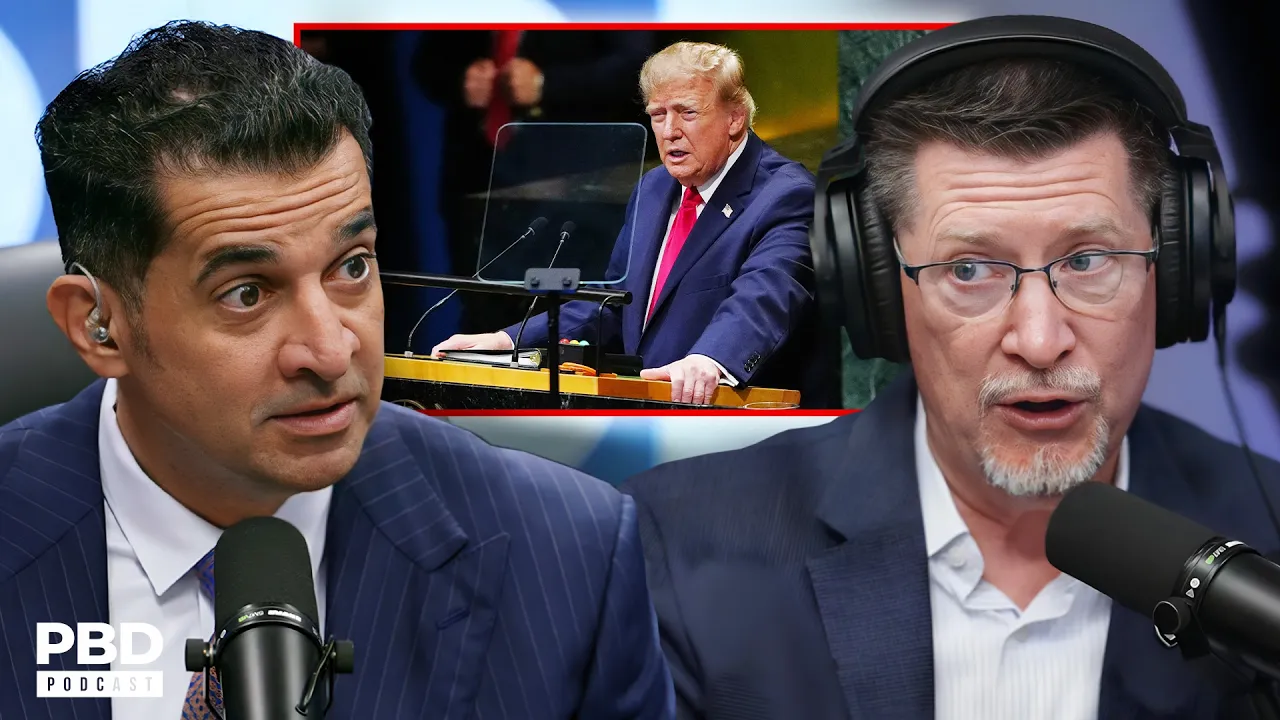
Trump Threatens Iran to Its Face at the UN
Valuetainment
4,714 views • 22 hours ago Save 17 min 5 min read
Video Summary
President Trump recently issued a stark ultimatum to Iranian leadership, publicly declaring his capacity to annihilate the Islamic Republic while simultaneously offering a path toward prosperity through a future deal. This confrontational stance, delivered alongside a rejection of the current election cycle's relevance to his foreign policy, signals a shift toward immediate, decisive action to prevent Iran from acquiring nuclear capabilities. By framing the regime's behavior as an existential threat that can no longer be ignored, the rhetoric emphasizes that the cost of inaction far outweighs the risks of confrontation.
Conversely, Iranian President Pazeshkian attempted to reframe the narrative by positioning Iran as a victim of Western-backed terrorism and historical grievances. However, observers argue this defense ignores decades of the regime's own internal suppression and proxy warfare. As the international community watches, the tension highlights a fundamental clash between democratic leaders seeking to dismantle Iranian influence and a regime accused of manipulating global institutions to shield its own survival.
Short Highlights
The video highlights several key claims and perspectives regarding the current U.S.-Iran conflict: * President Trump claims he has the power to destroy the Iranian regime but prefers a deal that could rebuild the nation. * Iranian President Pazeshkian portrays his country as a victim of U.S. and Israeli aggression, citing specific bombings. * Critics argue that the Iranian regime conveniently omits its own history of killing dissidents and suppressing its own population. * The U.N. is criticized as a failing institution that allows autocrats to lecture democracies. * Senator Marco Rubio and other officials emphasize that the U.S. President holds significant, independent power to act on national security regardless of political cycles. * The Iranian regime is accused of using stalling tactics to wait out the current U.S. administration. * Historical context is provided regarding the development of Michigan's demographics, linked to Henry Ford's labor practices.
Key Details
Trump's Ultimatum to Iran [0:00]
- President Trump addresses the Iranian leadership, stating he has the capability to annihilate the country but prefers a potential deal.
- He asserts that Iran's future depends on whether they choose to rebuild or face destruction.
Do I drive them into hell with no chance of survival?
Pazeshkian's Response [1:10]
- Iranian President Pazeshkian presents Iran as a victim of terrorism, specifically referencing the assassination of their supreme leader and the bombing of a school.
- Commentators argue this narrative ignores the regime's own history of violence against its citizens.
I come from an Iran in which our esteemed supreme leader was assassinated without any legal framework or reason.
Targeting Illegitimate Assets [2:45]
- Officials detail plans to freeze the regime's assets held in offshore accounts, such as those in the British Virgin Islands.
- The stated goal is to redirect these funds to the Iranian people or victims of terror.
We know where in the British Virgin Islands your accounts are at these trust companies. We know the $100 million houses you have around the world. And we are going to freeze those.
The Role of the U.N. [4:30]
- The United Nations is described as having lost its original purpose, becoming a platform for dictators to lecture democratic nations.
- Critics label the institution as a "banana republic" where human rights abusers hold influence.
Now, in 2026, you have dictators, autocrats, supreme leaders, thugs coming in, standing at the podium, and lecturing democracies about how they should be operating.
Avoiding Festering Problems [5:15]
- Trump emphasizes a policy of immediate action rather than allowing threats to grow over time.
- He explicitly rejects the authority of the International Criminal Court, calling it a rogue institution.
I do not believe in letting problems fester. They only become harder to solve. So while others have talked, I have acted.
The Ideological Divide [6:30]
- A distinction is drawn between rational actors like Russia or China and the Iranian regime, which is described as being driven by religious ideology.
- The discussion notes that the regime's long-term planning often relies on outlasting U.S. presidential terms.
These people are such ideologues that there's no negotiating.
Marco Rubio on Presidential Power [8:20]
- Senator Marco Rubio explains that the Iranian government fundamentally misreads the U.S. political system regarding executive power.
- He asserts that the President has extraordinary authority to act on national security, regardless of the political party in power.
In our system of government, obviously Congress, the legislative branch is a very important branch of government. I served in it for 14 years, so I understand its powers, but I also understand its limitations.
Historical Context of Michigan [9:30]
- The discussion explores how Henry Ford's labor practices led to the migration of workers from Yemen, Syria, and Lebanon to Michigan.
- This historical recruitment is cited as the reason for the establishment of the first mosques in the region.
He starts realizing he can recruit people from Yemen, from Lebanon, and from Syria. And the people that came from there, they did not want to be part of Union.