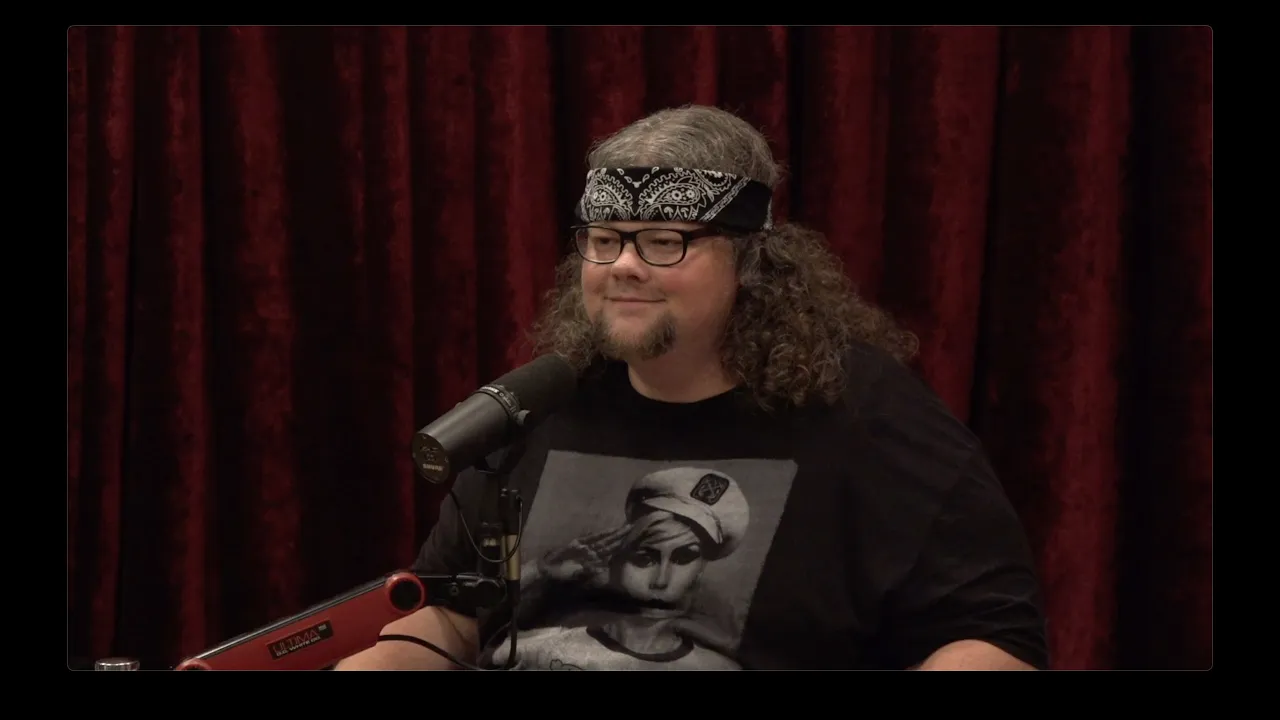
Joe Rogan Experience #2566 - Cody Tucker
PowerfulJRE
829,026 views • 6 days ago Save 155 min 10 min read
Video Summary
Cody Ko and Joe Rogan delve into a whirlwind of bizarre facts, historical oddities, and societal critiques. Rogan marvels at Ko's ability to consistently produce intriguing content, which Ko attributes to extensive reading and a penchant for following "rabbit holes." The conversation touches on unsettling topics like scopolamine, the "zombie drug" derived from anti-seasickness medication, and the disturbing history of Liberia, including the cannibalistic practices of "General Butt Naked." They also dissect the manipulation of pharmaceutical studies and the deceptive statistics used to market drugs.
The discussion pivots to the rampant lack of oversight in government and intelligence agencies, exemplified by a CIA official who stole $150 million by faking credentials. This leads to a broader examination of how easily deception can succeed in systems lacking accountability. The pair touch on the cultural impact of films like "Ex Machina" and "The Serpent and the Rainbow," exploring themes of AI, morality, and the human psyche. The conversation concludes with reflections on the nature of reality, the fear of death, and the human tendency to seek simplicity amidst chaos, as seen in the resurgence of country music and homesteading.
Short Highlights
- Ko explains his content creation process involves extensive reading and deep dives into obscure topics.
- The conversation touches on the drug scopolamine, its use in crime, and its connection to "zombie lore."
- They discuss the CIA's historical involvement in promoting abstract expressionist art as a form of propaganda.
- Rogan and Ko explore the lack of oversight in government and intelligence agencies, leading to significant fraud.
- The nature of reality, AI's potential, and human psychology are examined through film and personal anecdotes.
- They reflect on the human desire for simplicity and the appeal of country music and homesteading in uncertain times.
- The discussion touches on historical figures and their complex legacies, including Henry Ford and Mother Teresa.
Key Details
The Content Creation Engine [0:00]
- Joe Rogan expresses amazement at Cody Ko's ability to consistently produce unique and bizarre content.
- Ko attributes his output to extensive reading and a deep dive into various topics, describing it as a perpetual "rabbit hole."
"Dude, I read so much. And I'm a pretty quick reader. Like, I've always been very fast, like a good skimmer. And, yeah, I just, like, all day, every day. That's all I do."
The Zombie Drug and Criminal Exploitation [3:30]
- Ko introduces scopolamine, a deliriant drug also found in anti-seasickness medication like Dramamine.
- He recounts a story of a man in India using scopolamine to rob someone by touching the victim's neck, causing disorientation.
- The drug is referred to as "Devil's Breath" and is known for its use by criminals in Colombia to incapacitate victims.
"Scopolamine is a drug that is, I guess, it's in the class of deliriant. And if inhaled, you literally become like a prisoner to whoever gave you the drug. Like, you become like a zombie."
The CIA's Artful Propaganda [1:08:30]
- The conversation shifts to the CIA's involvement in promoting American abstract expressionism during the Cold War.
- The CIA funded the Congress for Cultural Freedom to advance an anti-Soviet agenda by showcasing American art as a symbol of freedom.
- Artists like Jackson Pollock and Mark Rothko became famous and valuable due to this covert promotion.
"The CIA secretly supported the international promotion of American abstract expressionism during the Cold War."
Deception in Pharmaceutical Studies [26:00]
- Ko discusses how pharmaceutical companies can manipulate studies to get drugs approved.
- He explains that only favorable study results are presented, and peer reviewers don't see the raw data.
- The concept of "100% effective" is explained through statistical manipulation, where fewer deaths in a treated group compared to a control group are presented as 100% effectiveness.
"So first of all, there's no transparency. So like, say if you have a drug that you want to release, you could do 10 studies and eight of them show this is complete bullshit."
The CIA's Internal Fraud [33:30]
- The discussion turns to a senior CIA official who stole $150 million by faking his credentials and military service.
- Rogan questions how such deception is possible within intelligence agencies.
- The official's lavish lifestyle, including luxury watches, cars, and real estate, is highlighted.
"So he faked a college degree and he faked his military service and got into the CIA and was a senior CIA official. How?"
The Paradox of Human Behavior [41:00]
- The conversation explores the idea of people being "house cats" who prefer comfort and routine over change.
- Ko expresses a strong aversion to change and a preference for the past, finding the future uncertain and anxiety-inducing.
- This leads to a discussion about the nature of consciousness, reality, and the possibility of living in a simulation.
"I like things to stay the exact same. I eat the same thing for breakfast. Wear the same clothes every day."
The Rise of AI and Its Implications [55:30]
- The film "Ex Machina" is discussed as a prescient depiction of AI's future capabilities and potential dangers.
- The film's themes of artificial intelligence, consciousness, and manipulation are explored.
- The current advancements in AI, like ChatGPT, are compared to the film's predictions.
"Because that was, I mean, it was like they predicted it brilliantly. Yeah. It's like her. That's a great one that kind of predicts, you know, how people have gone with their AI, you know, people developing relationships with their AI, like the chat GPT system or whatever."
The Problem of Bots and Manufactured Outrage [1:23:00]
- The prevalence of bots on social media and their role in manipulating public opinion is discussed.
- Ko shares an experience with a video about Henry Ford that was flooded with comments denying the Holocaust, suggesting a coordinated bot campaign.
- The difficulty in distinguishing between real users and bots, especially with sophisticated AI-generated profiles, is highlighted.
"So there's, like, levels of sophistication. And then eventually it's going to be ex machina type, you know, levels of sophistication where you're not going to be able to discern whether or not it's a real person commenting or not."
The Simplification Trend [2:12:00]
- The resurgence of country music and homesteading is linked to a societal desire for simplicity amidst growing uncertainty and technological advancement.
- People are seeking a more straightforward, less anxious existence, as exemplified by the themes in country music and the appeal of shows like "Yellowstone."
"It's because people want to be by the river with a pickup truck and just having a good time and praising Jesus, and they want simplicity."
The Nature of Performance and Charisma [2:30:00]
- The discussion touches on the entertaining aspect of preaching and how charisma plays a role in captivating an audience.
- This leads to a comparison between preachers like Jimmy Swaggart and entertainers like Jerry Lee Lewis, highlighting their shared "stage presence" and "dark sides."
"Churches, if someone's a good preacher, they're entertaining. Yes. That's part of it. Part of it is your charisma."
The Complexities of Human Morality [2:20:00]
- The conversation delves into the morally ambiguous legacies of celebrated figures like Henry Ford and Mother Teresa.
- Ko reveals Mother Teresa's alleged practice of hoarding donations while neglecting the sick in her care, believing suffering brought people closer to God.
"She basically just had a giant concrete storage room that she would put sick people in and donate and give all the money that was being donated to her to the Vatican."
The Art Market as a Scheme [2:25:00]
- The astronomical prices of modern art are questioned, with suggestions that it serves as a vehicle for money laundering.
- The CIA's historical role in promoting abstract expressionism is revisited as an example of art's use in propaganda and financial schemes.
"It is an interesting way to launder money, right? And they do it. I mean, like, there's no, like, what's to make a painting, you know, like 70 million and then one from an artist you've never heard of sells for like 35 million."
The Human Brain's Pattern Recognition [2:45:00]
- The discussion explores how the human brain's tendency to find patterns can lead to misinterpretations and even false memories.
- Optical illusions are used as an example of how the brain can trick itself, connecting this to the tendency to connect unrelated dots in historical narratives.
"It's because your brain is trying, in there somewhere to establish a pattern. What was that one that we looked at the other day, Jamie, where they look like two different colors until you put your fingers over the line in between them, and then they all of a sudden become one color?"
The CIA's Influence on Culture [2:50:00]
- The conversation touches on the CIA's alleged involvement in shaping cultural movements, including the hippie movement and hip-hop.
- The potential for intelligence agencies to influence societal trends and artistic expression is explored.
"Well, with the hippie movement, too, there is evidence that they were, you know, helping to stage protests and, like, organized protests."
The Unpredictability of Talent [3:05:00]
- The discussion shifts to music, questioning whether talent can be engineered or if it arises organically.
- Oliver Anthony's independent success is contrasted with the gatekeeping of the music industry in previous eras.
- The debate arises on whether modern music is too polished and lacks the imperfections that make older music compelling.
"But the thing is, though, is that you are very limited by the hardware. The hardware choices are only this one company. Whereas with Android, you can get all kinds of crazy shit."
The Fear of the Future and the Comfort of Routine [50:00]
- Ko expresses a deep-seated fear of the future and a strong preference for the past and routine.
- He admits to being a "creature of comfort" who dislikes change, preferring predictability in his daily life.
- This aversion to change and the future is linked to his anxiety and the need for constant distraction.
"I like things to stay the exact same. I eat the same thing for breakfast. Wear the same clothes every day."
The Struggle with Personal Habits [3:20:00]
- Rogan and Ko discuss their personal struggles with diet, alcohol, and exercise.
- Ko admits to being a "glutton" and having difficulty with moderation, while Rogan shares his experience with quitting drinking and the challenges of maintaining a healthy lifestyle.
"I eat so much. I'll eat, like, two, like, two entrees. Like, I'll have, like, two steaks. I'll have a steak. I'll have a big plate of pasta. I'll eat a bunch of appetizers."
The Role of Oversight and Accountability [30:00]
- The conversation highlights the critical lack of oversight in various institutions, from government agencies to pharmaceutical companies.
- This absence of accountability allows for fraud, deception, and manipulation to thrive.
- The idea of "manufactured outrage" and the creation of fake online personas to influence public opinion are also discussed.
"The problem is, is a lot of these jobs don't need to exist. That's one of the weird statistics about California. When California is experiencing this mass exodus, its government grew substantially. Substantially."