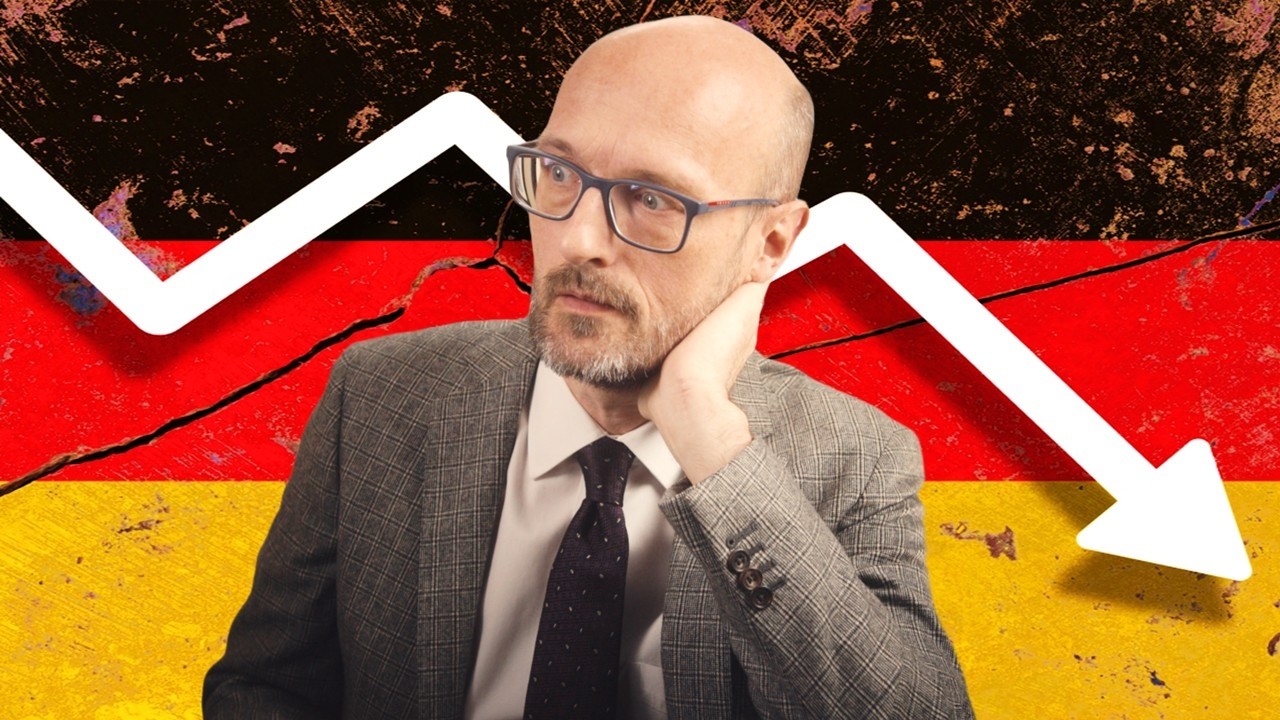
Why Germany Stopped Working
Patrick Boyle
987,557 views • yesterday Save 28 min 4 min read
Video Summary
Germany’s attempt to revitalize its crumbling infrastructure with a massive trillion-euro investment has stalled, revealing a deep-seated institutional paralysis that transcends simple fiscal policy. Despite suspending its constitutional "debt break" to fund critical repairs, the government has struggled to deploy these funds, with much of the money remaining unspent or diverted to routine operating costs. This failure highlights a systemic "second break"—an entrenched culture of extreme risk aversion and bureaucratic rigidity that prioritizes process over progress, leaving vital projects like bridge repairs and rail upgrades trapped in endless tender cycles.
While Germany clings to its legacy as a manufacturing powerhouse, its rigid adherence to past successes—such as mechanical engineering and traditional industrial models—has left it ill-equipped for the digital era. This "Smith Corona" problem, where nations protect outdated industries at the expense of innovation, mirrors a broader global trap where successful institutions prioritize stability over necessary evolution. As Germany grapples with this internal inertia, the stakes rise; failing to modernize risks not just economic stagnation, but the erosion of the very social and political stability that once defined its strength.
Short Highlights
Germany's failure to modernize its infrastructure despite massive funding stems from deep-seated institutional inertia rather than a lack of capital.
Related Video Summary
Key Details
The Illusion of Spending [0:00]
- Germany committed to borrowing nearly a trillion euros to address infrastructure decay and defense needs.
- Despite this, the most visible sign of the investment in Berlin was traffic cones and stalled construction sites.
- "While Germany had finally agreed to spend enormous sums fixing itself, the only thing it managed to build was a construction site with no actual construction."
The Hidden Second Break [1:30]
- Beyond the constitutional debt break, Germany faces a "second break"—an unlegislated, systemic culture of extreme risk aversion.
- This invisible constraint prevents the deployment of funds even after the legal barriers to borrowing were removed.
- "Germany took off the enormous break that everyone could see, the constitutional debt break, the one that made all the headlines and found a second break underneath it."
Crumbling Foundations [2:15]
- Decades of underinvestment meant spending failed to cover the depreciation of existing assets, leaving thousands of bridges in urgent need of repair.
- The collapse of the Carolabrücke in Dresden highlighted the physical consequences of this long-term fiscal neglect.
- "A section of the Corolla Bridge collapsed into the Elba River overnight. Fortunately, the last tram had crossed safely just minutes before."
Bureaucratic Gridlock [3:30]
- Legal requirements force large infrastructure projects to be carved into small, individual lots, necessitating multiple separate tenders.
- This "fairness" mandate creates a fragile process where a single delay or appeal can freeze an entire project.
- "The reason those barriers went up in Berlin with no construction behind them is a legal requirement in Germany that forces public authorities to carve big infrastructure projects into small individual lots."
The Limits of the German Model [6:00]
- Germany’s vocational training excels at mechanical engineering but struggles to adapt to software-driven, iterative product development.
- The reliance on traditional manufacturing expertise makes it difficult to pivot toward the modern, digital-first economy.
- "The trouble is that the world moved on to products where that relationship runs the other way. In a modern car, the machine serves the software."
The Smith Corona Problem [8:15]
- Germany exhibits a "Smith Corona" problem, clinging to legacy technologies and companies long after the market has shifted.
- The country’s attachment to outdated tools, such as the fax machine, reflects a broader desire for stability and permanence over rapid innovation.
- "The logic behind it is airtight, but the attachment to it just happens to describe a country that has decided to keep living in 1994."
Contrasting Economic Pathologies [10:00]
- While Germany suffers from institutional sclerosis and underinvestment, the United States displays a tendency toward speculative mania.
- American investors are pouring billions into "moonshot" projects with little traditional valuation, driven by fear of missing out.
- "One country is so frightened of a mistake that it won't resurface a road after parliament has already handed over the cash. The other is so relaxed about mistakes that it'll hand 65 million dollars to a man who wants to bounce sunlight around in space."
The Cost of Success [12:00]
- Every mature economy eventually drifts toward failure aversion as institutions prioritize protecting their existing status.
- Germany’s current struggle serves as a warning that manufacturing prowess is not a permanent shield against economic decline.
- "Every mature, successful economy drifts towards failure aversion, eventually. It's a natural byproduct of doing well."