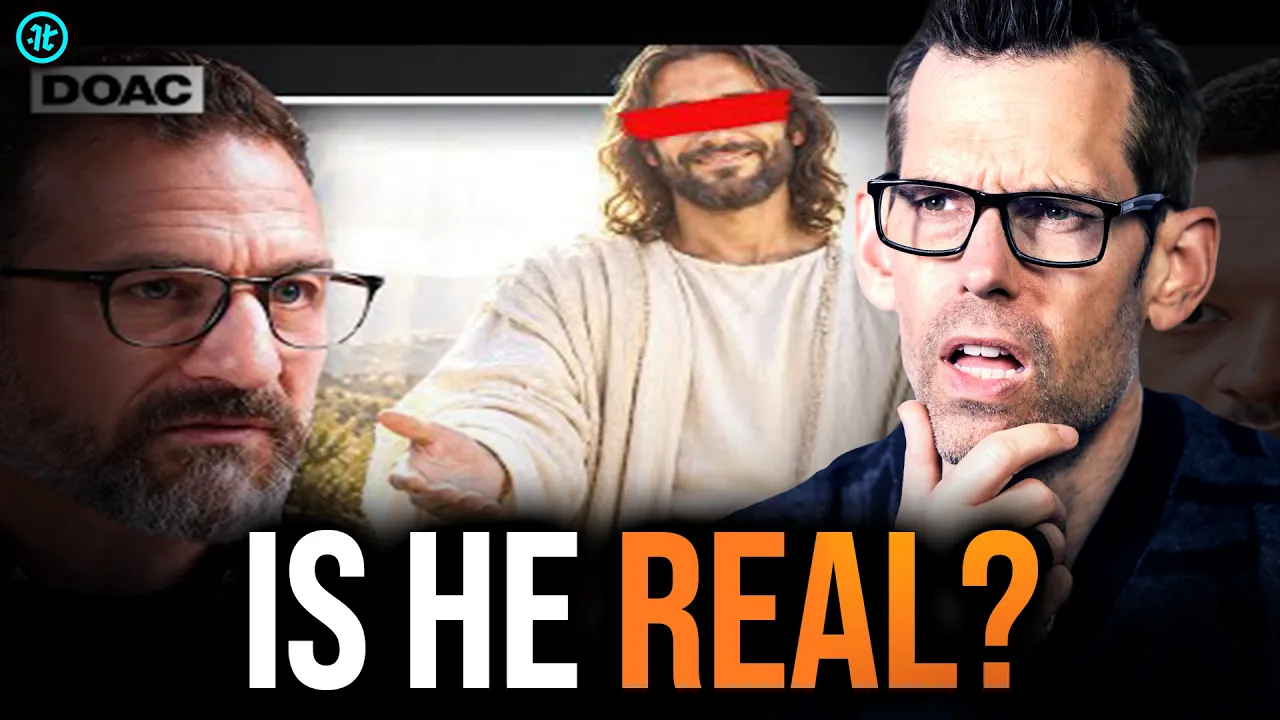
If You Think God Isn't Real, You Need To See This
Tom Bilyeu
28,302 views • yesterday Save 39 min 11 min read
Video Summary
The conversation delves into the nature of reality, consciousness, and the human experience, questioning whether our perception is a biological construct or something more profound. One speaker recounts a profound DMT experience that made them question the material world, leading to the conclusion that our reality is a "biological experience" shaped by neurochemistry and sensory limitations. This perspective suggests that emotions, often mistaken for truth, are merely chemical firings, and that mistaking this biological simulation for objective reality can lead to societal problems.
The discussion then explores the evolutionary role of religion and spirituality, positing that the human need to connect with something larger than oneself is a biological imperative that fosters cooperation. While acknowledging the power of faith and prayer to bring peace and improve well-being, the speakers emphasize that these experiences are still rooted in biological processes. They caution against fundamentalist interpretations of religious texts and highlight the importance of understanding the biological underpinnings of our perceptions to avoid being misled by subjective interpretations presented as objective truth.
Short Highlights
- Our perception of reality is a biological experience, a simulation constructed by our brains based on sensory input and neurochemistry.
- Emotions are neurochemical firings, not necessarily representations of truth, and mistaking them for truth can lead to flawed decision-making.
- Religion and spirituality may have an evolutionary basis, fulfilling a human need to connect with something larger than oneself and fostering cooperation.
- While faith and prayer can be beneficial, they are still rooted in biological processes and influence our neurochemistry.
- Understanding the biological mechanisms behind our experiences is crucial to avoid misinterpreting subjective reality as objective truth.
- Miracles are not outside the physical realm but rather phenomena we don't yet understand within the laws of physics.
- The human experience is a complex interplay of beauty and tragedy, with both positive and negative drives embedded in our biology.
Key Details
The Nature of Reality: A Biological Experience [00:00:00]
- The central question is about the right frame of reference for living a good life, touching on the reality of God and life's surprises.
- A "lost perspective" arises when people misunderstand the things life presents them.
-
"And if you fail to understand that, you will live your life in a lost perspective."
Psychedelics and Mental Health [00:01:15]
- The speaker discusses having taken psilocybin and DMT, motivated by their efficacy in mental health treatment and studies from London.
- The clinical data on psilocybin and ibogaine for various conditions is described as unbelievable.
-
"And I just thought, wow, you know, it's unbelievable, some of the clinical data."
Caution with Psychedelics and Interpreting Experiences [00:02:30]
- Caution is advised regarding substances that alter the mind, with disregard for their potential effects on the brain.
- A key issue is the inability to replicate insights gained from these substances.
-
"And arguably the most important part of this is they somehow believe that they have transcended their biology."
Neurochemistry vs. Transcendence [00:03:10]
- The interpretation of a psychedelic experience as transcending biology is questioned, as it's a direct manipulation of neurochemistry.
- The speaker finds it "super wild" that people manipulate neurochemistry only to conclude that neurochemistry doesn't matter.
-
"From a cause and effect perspective, what you're doing is manipulating your neurochemistry."
Hesitation and Fear of Psychedelic Experiences [00:04:45]
- Tom expresses hesitation towards extreme psychedelic doses due to fears about extreme effects on the brain.
- He mentions the possibility of doing them but is not rushing into it.
-
"But yeah, I could see. I think it's probably more likely that I do it at some point than I don't."
The Lingering Effects of Psychedelics [00:05:30]
- A story is shared about someone who felt LSD or acid altered their sense of reality for a week, leading to nihilism.
- The scary prospect of such a profound alteration, especially with potential psychotic breaks from substances like marijuana, is highlighted.
-
"He said, life doesn't feel real. And he was like, if I feel like this forever, he's like, this is a real problem."
Set and Setting: Context Matters [00:07:30]
- Terrence McKenna's emphasis on "set and setting" (how and where you take it) is discussed.
- The context informs the experience, turning a potentially good trip into a bad one.
-
"You know why? Why? Because you're having a biological experience."
DMT and the Nature of Material Reality [00:09:00]
- A DMT experience led one speaker to ponder religion and the idea that a small inhale of smoke could change material reality.
- The conclusion drawn is that material reality is a result of a "small amount of chemicals" or neurochemical and electrical combinations.
-
"So therefore I concluded that my material reality is literally, I mean, tell me if my logic's wrong, is a small amount of chemicals."
Living in the Matrix: Biological Construction of Reality [00:10:00]
- Our entire reality is a neurochemical and electrical combination, a representation created by the brain.
- We only perceive a tiny fraction of the electromagnetic spectrum, relying on shortcuts and algorithms.
-
"So you're living in the matrix, whether you live in the matrix simply because the brain exists and it is creating a representation of the world out there."
Biology as the Foundation of Experience [00:11:30]
- The core message is: "You are having a biological experience."
- Divorcing oneself from this biological reality makes life impossible to navigate.
-
"And when people start trying to divorce themselves from that, they make their life entirely impossible to navigate."
Emotions vs. Truth and Biological Experience [00:12:15]
- People often mistake emotions (neurochemical firings) for truth, leading to flawed reasoning and damaged relationships.
- The speaker emphasizes this is a biological, not spiritual, phenomenon.
-
"They mistake their emotions, which are merely the neurochemical firings in their brain. They mistake it for a representation of truth."
The Evolutionary Role of Religion and Awe [00:14:00]
- The need to "kneel before something" and the evolutionary role of religion are fascinating biological phenomena.
- Viewing these through a biological lens is more profound than divorcing them from biology.
-
"It is utterly fascinating to me that we all have the need to kneel before something."
Biology as Compartmentalized Chemistry [00:16:00]
- Most of biology is compartmentalized chemistry, including neural circuits for tenacity and learning.
- The mind influences itself, and conscious control over thoughts is critical.
-
"In a non-dismissive way, most all of biology is just compartmentalized chemistry."
Mechanical and Chemical Forces Shaping Brain Function [00:17:30]
- Brain function can be changed through mechanical means (e.g., breathing, massage) and chemical means (pharmacology, internal chemicals).
- Diaphragmatic breathing is highlighted as a powerful tool to shift from fight-or-flight to rest-and-digest states.
-
"There are two ways that you can change brain function, behavior and chemistry."
The Limits of Biology and Psychology [00:20:30]
- While biology and psychology are powerful, they have limitations in satisfying certain human needs.
- The speaker is intrigued by things outside conscious understanding, accessed through psychedelics, prayer, or faith.
-
"But there are certain things that are outside the abilities of our psychology and biology."
Religion as an Evolutionary Mechanism for Cooperation [00:21:30]
- Religion evolved as a mechanism for humans to cooperate in large groups.
- It created a reward for communing with perceived forces beyond ourselves, leading to more stable societies.
-
"And that answer is what we call religion."
The Evolutionary Roots of Religious Interpretation [00:23:00]
- Early humans interpreted natural phenomena through a pantheon of gods due to a lack of understanding of physics.
- This evolutionary mechanism of interpreting the world through a "shortcut" persists, leading to a feeling that there's "something bigger than me."
-
"And so that from an evolutionary standpoint, the people that had that big response and shared that response and started doing things like, no, there's a right time to go on a hunt because that's when the god of the hunt wants us to go on that."
Physics as a Higher Power and the Dangers of Dogma [00:25:00]
- Understanding the fundamental physics of the universe can unlock powers and abilities.
- However, religious dogma, written in books, can lead to problematic interpretations (e.g., slavery).
-
"So it is a very real thing. Now, when people hold that frame, I think that they're less likely to get themselves in trouble than when they take the shortcut and they take a religious frame."
Miracles: Unexplained Science, Not Supernatural Events [00:28:30]
- The speaker asserts there have been no true miracles; only phenomena we don't yet understand through science.
- The only "miracle" is why something exists instead of nothing.
-
"There's never been a miracle in life. Never once."
Faith, Doubt, and the Human Brain [00:32:00]
- Embracing faith in God can be useful and liberating, offering a different perspective on the human brain.
- The speaker's experience with prayer and observing hardship led to a realization that "we're not all meat and potatoes in there."
-
"I really want to know what God does thou believe in?"
Determinism, Biology, and the Limits of Logic [00:34:00]
- The deterministic nature of life and the complexity of systems challenge the idea of pure randomness.
- The brain's control over life and perception is undeniable, yet some believe it's not "all biology."
-
"So yeah, what we see is cause and effect as far as the eye can see."
Quantum Mechanics and the Limits of Human Understanding [00:36:30]
- Understanding quantum mechanics requires relying on math, as the human brain cannot fully grasp it logically.
- The term "quantum" is often misused to imply magic, but it's based on mathematical proofs.
-
"And he says, anyone who talks about the quantum field who can't show you the math, can't show you the proofs is lying."
The Decision to Believe: Friendly or Hostile Universe [00:40:00]
- The most important decision is whether to view the universe as friendly or hostile.
- This decision influences our biology and the quality of our lives.
-
"The most important decision any person will ever make is whether they live in a friendly or a hostile universe."
The Subconscious Mind and "Miracles" [00:43:00]
- Apparent "miracles" or answers to prayers are often the subconscious mind processing information in the background.
- New stimuli can trigger cascades of thoughts, leading to solutions that feel divinely inspired.
-
"But the reality is what's happening in the subconscious mind is we are a action reaction species."
Interdisciplinary Connections and Problem-Solving [00:44:30]
- Polymaths excel by drawing from multiple disciplines, allowing ideas to feed into each other.
- This cross-pollination of ideas can lead to novel solutions and insights.
-
"So having those different points of interaction will feel like, oh my God, I've been handed this thing from out of nowhere, but it's really, that's what your brain does."
Meditation and Brain Connectivity [00:45:30]
- Meditation can induce a calm, creative state where normally disconnected brain areas begin to communicate.
- This increased connectivity, rather than silencing activity, enhances the brain's processing power.
-
"What's going on in the brain is areas of the brain that don't normally talk to each other start talking to each other."
Prayer, Faith, and Biological Experience [00:47:00]
- Prayer and faith, even with doubt, can be liberating and educate us about the human brain.
- The Stanford neuroscientist's work shows that stimulating brain areas can alter perception, reinforcing the idea of a biological experience.
-
"The reason I did that talk is because our former director of neurosciences at Stanford had written to me and said, I think you should consider talking to this group."
The Brain as a Reality Constructor [00:49:00]
- Our understanding of the world is an abstraction created within our skull based on sensory input.
- This constructed reality is an approximation, making us susceptible to being "lied to" like in "The Matrix."
-
"Your understanding of the world is an abstraction that occurs inside your skull on the basis of photons that come in through your eyes."
The Dangers of Mistaking Simulation for Reality [00:50:30]
- In the current era, people mistake their internal simulations and interpretations for objective reality.
- This is being "weaponized" against them, with those who understand this control the approximation to benefit themselves.
-
"We are living in a time right now where everybody is convinced that that matrix, that simulation that's going on inside their brain is real."
Biology's Role in In-Group/Out-Group Dynamics [00:53:00]
- Biology dictates in-group/out-group dynamics, preparing us to be violent and dehumanize others.
- Altering this biology is necessary to overcome these tendencies and move past societal conflicts.
-
"It paints things like in-group, out-group. It makes you prepared to be violent and to other people that are in the out-group to dehumanize them."
Grand Design vs. Natural Evolution: A Biological Critique [00:55:00]
- The concept of a "Grand Design" by God is critiqued for its "terrible engineering," citing childbirth as an example of poor design with high mortality rates.
- Natural evolution, or the "blind watchmaker," is presented as a more plausible explanation.
-
"So if Grand Design is basically God did this, so we're a product of evolution, yes, but we're a product of a designer, I would say there's no evidence for that."