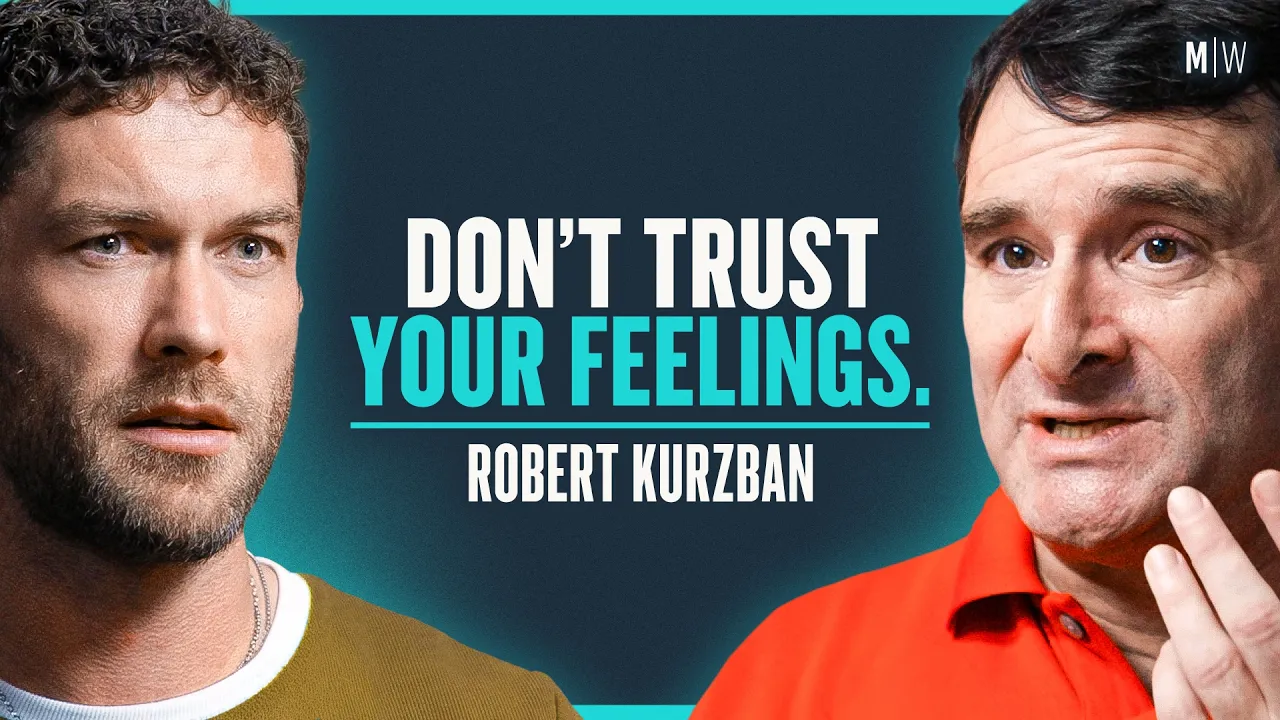
35 Emotions Explained By Evolutionary Psychology - Rob Kurzban
Chris Williamson
525 views • 16 hours ago Save 137 min 11 min read
Video Summary
Evolutionary psychology offers a powerful lens for understanding why we feel emotions, suggesting they are not arbitrary but evolved mechanisms designed to measure and motivate adaptive behaviors. This perspective posits that feelings, from hunger to jealousy, serve crucial functions, acting as internal measurement systems that guide our actions toward survival and reproduction.
The speaker explores how emotions function as a "common currency" in complex organisms, helping to prioritize competing motivations. For instance, the subjective experience of fear or hunger allows us to weigh different needs and make decisions. This evolutionary framework also sheds light on why unpleasant feelings, like pain, are essential for signaling danger and prompting necessary actions, while pleasant feelings encourage beneficial behaviors. The discussion delves into specific emotions like envy, anger, disgust, and anxiety, explaining their potential adaptive roots and how they can become misaligned or overactive in the modern world, leading to maladaptive outcomes.
Short Highlights
- Emotions are evolved mechanisms for survival and motivation.
- Feelings act as a "common currency" to prioritize competing needs.
- Unpleasant emotions signal danger, while pleasant ones encourage beneficial actions.
- Modern environments can cause emotions to become misaligned or overactive.
- Understanding the evolutionary function of emotions can help manage them.
Key Details
The Evolutionary Purpose of Feelings [00:00:00]
- Emotions are fundamental to human motivation and behavior.
- Evolutionary psychology provides a framework for understanding the origins and functions of feelings.
- Feelings like hunger, arousal, and jealousy drive actions essential for survival and reproduction.
"So for me, feelings are everything, right? So our motivations basically come from where we feel."
The Evolutionary Lens on Human Behavior [00:01:00]
- Humans, as animals, are subject to evolutionary history and natural selection.
- Applying evolutionary theory to human behavior is crucial for understanding why we do what we do.
- The brain's complexity is understood by asking what it is designed to achieve.
"If you want to explain and understand the behavior of any organism, I mean, it'd be weird to study an ape or a mongoose without the theory of evolution by natural selection."
The Phenomenology of Feelings [00:02:00]
- The subjective experience of emotions, or "phenomenology," is a puzzle.
- Unlike a thermometer detecting heat, brains generate feelings, a process not fully understood.
- Artificial systems like Waymo can function without subjective experience, highlighting biology's unique approach.
"Why do feelings need to feel like anything at all? It's not obvious that there needs to be a phenomenology to stuff."
Emotions as a Decision-Making Arbiter [00:03:00]
- Complex organisms face competing motivations (e.g., fear vs. hunger).
- Emotions provide a "common currency" to weigh the intensity of different feelings and prioritize actions.
- This system helps organisms triage priorities for survival and reproduction.
"So maybe the sense that we have is like a way to figure out of all the different things that we're kind of motivated, which one should I do right now?"
Measuring and Motivating Emotions [00:04:00]
- Emotions involve both measurement (detecting internal states or external cues) and motivation (driving action).
- This "measure-motivate" system applies to all feelings, from basic needs to complex social emotions.
- Adaptively relevant information must lead to behavioral change to be useful.
"Emotions measure something in the body or outside the world, which is going to be adaptively relevant, and then get you to do something."
Misunderstanding Emotional Measurement [00:06:00]
- Modern life can lead to misinterpreting what emotions are measuring.
- Social media, for instance, can trigger envy systems with unrealistic comparisons.
- Anger from traffic incidents, while once useful for deterrence, is often now misdirected.
"So your envy system is like an overdrive, being fooled into thinking that, you know, it would be a good idea for you to try to get what they have."
The Adaptive Role of Unpleasant Feelings [00:07:00]
- Unpleasant feelings are often necessary to motivate adaptive actions.
- People lacking the sensation of pain have significantly shorter lifespans due to not avoiding harm.
- The negative feeling associated with pain or other unpleasant emotions is a crucial part of the survival system.
"If you didn't hate having your hand in a fire, you wouldn't take your hand out of it."
Body Maintenance Emotions: Itchiness [00:08:00]
- Itchiness serves as a defense mechanism against parasites and irritants on the skin.
- The sensation compels scratching, which can remove harmful organisms.
- Itchiness can be socially transmitted, potentially signaling environmental hazards.
"And so you have to have little defense systems. And so there's like an interesting kind of way in which, um, you need to defend yourself against, you know, all the things that are coming to eat you or, um, exploit you in some way."
The Mystery of Yawning [00:10:00]
- Yawning is a complex behavior with multiple proposed explanations, including social transmission and oxygen intake.
- Research is still needed to fully understand its adaptive function.
- The speaker humorously calls for more funding for yawning research.
"I will say this, we know other critters do it. So it's not just a human thing."
The Adaptive Problem of Pooping [00:11:00]
- The need to defecate involves sensory systems measuring pressure and motivating the act.
- Optimal pooping involves finding a safe, private time and place to avoid leaving evidence that attracts parasites.
- Latrine behavior in many species, including humans, reflects this adaptive problem.
"So you want to kind of poop when it's necessary, but not more often."
Nausea as a Parasite Defense [00:13:00]
- Nausea motivates vomiting, which can expel parasites and toxins from the digestive system.
- Motion sickness, which can trigger nausea, may be linked to sensory mismatches that signal potential poisoning.
- This system helps protect the body from ingested harmful substances.
"And the nice thing about throwing up or vomiting is that if you do have a lot of parasites in your, um, digestive system, that gets them out."
Disgust and Pathogen Avoidance [00:15:00]
- Disgust is a defense mechanism against pathogens, particularly at vulnerable body openings.
- It measures the risk of pathogen presence, motivating avoidance or expulsion.
- The physical disgust reaction, like the tongue movement, may be an ancient expulsion reflex.
"The smell of feces, right? That's where the organisms, like little maggots, like that's a really good indication that there's some kind of parasites in there."
Sexual Disgust and Kin Recognition [00:16:00]
- Sexual disgust can prevent mating with closely related individuals (Westermark effect).
- This mechanism ensures genetic diversity and avoids the risks of inbreeding.
- Cultural practices like arranged marriages can reinforce this aversion, even without genetic relation.
"So the main... Oh, Westermark. Yeah, the Westermark stuff, right? So people who were raised with someone, they find just the idea of sex with them, and this is Deb Lieberman's work, excellent research on this."
Claustrophobia and Prospect/Refuge [00:18:00]
- Claustrophobia may stem from an evolved need for "prospect and refuge" – the ability to see threats and escape.
- Enclosed, dark spaces lack these elements, triggering fear.
- The preference for expansive vistas over confined views aligns with this adaptive need for situational awareness.
"You should be afraid of enclosed spaces because you don't have so-called prospect and refuge, right? The best place to be."
The Adaptive Value of Fun and Excitement [00:23:00]
- Fun and excitement often involve practicing skills or learning in safe environments.
- These activities are evolutionarily rewarded to encourage skill development for hunting, warfare, or social coordination.
- Dancing and games may serve these training and social bonding functions.
"So fun is evolution's way of saying, yes, this is a good thing for you to do and do more of that, keep doing it."
Music, Mating, and Supernormal Stimuli [00:24:00]
- Music production can signal intelligence, creativity, and taste, potentially serving as a form of sexual signaling.
- The intense reactions to musicians can be seen as a "super normal stimulus," an exaggerated version of what typically attracts mates.
- This also relates to pornography and sex toys, which can create "super normal stimuli" by exceeding natural levels of stimulation.
"So you can't make beautiful music unless you are, you know, you have really good, you have to be smart. You have to be creative."
Spiciness: Pathogen Defense and Palatability [00:26:00]
- Spices may have evolved as a defense against pathogens in food, especially in warmer climates.
- While a little spice can be beneficial, excessive heat becomes painful, indicating potential harm.
- The enjoyment of spice involves finding a balance between benefit and pain, similar to enjoying a roller coaster.
"So spices probably are important for, they all going back to pathogens. They seem to have some role in suppressing pathogens."
Contempt and Resentment: Social Navigation [00:28:00]
- Contempt signals that an individual is unworthy of affiliation due to their low status or past actions.
- Resentment arises from perceived unfairness or violations of exchange principles, often motivating social attacks.
- These emotions help navigate social hierarchies and enforce norms.
"Contempt is sort of saying, look, I have a limited amount of time in my day. I have a limited amount of time in my life. I have a limited number of friendship slots."
Embarrassment, Shame, and Guilt: Social Norms [00:29:00]
- Embarrassment signals a violation of social norms, often involuntarily (e.g., blushing), to show awareness and intention to correct.
- Shame involves a perceived loss of social value due to norm violations, sometimes even when not directly at fault.
- Guilt relates to past behavior and the desire to repair harm.
"Embarrassment seems to be measuring something like, did I just violate some social norm?"
Mental Effort and Boredom: Self-Monitoring [00:31:00]
- The negative feeling of mental effort signals opportunity costs – that cognitive resources could be used for more beneficial tasks.
- Boredom arises when current activities are unrewarding, prompting a search for more engaging pursuits.
- These feelings involve the mind monitoring and regulating its own activity.
"Effort is the felt sensation of, is there something else I could be doing right now with those, not physically, but with those mental systems that would be more beneficial to me."
Jealousy of Friends and Childhood Allegiances [00:33:00]
- Jealousy can extend beyond romantic relationships to friendships, particularly in childhood.
- Children may feel jealous of friends forming new alliances due to their greater dependence and less developed strategic thinking.
- This highlights the importance of social bonds and the fear of losing support.
"I remember feeling that as a kid. Yeah. I remember that as a kid too. Like I was, you would even bar you say, I'll be your best friend."
Deja Vu and Nostalgia: Temporal Anomalies [00:34:00]
- Deja vu, the feeling of having experienced something before, is considered strange and likely a side effect of cognitive processes.
- Nostalgia, a longing for the past, also lacks a clear, immediate adaptive function, possibly being a byproduct of memory systems.
- Many emotions remain mysterious and under-researched.
"Deja vu, I think is pretty weird. Like the sense that you, you know, that you've seen something before that you definitely haven't."
Envy and Moral Condemnation: Modern Havoc [00:35:00]
- Envy and moral condemnation are identified as emotions causing significant havoc in modern life.
- Envy is exacerbated by constant exposure to others' successes via social media.
- Moral condemnation is fueled by a desire to attack others, often for personal gain or social conformity.
"Envy. Almost without a doubt. I think, I don't, I mean, I don't know. I mean, there's probably other ones too."
Trust as a Societal Fulcrum [00:36:00]
- Trust is fundamental to societal function, enabling coordination and transactions.
- Societies with high trust, like Japan, require less top-down enforcement.
- Immigration discussions often center on trust and cultural norms, highlighting its crucial role.
"So yeah, trust's fundamental. I think it's fundamental."
Integrating Emotions: Acceptance and Function [00:39:00]
- Accepting that emotions arise naturally, without judgment, is key to managing them.
- Understanding an emotion's evolutionary purpose ("what is it trying to get me to do and why?") helps assess its current utility.
- This perspective encourages a more compassionate relationship with one's own feelings.
"So I think that's sort of the, the thing is to come just to terms with, yeah, I'm just going to feel those."
The Modular Mind and Emotional Acceptance [00:41:00]
- The evolutionary view of the mind as modular, with different emotional systems, aligns with accepting diverse feelings.
- Welcoming all emotions, even those that seem inconvenient or negative, can reduce self-judgment.
- This approach fosters a more integrated and less conflicted emotional life.
"And I also think that resonates with this kind of approach to emotions like, oh, there's these different modular emotional systems and they're going to get in there when I'm trying to just be, and I'm going to be like, oh, actually it's kind of, okay."