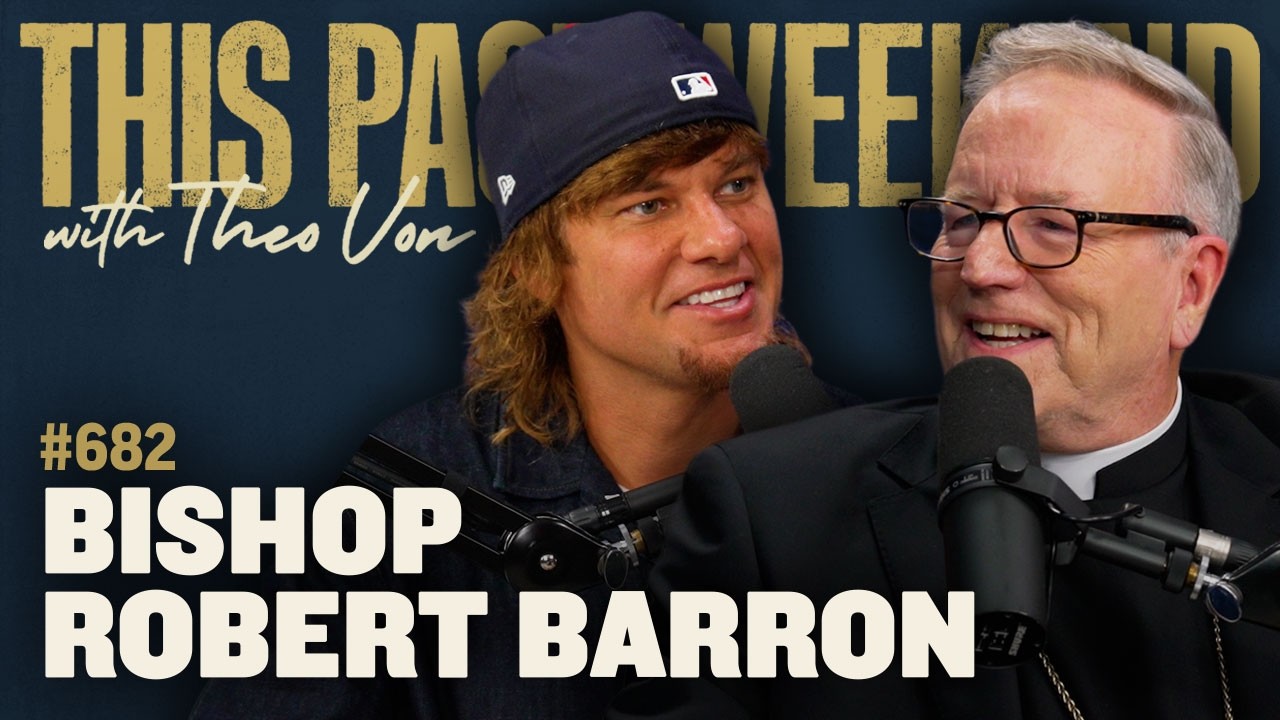
Bishop Robert Barron | This Past Weekend w/ Theo Von #682
Theo Von
873,602 views • 3 days ago Save 100 min 11 min read
Video Summary
Bishop Robert Barron, a leading voice in the Catholic faith and founder of Word on Fire Ministries, discusses his unexpected appointment as a bishop, his early jobs, and the profound impact of Thomas Merton's "The Seventh Story Mountain." He offers a philosophical definition of God as the "uncaused cause" and explains that evil is a "lack of being" rather than a direct creation of God. Barron emphasizes the importance of prayer, particularly the "holy hour," and the honesty required in one's relationship with God, highlighting confession as a sacrament of healing and spiritual health. He touches upon the concept of grace as a "free gift" and the nature of selfless love, exemplified by the story of St. Maximilian Kolbe. The conversation delves into the challenges of modern life, the loss of purpose, the dangers of technology and social media, and the church's role in spiritual warfare and fostering connection. Barron advocates for a "transcendent third" in relationships and highlights the importance of initiation rituals, while also addressing contemporary issues like pornography, artificial intelligence, and the church's stance on political matters and the state of Israel.
Short Highlights
- Divine Calling and Unexpected Appointments: Bishop Barron recounts how his appointments as bishop came as complete surprises, emphasizing that such roles are chosen by the Pope, not sought after by individuals.
- The Nature of God and Evil: God is defined as the "uncaused cause" and the reason for existence, while evil is understood as a "lack of being" or a privation, not a direct creation.
- The Practice of Prayer and Honesty: Barron stresses the importance of dedicating time to prayer, suggesting a "holy hour" and advocating for complete honesty with God, as He already knows everything.
- The Power of Selfless Love: Drawing on examples like St. Maximilian Kolbe, he illustrates selfless love as willing the good of the other, a concept central to God's nature and the ideal for human relationships.
- Navigating Modern Spiritual Crises: The discussion addresses the modern sense of being lost, the impact of technology and social media, and the need for spiritual direction and community.
- The "Transcendent Third" Principle: Barron highlights Aristotle's and Fulton Sheen's idea that relationships flourish when individuals share a common love for something beyond themselves, such as God, country, or art.
- The Church's Role and Challenges: The conversation touches on the church's spiritual warfare against dark powers, the struggle against pornography, the ethical considerations of AI, and the importance of humility and spiritual revolution.
Related Video Summary
- Why Navy SEALS Are Starting to Question Everything
- "Your Son Is WATCHING" - Harvard Professor Says Fathers Determine Their Children's Faith
- Iran's new military appointments signal offensive strategy: Analysis
- The Psychology Research That Proves You Are Not the Problem — Your Environment Is | Angela Duckworth
Key Details
Unexpected Call to Bishopric [00:00:00]
- Bishop Robert Barron shares the surprising nature of his appointments as bishop, which came directly from the Pope.
- He describes receiving the call while casually watching golf, with no prior indication of being considered.
"And it came from this guy we call the Apostolic Nuncio, who's like the Vatican ambassador to the U.S. And he says, the pope has appointed you auxiliary bishop of Los Angeles."
Early Work and Literary Influence [00:02:44]
- Barron reflects on his early jobs, including dishwashing at Steak and Shake and working in a bookstore.
- He credits discovering Thomas Merton's "The Seventh Story Mountain" at age 16 with significantly impacting his spiritual development.
"I discovered a book in that job called The Seventh Story Mountain by a guy named Thomas Merton."
Defining God and the Problem of Evil [00:08:35]
- God is defined as the "uncaused cause" or the "ground of being," the reason for existence.
- Evil is explained not as a created entity but as a "lack of being," using the analogy of a cavity in a tooth.
"God is the uncaused cause. God is the first mover. God is the reason why there's anything at all."
The Nature of Grace and Love [00:14:09]
- Grace is described as a "free gift," with existence itself being a primary example.
- Love is defined as "willing the good of the other," exemplified by the sacrifice of St. Maximilian Kolbe in Auschwitz.
"To love is to will the good of the other. Of the other as other."
The Path to Spiritual Connection [00:19:28]
- Barron recommends dedicating time to God daily, suggesting a "holy hour" as popularized by Fulton Sheen.
- He discusses prayer as a way to calm the "monkey mind" and focus on the divine.
"Take the time. In other words, dedicate some time every day to God."
Honesty and Confession in Faith [00:25:40]
- Honesty with God is paramount, as God already knows everything.
- The sacrament of confession is presented as a psychologically healthy practice for admitting failings and seeking grace.
"The beauty of confession, that we have this sacrament. You know, Jordan Peterson said this one time, to go before a representative of God, to admit your failure, and your weakness, and your sin, and to seek the grace of God to do better, he said, I can't imagine anything psychologically healthier than that."
The "Little Way" and Detachment [00:49:59]
- Therese of Lisieux's "Little Way" involves finding the path of love in every moment.
- Spiritual maturity involves detachment from worldly outcomes, freeing oneself from addictions and fears.
"At every moment of the day, find the path of love. So at every moment, no matter what condition you're in, there's an opportunity for love."
The Problem of Pornography [00:55:15]
- Barron agrees that pornography is a significant problem, particularly for young people, and acknowledges its addictive nature.
- He notes that the church has spoken out against it, but suggests government intervention may be necessary.
"My generation, I mean, thank God we didn't get addicted the way young people are now because you couldn't get pornography the way, I mean, a 10-year-old could get hardcore pornography on his cell phone."
The Cross as a Symbol of Spiritual Transformation [01:04:55]
- The image of the crucified Christ is presented as a powerful symbol of stripping away worldly desires and illusions.
- Mounting one's own "cross of the moment" involves embracing challenges and allowing for spiritual change (metanoia).
"We'd rather die in our dread than mount the cross of the moment and let our illusions die."
The "Transcendent Third" in Relationships [01:14:29]
- Aristotle's concept of friendship flourishing through a shared love for a "transcendent third" is discussed.
- Fulton Sheen's "Three to Get Married" is cited, emphasizing Christ as essential for marital success.
"A friendship will flourish when it goes beyond the two friends loving each other. So I like you, you like me. Okay, great. But it'll really flourish when together we fall in love with a transcendent third."
The Church's Militant Stance [00:35:45]
- The church is described as a "militant organization" actively attacking the "gates of hell," not merely defending itself.
- Barron laments a loss of confidence and purpose within the church, urging a return to its prophetic mission.
"The image is not we're defending ourselves against the onslaught of hell. No, no. We're going after you. We're going after the powers of darkness, and we're going at your gates because it's the weakest place, and we're going to break in, and we're going to conquer you."
The Dangers of Artificial Intelligence [01:19:05]
- Barron expresses concern that AI could become a substitute for genuine human connection and spiritual understanding.
- He warns that AI's focus on data and efficiency could undermine human dignity and capacity for understanding.
"The AI is not going to give that to us. There's the economic side, too. You know, jobs will be taken, for sure, by AI."
The Role of Lore and Initiation [00:39:37]
- Modern society lacks the traditional initiation rituals that prepare individuals for hardship and tribal belonging.
- Religion historically presided over these processes, imparting essential "lore" and fostering a sense of purpose beyond the self.
"Life is hard. I mean, life's going to, going to knock you around. And so you're saying that like young men, they used to, they would extract them from sort of their comfort zone."
The Church's Response to Abuse [00:45:20]
- Barron addresses the issue of sexual abuse within the church, stating that pedophiles are attracted to positions of authority and access to children.
- He highlights the church's current rigorous screening processes and zero-tolerance policy for guilty clergy.
"The problem was for so long a time, bishops, and some of them, I think, in goodwill, thinking it was the best thing, would send a guy for, you know, prayer and maybe some psychological treatment and then reassign him."
The Nature of Shame and Conscience [01:11:58]
- Shame in the presence of God is seen as a healthy, liberating reaction, a signal from Christ within.
- The conscience is described as the "aboriginal vicar of Christ in the soul," guiding individuals toward moral good.
"Shame is? It is if you're shamed in the presence of God. I mean, if you're shamed in front of somebody else, but it might be stupid."
The Church's Global Influence [01:25:48]
- Despite a move away from political power, the church's global influence, particularly the Pope's, remains immense.
- The church maintains a prophetic stance, offering guidance without endorsing specific political parties.
"But in terms of our global impact and all that, I mean, look at the role. The pope is the most recognized religious leader in the world."
The Problem of Self-Regard [00:37:41]
- Humility, the opposite of pride and self-regard, is the one thing the devil cannot manipulate.
- True humility involves surrendering ego and plans to God, unleashing immense spiritual power.
"The devil is marked by pride, above all. Pride means self-regard. Me, me, me, right?"
The Biblical View of Israel [01:22:07]
- The church distinguishes between biblical Israel and the modern political state of Israel, affirming the latter's right to exist while being critical of its policies.
- Anti-Semitism is condemned, and the church emphasizes its role as the "new Israel" symbolizing heaven.
"The church recognizes the right of the state of Israel to exist. So the churches and the popes have affirmed that, you know, over the last several decades."
The Value of Community and Prayer [00:22:18]
- Finding connection with others and dedicating time to prayer are crucial for spiritual well-being.
- The "monkey mind" can be calmed through practices like the rosary, which acts as a Catholic mantra.
"The Buddhists have this thing, the monkey mind they talk about. The monkey mind is jumping around from branch to branch."
The Power of Small Acts of Love [01:31:07]
- The simplest act of love, willing the good of the other, can pull individuals out of self-absorption and lead to joy.
- Religious practice is designed to facilitate this shift from self-preoccupation to connection with God and others.
"Perform every day the simplest act of love. And they know what I mean by that, to will the good of the other."
The "Militant Church" and Spiritual Revolution [00:35:45]
- The church is described as a "militant organization" actively attacking the "gates of hell," not merely defending itself.
- Barron laments a loss of confidence and purpose within the church, urging a return to its prophetic mission.
"The image is not we're defending ourselves against the onslaught of hell. No, no. We're going after you. We're going after the powers of darkness, and we're going at your gates because it's the weakest place, and we're going to break in, and we're going to conquer you."
The Impact of Technology and Data [01:19:05]
- Barron expresses concern that AI could become a substitute for genuine human connection and spiritual understanding.
- He warns that AI's focus on data and efficiency could undermine human dignity and capacity for understanding.
"The AI is not going to give that to us. There's the economic side, too. You know, jobs will be taken, for sure, by AI."
The Importance of Argument and Discourse [01:28:49]
- True arguments, as opposed to insults, are a valuable, non-violent way to adjudicate disputes and foster understanding.
- The decline of reasoned discourse in favor of snarky attacks is seen as detrimental.
"An argument is, yeah, I mean, assembling data, putting it together in a logical formula, entertaining the view of your opponent, answering their objections. That's an argument, right?"
The Nature of Addiction and Sin [01:09:26]
- Sin is defined as addiction to anything other than God, whether it be wealth, pleasure, power, or honor.
- Breaking free from addictions and fears is essential for spiritual freedom and allowing God to work through us.
"Sin is always an addiction, right? Because sin, capital S, is putting something other than God at the center of your life."