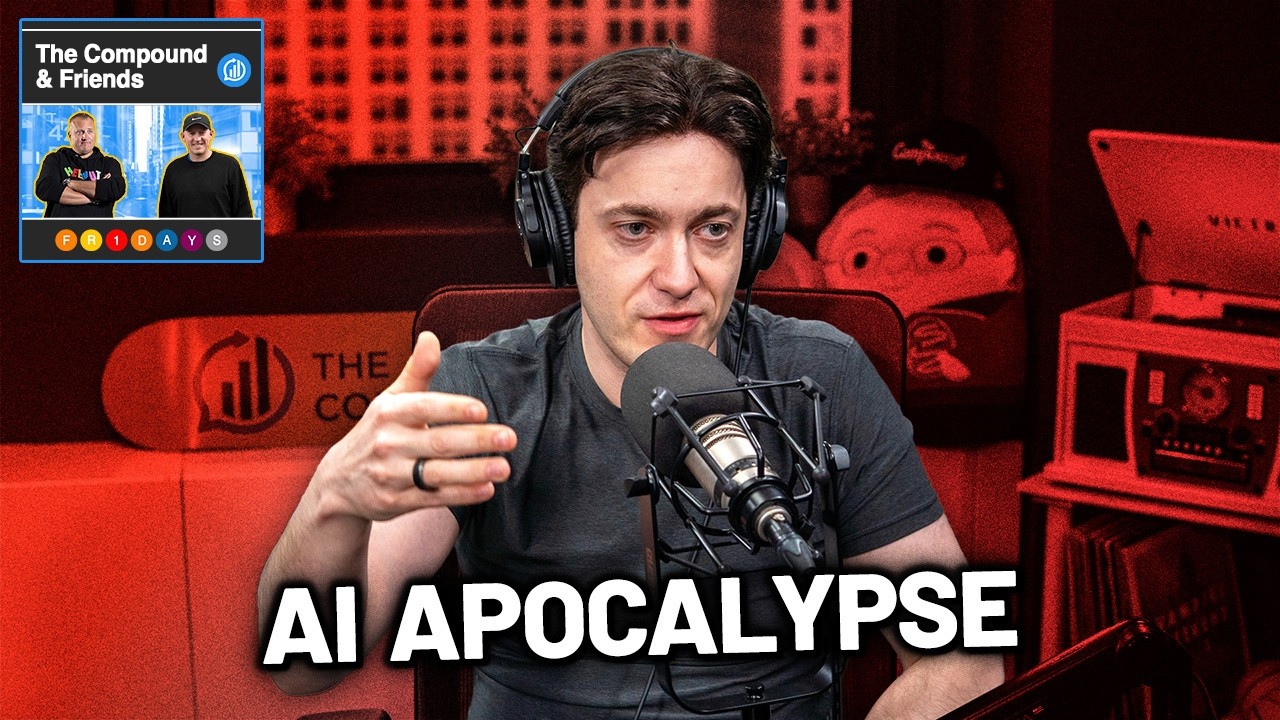
The Four Horsemen of the AI Apocalypse | TCAF 257
The Compound
297,496 views • 1 month ago Save 77 min 8 min read
Video Summary
The AI industry is hurtling toward a potential economic catastrophe driven by a massive, unsustainable build-out of data centers that lack legitimate revenue to justify their existence. While tech giants and startups like OpenAI and Anthropic project massive future growth, they are currently burning through billions in capital expenditures while relying on opaque, potentially illusory demand signals. This cycle is fueled by a dangerous reliance on private credit and vendor financing, creating a house of cards that threatens to destabilize more than just the tech sector.
At the heart of this tension is a "rot economy" where companies prioritize perpetual growth over user experience and product innovation. As hyperscalers and startups engage in circular financial maneuvers—often acting as both investors and customers to inflate their own metrics—the risk of a systemic collapse grows. If these companies cannot secure the astronomical amounts of capital required to sustain their infrastructure, the resulting shock could ripple through the economy, affecting everything from pension funds to the broader financial system.
Short Highlights
- The AI sector is currently experiencing an unsustainable infrastructure build-out driven by venture capital and debt rather than real, profitable demand.
- OpenAI and Anthropic are not generating sufficient revenue to cover their massive compute commitments, creating an existential risk for their hyperscaler partners.
- Nvidia's revenue growth is highly concentrated among a handful of customers who are themselves heavily reliant on debt to fund their data center expansions.
- The "rot economy" phenomenon describes how tech giants have abandoned product quality and user experience in favor of relentless, artificial growth metrics.
- Private credit and insurance annuities are increasingly funding these risky, multi-billion-dollar data center projects, potentially exposing the broader economy to systemic failure.
- The current AI hype cycle lacks the foundational utility of previous tech bubbles, as AI GPUs have limited applications outside of specialized data processing.
- Potential catalysts for a market correction include an IPO failure of a major AI startup, a downgrade of hyperscaler debt, or a sudden, forced pullback in capital expenditures by a major player.
Key Details
The Illusion of AI Revenue [00:01:22]
- Journalists and analysts frequently praise AI investments without disclosing actual revenue figures from the technology.
- The speaker notes that despite billions in capital expenditure, he could not find evidence of significant, sustainable revenue generation from AI products.
i couldn't find any revenues like i couldn't find and every time i was like okay great but how much does it make and everyone was like i couldn't possibly say
The Reality of Professional Investors [00:03:03]
- Professional investors are often willing to engage with bearish perspectives if they have significant capital at stake.
- The speaker differentiates between intelligent institutional investors and retail investors who may be more susceptible to hype.
i don't think that's the same is true for retail investors but we're not going to concern ourselves with that i think professionals do like to hear both sides
Unrealistic Growth Projections [00:05:07]
- OpenAI projects massive revenue growth by 2030 while simultaneously planning to spend hundreds of billions on compute.
- The speaker argues that these projections are disconnected from reality and would require OpenAI to become larger than Meta within three and a half years.
the people who read that and they're like yeah sounds good to me those people are not living in reality and i don't need a degree
The Hyperscaler Financial Trap [00:07:35]
- Hyperscalers like Microsoft, Amazon, and Google have become financially dependent on the growth of unprofitable startups like OpenAI and Anthropic.
- There is an economic mismatch between the current demand for AI and the trillion-dollar commitments made for data center infrastructure.
open ai and anthropic need to have 10 times the demand they have right now it's not even however you may feel about these companies they are not big enough
The Illusory Demand Signal [00:09:15]
- The scarcity of AI GPUs has created a false sense of overwhelming demand, largely driven by a small group of companies.
- Microsoft's AI revenue, when excluding OpenAI, is described as a single-digit billion-dollar business despite massive capital investment.
there's a big barry bonds esterisk at the top of that there's so much demand from ai from two companies pretty much meta as well but they're not doing anything
Nvidia's Concentration Risk [00:13:30]
- A significant portion of Nvidia's revenue is derived from a very small number of customers, creating high concentration risk.
- The speaker notes that while Nvidia is profitable, its future growth depends on these few customers finding massive amounts of additional debt.
16 percent of their latest quarter revenue was one customer 44 percent if they look first half of fiscal 2027 was three customers
Microsoft's Struggling AI Products [00:15:15]
- Microsoft's AI-native products have failed to generate significant demand despite aggressive sales tactics.
- The transition of GitHub Copilot to token-based billing is cited as an example of the company struggling to monetize its offerings.
microsoft is the apex predator of software sales they have hundreds of thousands of resellers they have tens of thousands of sales people and they can't scrape together more than single digit billion dollars
The Problem with ARR Run Rates [00:20:45]
- AI startups often use "run rate" metrics rather than traditional annual recurring revenue to inflate their perceived size.
- These metrics are snapshots that do not accurately reflect the stability or long-term viability of the business.
it is not a trustworthy measure of a business and the fact it gets accepted is an insult to investors intelligence
The Gigawatt Data Center Mania [00:22:45]
- Data centers are being built at an unprecedented scale, condensing massive power requirements into small footprints.
- The speaker criticizes the lack of due diligence in funding these multi-billion dollar projects.
stargate abilene the information had a report about this the blue owl agreed to invest in 10 minutes that's how that's how the due diligence gone boys
The Rot Economy and User Experience [00:32:10]
- Tech companies have engineered their products for perpetual growth, often at the expense of user experience and product quality.
- The speaker argues that companies like Google and Meta have deliberately made their services worse to increase ad revenue.
they have made that product like all of these companies worse to increase growth
The Questionable Utility of LLMs [00:38:20]
- The speaker questions whether the high cost of developing and running LLMs is justified by their actual utility.
- He notes that many AI integrations fail or provide unremarkable results compared to the massive financial and environmental costs.
what it does today is unremarkable compared to its cost and it's about what i would expect
The Danger of Private Credit [00:46:10]
- Private credit is increasingly funding AI infrastructure, which the speaker views as a major warning sign for the broader economy.
- There is little transparency regarding how these funds are underwritten or the risks they pose to pension funds and insurance annuities.
i think a sixth of insurance annuities are private credit funded we've got public pension funds we've got private pension funds we've got everybody's in
Accounting Shenanigans [00:49:15]
- The speaker highlights concerns regarding Nvidia's growing accounts receivable and its role in leasing its own hardware to customers.
- He suggests that these practices may be used to mask a lack of genuine demand from external parties.
why are your daily sales outstanding growing which would like why is it we like to think of them as backlog but that's the thing though why is this extending
The Lack of a Safety Net [00:51:30]
- Unlike the dot-com bubble, where infrastructure like dark fiber eventually found utility, AI infrastructure is highly specialized and expensive to maintain.
- The speaker warns that there is no "happy ending" for the current level of spending if the expected demand does not materialize.
ai gpus are not useful for other stuff and also if a data center is left on incomplete unbuilt it's going to cost just as much in three years to finish
The Potential for Systemic Shock [00:54:15]
- Because the AI bubble is tied to private credit and institutional money, a collapse could have broader economic consequences than previous tech crashes.
- The speaker emphasizes that the sheer scale of the investment makes the potential fallout difficult to quantify.
what you're describing because the numbers are so much bigger and because the private credit people are all in yeah and they are not nasdaq stocks
Conclusion and Outlook [00:56:45]
- The speaker remains skeptical that the current trajectory can continue without a major correction.
- He argues that while he may not be able to time the collapse, the fundamental economics of the sector are broken.
i don't see how this goes on as long as they they expect to be making hundreds of billions of dollars in compute revenue just from anthropic and open ai