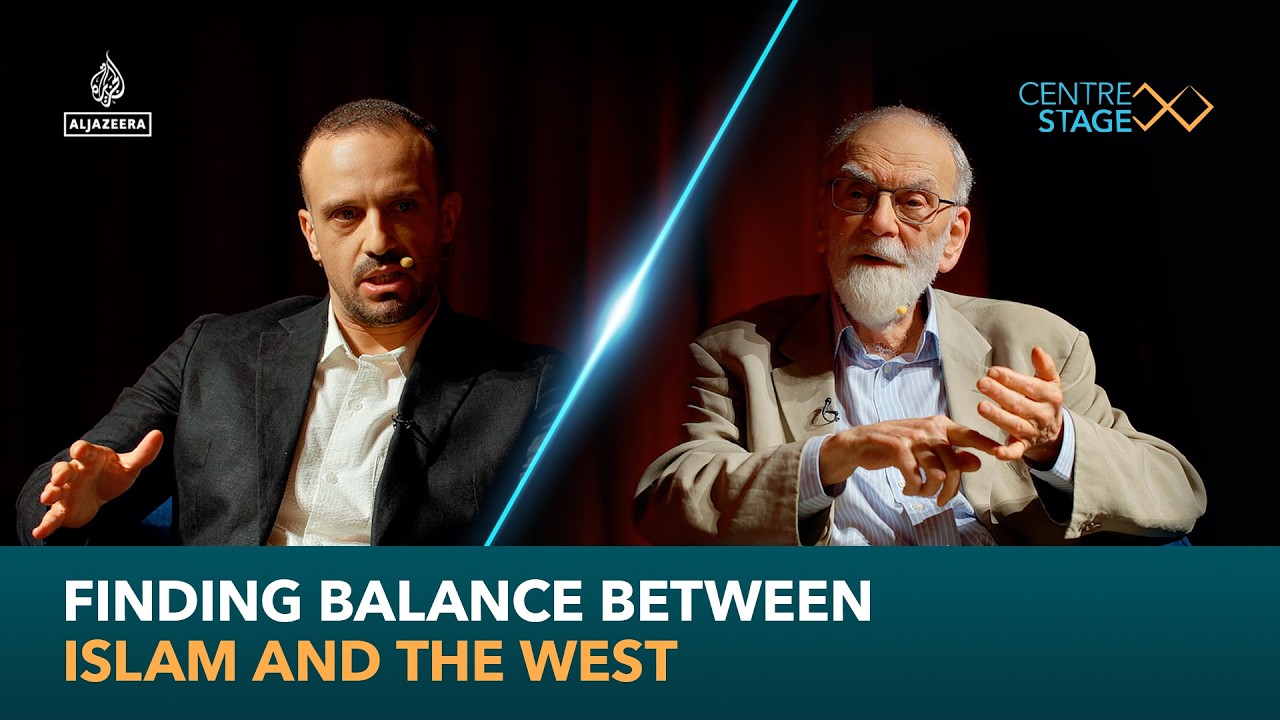
How can the Islamic world challenge Western narratives about it?
Al Jazeera English
817 views • 15 hours ago Save 57 min 9 min read
Video Summary
In a world grappling with escalating crises and a "nightmare existence," British intellectual Ahmed Paul Keeler champions the Islamic principle of Al-Mizain—balance, justice, and scale—as a vital paradigm for humanity's survival. Keeler, who founded the landmark World of Islam Festival in 1976, argues that the modern world's obsession with "progress" has led to environmental destruction, social fragmentation, and a loss of connection with the divine. He asserts that the Muslim world, traumatized by colonization and viewing itself through Western eyes, must reclaim its identity and embrace the Mizan perspective to counter the "monstrous understanding and views about Islam" being propagated.
Keeler's journey from an education for empire to embracing Islam through the arts highlights a profound shift in perspective. He contends that the current "storm" requires Muslims to be strong and to present Islam's inherent balance and justice, not as a relic of the past, but as a vital refuge and witness for all mankind. He expresses hope for a new generation of morally intact Muslims who can offer this essential counterbalance to a disintegrating world.
Short Highlights
- The principle of Al-Mizain (balance, justice, scale) is essential for humanity's survival in a disintegrating world.
- The modern concept of "progress" has led to environmental destruction, social chaos, and a loss of connection with the divine.
- The Muslim world must reclaim its identity and reject the Western narrative of decline and stagnation.
- Colonization has traumatized the Muslim world, causing it to view itself through the conqueror's lens.
- Islam offers a refuge and a witness to truth in times of global crisis.
- A new generation of Muslims is emerging with confidence in their heritage and the strength to defend it.
- Presenting Islam in its best light is crucial for Muslims and for the host community.
Key Details
The Crisis of Modernity and the Call for Al-Mizain [00:00:00]
- The world faces escalating crises, a "nightmare existence" driven by a false concept of "progress."
- Islamophobia is being "stoked, funded and financed" on a massive scale.
- Muslims must become strong to defend their culture and civilization.
"Islamophobia is being stoked, it's being funded and financed in a huge way now. So we Muslims have to be very, very strong and when it comes to being able to defend ourselves, we're very weak when it comes to people attacking our culture, our civilization, because we don't know what it is."
From Empire Education to Counter-Culture [00:03:15]
- Ahmed Paul Keeler was educated for empire, instilled with a belief in British superiority.
- The 1960s brought a political awakening and a dismantling of the empire, leaving his generation "out of a job."
- He pursued drama, immersing himself in the "hotbed of the new modern drama" that satirized the establishment and empire.
"The empire was being dismantled. So basically we were out of the job."
The Avant-Garde Art World and Communal Living [00:07:50]
- Keeler transitioned to the modern art world, running an avant-garde gallery that ultimately failed financially.
- He lived in a "multi-cultural commune" with up to 70 people, engaging with the late 60s counter-culture.
- This period was an "incredible decade" of cultural revolution and exploration.
"And it wasn't making any money. It wasn't making money, not only making money, it was deeply in debt."
An Unexpected Gateway to Islam [00:10:40]
- Keeler's entry into Islam was "totally unexpected," stemming from an invitation to a North Indian classical music concert.
- The musician was a master of a living tradition that had existed for over a thousand years, from West Africa to China.
- This encounter revealed a "world that had existed for more than a thousand years" that had been "smashed" and replaced by modernity.
"I entered another world because he was a master of a tradition that was fully alive, completely living."
The Vision of the World of Islam Festival [00:15:00]
- Keeler's exploration of Islamic art led him to see the connection between Moorish Spain and Mughal India through Islam.
- He recognized the governing principles of Islamic arts: calligraphy, geometry, and mathematics.
- This vision fueled his desire to communicate and share this understanding, leading to the World of Islam Festival.
"And suddenly saw that Moorish Spain and Mughal India, the only thing that connected them was Islam, nothing else."
Overcoming Debt and Doubling Down [00:17:30]
- An initial festival left Keeler with a £10,000 debt (equivalent to £100,000 today).
- A "little voice" advised him to do the festival on the "highest scale," involving all institutions and the Queen.
- This advice led him to "double down" and pursue the grand vision.
"Yes, but you've got to do it on the highest scale. You've got to involve all the institutions. You've got to do it through all the media. And the Queen has got to open it."
The Unprecedented Scale of the 1976 Festival [00:21:00]
- The 1976 World of Islam Festival involved over 30 institutions, including the British Museum and the V&A.
- It was officiated by Queen Elizabeth II, spanned three months, and featured 6,000 pieces from global collections.
- The festival's scale was facilitated by a less bureaucratic organizational culture in institutions at the time.
"This is on a massive scale that makes it countrywide. It goes on for three months."
The Impact of the Oil Crisis and Funding [00:26:00]
- The October 1973 oil crisis and the independence of Gulf states led to an influx of wealth.
- Keeler approached these "new rich Gulf states" with the festival's concept of Islamic unity.
- They raised £2.4 million (approx. £30 million today) to fund the ambitious project.
"We have the whole establishment. We're going to present the world of Islam in terms of its unity and from the Islamic perspective. How could they not be delighted?"
Presenting the Unity of Islamic Arts and Sciences [00:27:30]
- The festival featured 10 major loan exhibitions, showcasing the arts and sciences of Islam.
- A central exhibition displayed magnificent Holy Quran manuscripts from Cairo.
- Figures like Said Hussein Nasser and Thesis Burkhardt provided a vision of Islamic unity.
"And at the center of the whole thing, a glorious exhibition of the Holy Quran were the most magnificent manuscripts from the library in Cairo."
A Global Gathering and Upgraded Institutions [00:30:00]
- The festival brought together 3,000 people from 32 countries and over 150 collections.
- Curators, librarians, and scholars descended upon London, engaging globally.
- Participants took away the concept of Islamic arts' unity, leading to upgraded museums worldwide.
"And all of them were presented in terms of the arts of Islam. It was incredible."
Ignorance as a Catalyst for Success [00:32:00]
- Keeler admits his "ignorance" of Islamic politics and sects was key to realizing the festival's vision.
- He attributes the success to divine providence, viewing himself as an actor in a larger divine drama.
- His unusual gateway into Islam through a musician, rather than a sheikh, allowed him to maintain his artistic passion.
"Because I knew nothing about Shias and Sunnis and, you know, the whole political thing and the Arabs and the Israelis. I didn't know nothing. I was innocent in all these things. I just had a vision and I just went and realised it."
The Shift After the Iranian Revolution [00:37:00]
- The 1979 Iranian Revolution marked a significant change in how Islam was perceived globally.
- Islam became associated with fanaticism and terrorism, leading to widespread Islamophobia.
- Keeler "disappeared" from public life for 45 years, working on projects that never reached the public.
"And then everything changed. And since that time, the next 45 years, I literally disappeared."
The "Golden Web Project" and Perceived Failure [00:40:00]
- Keeler spent 20 years on "The Golden Web Project," which ultimately failed to launch.
- He felt his life had been a "terrible failure" and apologized to his family.
- A friend's persistent question, "When will your book be ready?" eventually spurred him to write.
"I thought my life had been a terrible failure. I looked back and I thought, well, I did the festival, but that was, you know, 45 years ago. Nothing. Nothing since then."
Reconstructing Identity Through Mizan [00:45:00]
- The Mizan thesis posits that balance, justice, and scale are universal principles essential for existence.
- The Muslim world, traumatized by colonization, views itself through the lens of the conqueror, creating a "deluded past."
- Recovering the true history and identity of Islamic civilization is crucial for Muslim strength and clarity.
"If you have a past which is a fabrication, which is somebody else's view, then it weakens you, it upsets your identity, you become confused."
The Falsehood of Progress and the Reality of Hell on Earth [00:50:00]
- The modern concept of "progress" is intellectually insane and has led to environmental destruction and social breakdown.
- This idea, born from a rebellion against heaven, has turned the world into a "hell on earth."
- Nietzsche foresaw the "crisis of civilization" in the 21st century due to these ideologies.
"But the reason why it is false is because it is an idea that was developed by the rebellion from heaven. And heaven is real."
The Muslim Response: Reclaiming Balance [00:55:00]
- Muslims are the guardians of truth (al-Haq) and must be strong against attacks on their civilization.
- The Mizan perspective offers a framework to see the world clearly, like obtaining "proper spectacles."
- Recovering this balance is essential for humanity's survival as the modern world disintegrates.
"So we Muslims have to be very, very strong. And when it comes to being able to defend ourselves, we're very weak when it comes to people attacking our culture, our civilization, because we don't know what it is."
A New Generation and the Return of Islam [01:05:00]
- A new generation of Muslims is emerging with confidence in their heritage and moral integrity.
- Islam is returning to the center, as the final revelation and a refuge in times of storm.
- Keeler hopes humanity will adopt the Mizan perspective to serve humanity and recover its connection with heaven.
"And I believe that Islam is coming back to the centre. And in this time of storm is the refuge and is the witness to the people of the world, to all of mankind."