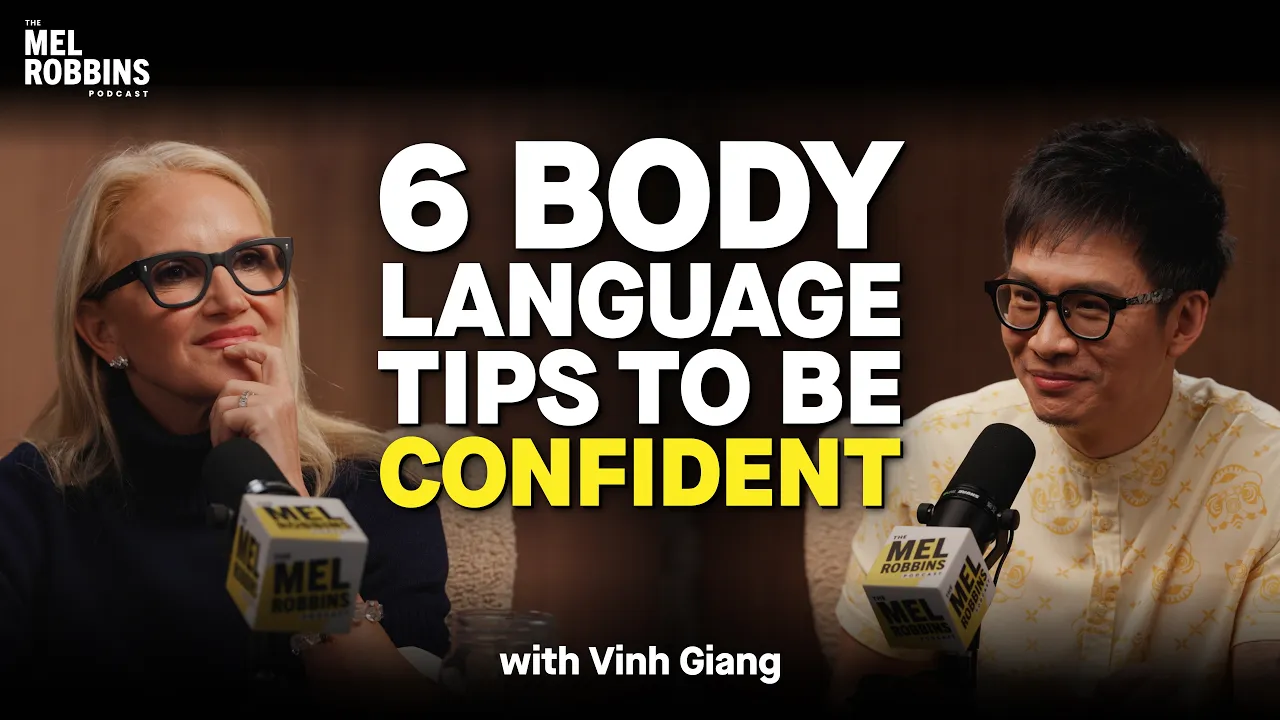
If You Get Anxious Around Other People, Watch This | Communication Expert Vinh Giang
Mel Robbins
272,499 views • 5 days ago Save 33 min 7 min read
Video Summary
Communication expert Vin Jiang reveals a powerful framework for confidence and connection on the Mel Robbins podcast, coaching staff members through common struggles.
Jiang introduces the "3-2-1" method and emphasizes that communication is a learnable skill, not an innate talent. He coaches Scott, a photographer, on managing performance anxiety by physically expelling adrenaline through exercise before high-stakes situations. For Jenea, who struggles with interrupting, Jiang advises asking follow-up questions to create space for others to finish their thoughts, fostering deeper relationships. Jenny, an editor, learns to overcome fear of rejection in group settings by practicing improv techniques to engage more comfortably in conversations. Jiang encourages listeners to become the "author of their own story" by taking control of their communication and asserting their voice to create a more impactful life.
Short Highlights
- Communication is a learnable skill, not an innate talent.
- Manage adrenaline and anxiety by moving your body before high-stakes situations.
- Stop interrupting by asking follow-up questions and holding space for others.
- Overcome fear of rejection in groups by practicing improv and joining conversations.
- Become the author of your own story by using your voice.
Key Details
Introduction to Live Coaching [0:00]
- Mel Robbins introduces communication expert Vin Jiang for a live coaching session on her podcast.
- Jiang's "3-2-1" framework is highlighted as a simple tool for communication.
- The session aims to teach listeners how to communicate with more confidence.
"For the first time ever, we are going to do live coaching on the show with the world's number one communication expert, Vin Jiang."
Why Communication Skills Matter [1:30]
- Jiang explains that communication is a skill most people are never formally taught.
- This lack of training leads to common issues like rambling, freezing, or using filler words.
- He emphasizes that these are not personal failings but a result of not learning the skill.
"It's not your fault. It's because when were you ever taught this skill?"
Coaching Scott: Managing Performance Anxiety [4:00]
- Scott, a photographer, struggles with flustering and shakiness when directing large groups or high-level individuals.
- He experiences imposter syndrome and physical symptoms like sweating and shaking.
- Jiang suggests immediate physical activity, like star jumps and push-ups, to manage adrenaline.
"So we want to do maybe, we'll do together 20. We don't have to show it."
The Science Behind Physical Release [5:30]
- Moving the body helps manage adrenaline, reducing shakiness and clearing the mind.
- Exercise encourages deep breathing, further calming the nervous system.
- After the physical exercise, Scott's questions become clearer and more coherent.
"So as you do brisk forms of exercise, it gets rid of that adrenaline which stops and reduces the shakiness."
Scott's Communication Archetypes [8:00]
- Jiang identifies Scott's primary communication archetypes as "friend" and "educator."
- He encourages Scott to lean more into the "coach" archetype for assertiveness.
- The "coach" archetype involves guiding and directing, with a scale from 0 to 10, not necessarily being overly aggressive.
"And then I also see you in the archetype of educator. Right? I know you know your stuff and you can speak on something complex."
Practicing Assertiveness [10:00]
- Jiang guides Scott through a role-play, instructing him to direct Jiang to sit for a photo.
- Scott initially uses a softer tone but is encouraged to be more assertive.
- Jiang emphasizes that clear, confident direction makes the "talent" feel safe and guided.
"Okay, Vin, I need you to move that chair right over there, right in front of the microphone."
The Power of Vocal Archetypes [12:00]
- Jiang introduces four core archetypes: friend, educator, coach, and motivator.
- He explains that people often have negative associations with "coach" but that it exists on a spectrum.
- Practicing these archetypes, even with music, can help develop communication flexibility.
"Motivator, educator, coach, friend. You just got to itch up that volume notch and not be afraid of it."
Coaching Jenea: Stopping Interruptions [14:00]
- Jenea identifies as a "professional yapper" who struggles with cutting people off.
- She fears forgetting her thoughts if she doesn't speak immediately.
- This habit negatively impacts her relationships as people forget their points.
"I am struggling with cutting people off. I'm a professional yapper."
The "Ask Questions First" Tactic [16:00]
- Jiang's tactical advice for Jenea is to ask follow-up questions about what the other person is saying.
- Only after asking questions and holding space should she share her own thoughts.
- This creates a new behavior that prioritizes listening and connection.
"Anytime now you're connecting with someone you really love, you have to now ask follow-up questions on the very thing they're speaking about."
The "Last Word, Last Letter" Game [19:00]
- To combat racing thoughts, Jiang introduces a game where the next speaker must start with the last letter of the previous speaker's last word.
- This game forces the listener to focus on the current speaker and prevents planning their response prematurely.
- It helps create awareness of the tendency to think ahead rather than listen.
"So you're only allowed to think of what you're going to say when I finish my sentence and you have to continue the conversation with a word that starts with my last letter of my last word."
Coaching Jenny: Fear of Rejection [23:00]
- Jenny, a social media creator, feels intimidated and shrinks in group settings, fearing rejection.
- She struggles to separate her ideas from her self-worth, believing that if an idea is rejected, she is rejected.
- This fear stems from small, cumulative experiences rather than one significant incident.
"I think the fear is rejection of if I put myself out there and in a social setting, I am too vulnerable or too open that I would be rejected by the people around me."
The Power of Improv [25:00]
- Jiang suggests that the skill of improv can significantly improve conversational abilities.
- He recommends improv classes to practice thinking on the spot and becoming comfortable with the unknown.
- A key improv technique is to join existing conversations by asking questions, rather than feeling pressure to contribute a novel idea.
"So as you learn the skill of improv, you actually become a better conversationalist."
Improv Game: The Present [27:00]
- Jiang and Jenny play an improv game where they exchange imaginary presents.
- This exercise demonstrates how to build on what the other person says and respond creatively.
- It helps build comfort with spontaneity and the unpredictable nature of conversations.
"Because I knew that you wanted more responsibility, Jenny. And I wanted to help you learn the responsibility because they poop, they pee, and they bark."
Taking Back the Pen [30:00]
- Jiang encourages listeners to become the "author of their own story."
- This means taking control of their narrative, changing the meaning of past events, and choosing to write new chapters.
- He emphasizes that even if past events can't be controlled, their meaning and impact can be.
"You have so much more potential than you realize. Take your pen back. Start writing your story because you are the author of your own story."
Conclusion and Encouragement [32:00]
- Mel Robbins thanks Vin Jiang and the staff members for their vulnerability and participation.
- She highlights the importance of applying the learned communication tools and using one's voice.
- Both Robbins and Jiang express love and belief in the listeners' ability to create a better life through confident communication.
"And in case no one else tells you, I'm going to use my voice as your friend to tell you that I love you and I bet Vin wants to tell you too."