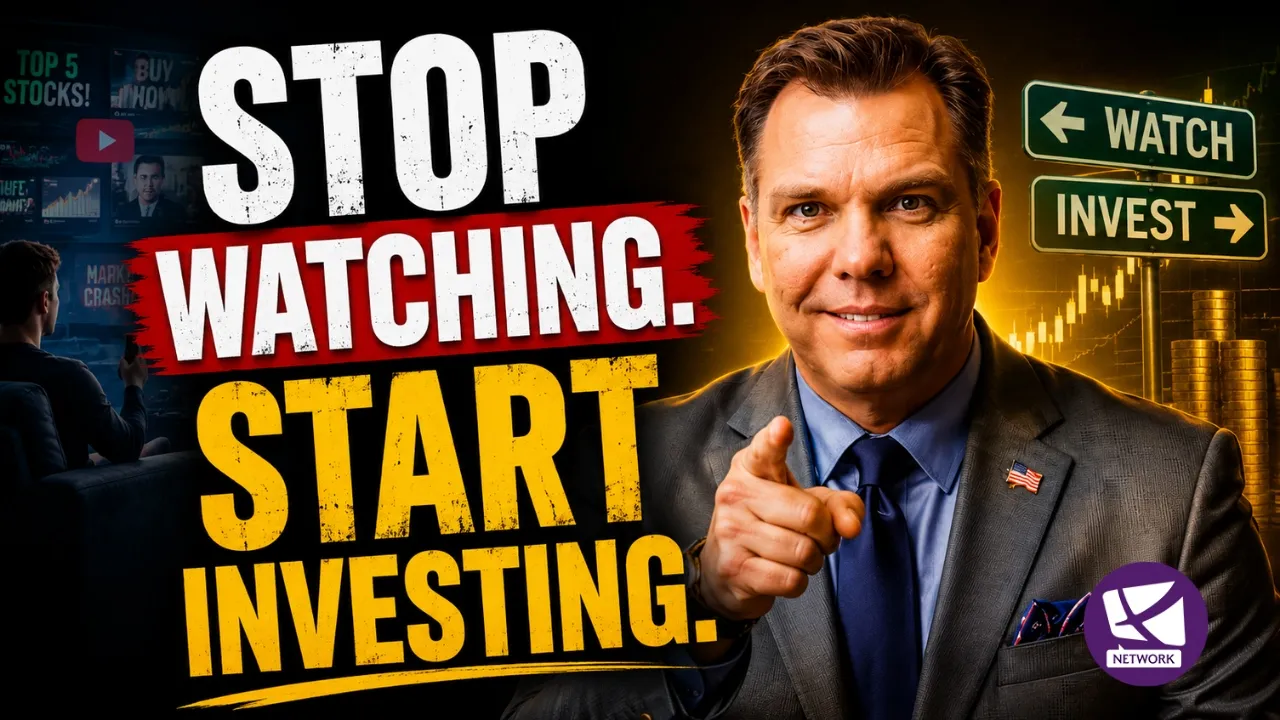
Why Watching More Investing Content Won't Make You a Better Investor - Andy Tanner, Del Denney
The Rich Dad Channel
12,658 views • 1 month ago Save 31 min 6 min read
Video Summary
The sheer volume of financial information available today can lead to paralysis rather than clarity, according to Andy Tanner on Rich Dad Stockcast. He argues that the problem isn't too much information, but rather a "post-truth world" filled with misinformation. Tanner emphasizes the need for discernment and education to separate reliable data from falsehoods. He highlights that successful investing requires a personalized system and standard operating procedures (SOPs), not a one-size-fits-all recipe.
Tanner introduces the "four pillars of investing" as a framework to cut through the noise: fundamental analysis (studying the asset), technical analysis (studying market participants' emotions), positioning (acting on the analysis), and dealing with change (having contingency plans). He stresses that information alone is meaningless without education and action, urging listeners to move beyond passive consumption to active skill-building through resources like stockcastbonus.com and the Cashflow board game.
Short Highlights
- Information vs. Education: Information without education is meaningless; education turns data into actionable insights.
- The "Post-Truth" Market: The biggest challenge is not too much information, but distinguishing truth from misinformation.
- Personalized Investing Systems: A successful investor needs a unique system and standard operating procedures (SOPs) tailored to their situation.
- The Four Pillars of Investing: A framework to simplify decision-making:
- Fundamental Analysis
- Technical Analysis
- Positioning (Action)
- Dealing with Change
Related Video Summary
Key Details
The Information Deluge [0:00]
- Investors today face an overwhelming amount of information from various sources like CNBC, YouTube, X, podcasts, and AI.
- Conflicting advice—market crash predictions versus bull market forecasts—can lead to "paralysis" rather than clarity.
- The core question is what information is actually needed for successful investing.
"And at some point, more information doesn't create clarity. It creates paralysis."
Cutting Through the Noise with Systems [1:30]
- Andy Tanner joins host Del Denny to discuss how to identify what matters and develop a system for confident investing.
- Resources are available at stockcastbonus.com for those ready to develop investing skills beyond just consuming information.
- The goal is to reduce information into actionable steps through a Standard Operating Procedure (SOP).
"And so stockcastbonus.com has great stuff for that."
Information Overload or Misinformation? [3:45]
- The problem isn't too much information, but a "post-truth world" with significant misinformation.
- Freedom of speech requires listeners to develop discernment and education to identify reliable sources.
- The first step is separating real information from misinformation.
"And so the first step, I think, is to curate or to separate or to clean all that information out there between what's real and what's misinformation."
The Mandate to Learn More [5:50]
- Former SEC Chairman Arthur Levitt stated that today's investors, with easy access to technology, should be the most informed in history.
- Technology is an opportunity and a mandate to learn, be more, and do more, not an excuse to do less.
"The ease of today's technology is not an excuse to do less, but an opportunity to mandate to learn more, be more and do more and go out and find success."
Investing is Personal: Beyond the Recipe [8:10]
- Jack Schwager's "Market Wizards" highlights that successful investors have unique styles, challenging the idea of a universal recipe.
- Investing is personal due to varying ages, risk tolerances, aptitudes, disciplines, and interests.
- Unlike a cookie recipe, financial situations are complex and not uniform.
"There's different ages, there's different tolerances, risks, there's different aptitudes, there's different disciplines, there's different interests, uh, different levels of, of commitment participation."
Developing a Viable System and Habits [10:30]
- The solution to information overwhelm is developing a viable system and establishing habits through a personal SOP.
- Andy Tanner filters information by choosing an asset class (stocks and options for him) and curating based on specific criteria.
- He uses technology to run searches that narrow down thousands of opportunities to a manageable list.
"And so I have criteria that I can run searches on, gives me a list that narrows down the thousands of opportunities down to 10, right down to 10."
Warren Buffett's "Moat" and Picking Pitches [12:00]
- Tanner uses criteria similar to Warren Buffett's concept of a "moat" and Ted Williams's "strike zone" to select investment opportunities.
- He identifies pitches he can hit, focusing on criteria that align with his investment style.
- He waits for market pullbacks to buy good companies when others are fearful, "backing up the truck" when they go on sale.
"He talks about a moat. And so I have criteria that I can run searches on, gives me a list that narrows down the thousands of opportunities down to 10, right down to 10."
Education: The Key to Meaningful Information [18:00]
- Robert Kiyosaki's principle: "Information without education has no meaning."
- Education is crucial to understand jargon and complex reports (like SEC filings) and prioritize what's important.
- Mentorship, books, coaches, and serious commitment to learning are vital for transforming information into understanding.
"Information alone by itself without education is meaningless. It doesn't have any meaning for me."
The Four Pillars of Investing [23:00]
- Robert Kiyosaki encouraged Andy Tanner to organize his knowledge, leading to the identification of four pillars that encompass all asset classes.
- Pillars 1 & 2 focus on information gathering (fundamental and technical analysis); Pillars 3 & 4 focus on action.
- Pillar 1: Fundamental Analysis: Studying the asset's intrinsic value, health, and viability (e.g., cap rate, NOI for real estate; company performance for stocks).
- Pillar 2: Technical Analysis: Studying market participants' emotions, opinions, and fears through price and volume data.
- Pillar 3: Positioning (Cashflow): Turning analysis into action, deciding to buy or sell, and generating cashflow.
- Pillar 4: Dealing with Change: Having a plan for sudden shifts in information or market conditions (exit strategy, insurance, hedges).
"So the first two are about information gathering. The second two are about what you do with it and how you position yourself."
Applying the Pillars and Taking Action [34:00]
- The four pillars provide a framework to filter overwhelming information and make intelligent decisions.
- Resources like stockcastbonus.com, the Cashflow board game, and paper trading accounts help in moving from information to execution.
- Tanner's "Four Pillars of Investing" course offers a 20-hour deep dive into these principles, providing a working knowledge to navigate financial markets confidently.
"So if you're ready to move beyond information overload and start building those skills, head over to stockcastbonus.com."