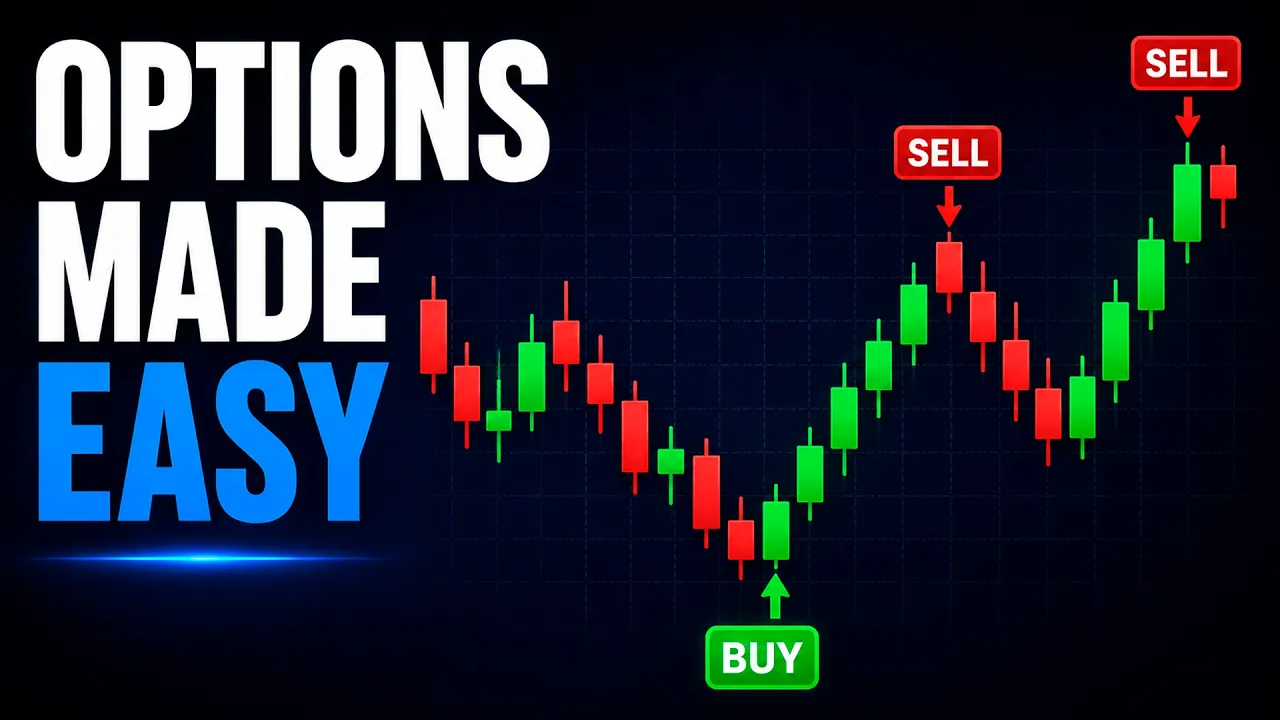
How To Start Options Trading As A Beginner (Step By Step)
SMB Capital
29,566 views • 1 month ago Save 19 min 4 min read
Video Summary
Options trading is not a binary bet on stock direction, but a sophisticated exercise in risk management where buyers and sellers exchange obligations to achieve specific financial goals. By breaking down the components of a contract—underlying assets, strike prices, expiration dates, and premiums—traders can move beyond simple directional speculation to engineer precise exposure to time, volatility, and price movement.
Success in options requires shifting the focus from the contract itself to the underlying thesis. Whether you are paying premium to own a right or collecting it to accept an obligation, every trade involves a trade-off between convexity, theta decay, and volatility sensitivity. By mastering the 'Greeks' as a risk dashboard, traders can combine long and short positions to build custom risk profiles, ensuring every component of a strategy serves a deliberate, measurable purpose.
Short Highlights
- Understand that buying and selling options are two sides of the same coin, each serving different risk-management objectives.
- Master the five essential components of an options contract:
- Underlying asset
- Expiration date
- Strike price
- Option type (Call or Put)
- Premium
- Recognize that being right about a stock's direction does not guarantee profit due to the influence of time and volatility.
- Utilize the 'Greeks' as a risk dashboard to measure exposure:
- Delta (Direction)
- Gamma (Acceleration)
- Theta (Time)
- Vega (Volatility)
- View premiums as compensation for risk rather than free income.
- Build complex positions by combining long and short options to achieve specific risk, reward, and exposure profiles.
- Always define your trade thesis and risk tolerance before selecting an options structure.
Key Details
The Anatomy of an Options Trade [0:00]
- Every trade involves a buyer paying for a right and a seller receiving premium for accepting an obligation.
- The goal is not just to pick a direction, but to build specific risk exposure.
the buyer is paying for the right the seller is being compensated for accepting an obligation
Decoding the Options Contract [2:20]
- Contracts are tied to underlying assets like stocks or ETFs, with standard equity contracts representing 100 shares.
- Five variables define every contract: underlying, expiration, strike price, type, and premium.
an option is simply a contract tied to an underlying asset
Inputs of Option Value [4:10]
- Premium is composed of intrinsic value (in-the-money amount) and extrinsic value (time and volatility).
- Four primary factors drive value: underlying price, strike price, time to expiration, and implied volatility.
extrinsic value is everything above that it's the remaining premium driven primarily by things like time and implied volatility
Managing the Greeks [6:00]
- Greeks are not just formulas; they are a dashboard for monitoring your exposure to market variables.
- Delta measures directional sensitivity, while Gamma tracks how quickly that directional exposure changes.
i don't want you looking at greeks as a bunch of complicated formulas think of them as your risk dashboard
The Buyer's Perspective [8:00]
- Buyers pay for defined risk, positive convexity (gamma), and directional exposure.
- The primary adversary for the buyer is theta decay, as time constantly erodes the option's value.
one of the biggest benefits is defined risk if i'm simply buying an option the most i can lose is the premium i paid
The Seller's Perspective [9:30]
- Sellers collect premium in exchange for accepting obligations and taking on potential negative convexity.
- Sellers often benefit from theta decay and falling implied volatility, provided the underlying stays within the expected range.
premium is compensation for risk when i'm selling an option the important question isn't simply how much premium i can collect it's what risk am i being paid to accept
Building Custom Positions [11:15]
- Professional traders often combine long and short options to hedge, reduce costs, or modify greeks.
- The ultimate goal is to align the structure of the trade with the specific thesis and risk tolerance of the trader.
start with the trade idea first what is my thesis what do i actually think is going to happen