The Inequality Debate Is a Lie — Both Sides Are Right (And Wrong)
Tom Bilyeu
70,844 views • 5 days ago Save 44 min 10 min read
Video Summary
While many believe economic inequality is at an all-time high, the data presents a more complex picture, with differing interpretations leading to a lack of consensus among economists. Some argue that wealth concentration has surged, with the top 0.1% holding a significantly larger share of total wealth than in previous decades. This is often attributed to financialization, inflation, and a weakening dollar, making investment crucial for wealth preservation. Conversely, others contend that global inequality has decreased dramatically, citing the vast reduction in extreme poverty worldwide, particularly due to market capitalism's adoption in countries like China.
The debate is further complicated by how "wealth" is defined—as tangible assets or speculative paper value. While some data suggests a widening gap, other analyses of consumption inequality show a much smaller divergence, indicating that material well-being for the average person has improved significantly due to technological advancements and increased affordability of goods. Ultimately, the perception of inequality is influenced by psychological factors like loss aversion and an idealized view of the past, overshadowing real improvements in global living standards and the quality of life for marginalized groups.
Short Highlights
- Conflicting Data on Inequality: Economists disagree on whether inequality is at an all-time high or has significantly decreased globally.
- Wealth vs. Income: The definition of "wealth"—whether tangible assets or speculative paper value—significantly impacts inequality metrics.
- Global Poverty Reduction: Market capitalism is credited with lifting hundreds of millions out of extreme poverty worldwide.
- Technological Impact: Advancements in technology have increased productivity but also contributed to wealth concentration and worker disempowerment.
- Consumption vs. Income Inequality: While income inequality may have risen, consumption inequality has grown at a much slower rate, suggesting improved material well-being.
- Psychological Factors: Perceptions of inequality are influenced by loss aversion and an idealized view of the past, often overshadowing real progress.
- Data Interpretation Challenges: Methodological choices in data processing lead to vastly different conclusions, even when using the same datasets.
Key Details
The Great Debate: Is Inequality Skyrocketing? [0:00]
- The common belief is that inequality is at an all-time high, but data suggests a more nuanced reality.
- Economists often have conflicting opinions, especially on the topic of inequality.
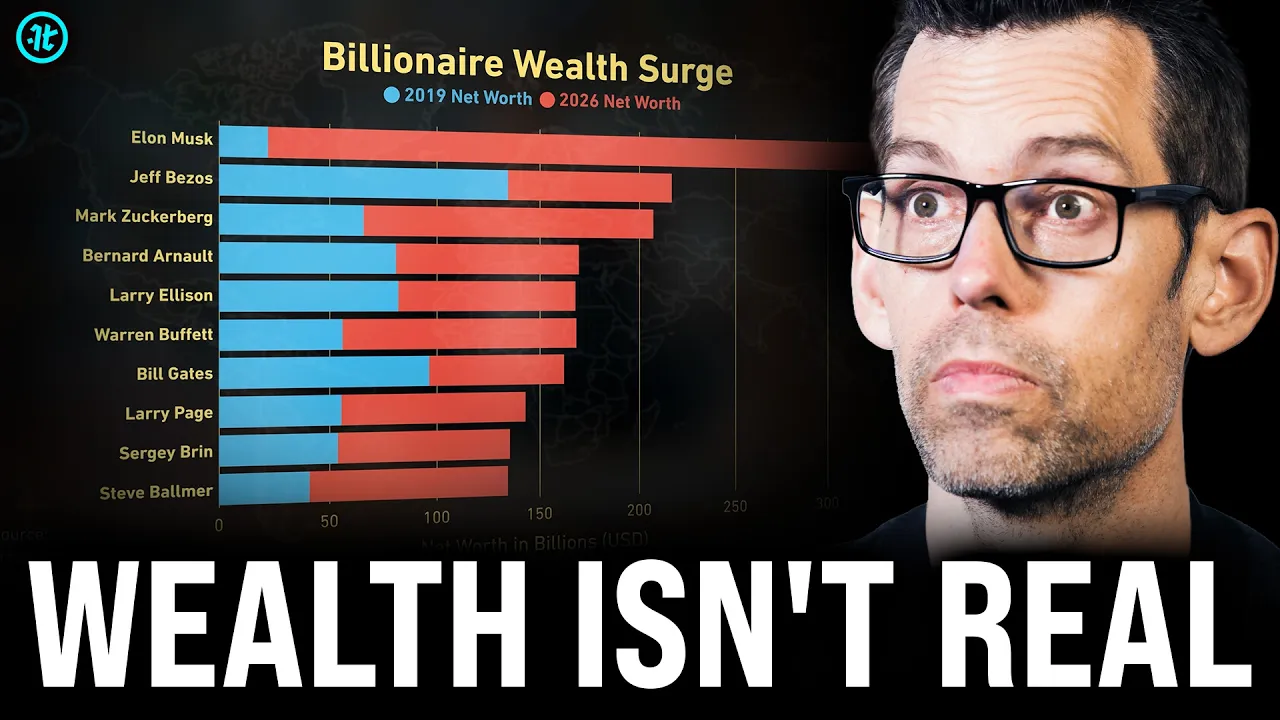
- The recent emergence of a trillionaire highlights extreme wealth concentration.
"The world recently, albeit briefly, had its first trillionaire a few weeks ago, who alongside just 11 other people control more wealth than the entire bottom half of humanity combined."
Wealth vs. Speculation: What's Real? [1:33]
- A significant portion of perceived wealth is "fictional" or speculative, not actual money in hand.
- The distinction between money in a bank account and speculative wealth is crucial for understanding the middle class.
- While more people are becoming wealthy, the "centered bell curve" of a thriving middle class is not materializing.
"We've got to come to grips with the difference between, I have money in my bank account, and I have fictional wealth that may one day come true, but it's completely speculative, and what's happening with the middle class."
The Optimistic Counter-Argument: Global Gains [2:52]
- Despite concerns, a strong argument exists that the world has become more equal.
- Global poverty has drastically declined, especially since China joined the WTO.
- Free market capitalism is credited with lifting millions out of poverty.
"The number of people that used to live in abject poverty has just been declining rapidly since China has been welcomed into the WTO."
The Data Dilemma: Interpretation and Bias [4:15]
- Economists often have pre-conceived notions, leading them to seek data supporting their existing beliefs.
- Data can be manipulated or misinterpreted to fit a desired narrative.
- Understanding the complexities of data collection and processing is essential.
"And really, they are only interested in hearing or looking for stats and figures that they want to hear."
The "Worsening" Inequality Case: The Top 0.1% [6:10]
- Research by Saez and Zuchman shows the top 0.1% of US households have tripled their share of total wealth since the late 1970s.
- This concentration is linked to financialization, inflation, and the weakening value of the dollar.
- Lack of investment knowledge exacerbates this trend, as a small percentage of people own a vast majority of assets.
"The share of total wealth held by the top 0.1% of American households roughly tripled, from about 7% in the late 1970s to around 20% in recent years."
The Gilded Age Echo: Extreme Wealth Concentration [7:45]
- Recent data suggests wealth concentration may have surpassed even the Gilded Age.
- A tiny fraction of families now hold a larger share of wealth than dominant families did in 1913.
- This extreme concentration is a key focus of concern.
"The top 0.00001%, which is on the order of about 18 families, including the likes of Bezos, Gates, and Zuckerberg, held roughly 1.35% of all American wealth..."
Piketty's Thesis: Catastrophe as an Equalizer [8:30]
- Thomas Piketty argues the mid-20th century's egalitarianism was a result of historical catastrophes (World Wars, Great Depression).
- These events destroyed concentrated capital and led to progressive tax systems.
- The post-war period saw capital returns and economic growth move in tandem.
"Piketty's central historical claim is that the egalitarian mid-20th century was not the normal state of market economies, but a one-off product of catastrophe."
Post-War Prosperity: Industrial Might and Rebuilding [9:45]
- The post-WWII economic boom was driven by US industrialization and aid to rebuild other nations.
- This created trading partners and fostered global economic growth.
- The focus was on rebuilding and fostering strong economies, not imperialistic dominance.
"America has, post-World War II, a pretty radical approach to helping rebuild what were once their enemies, all with an eye towards who can we deal with?"
Unions and Worker Power: A Complex Relationship [11:00]
- Strong unions in the mid-20th century coincided with high marginal tax rates and economic growth.
- The speaker argues for empowering workers but questions if strengthening unions is the best method.
- Unions can create a "holdup problem," potentially capturing returns that could otherwise be invested in R&D and capital.
"My thesis is if you want to create a world where we have that optimistic view of the future, we are coming back towards the middle, you've got to put power back in the workers hands."
Union Impact on Investment and Growth [12:30]
- Firms in highly unionized sectors tend to underinvest in physical capital and R&D compared to non-unionized peers.
- Winning a union election can lead to a long-term decline in a company's equity value.
- This can hurt shareholder value and, consequently, workers' long-term gains and company growth.
"firms in highly unionized sectors under invest in physical capital. So they're building less things and they under invest in R and D compared to their non unionized peers."
The Bureaucracy Problem and Corporate Focus [15:00]
- Unions can lead to bureaucracies that prioritize their own growth over the company's long-term health.
- Companies may focus on short-term gains rather than sustainable growth and viability.
- This shift can disempower workers and harm the broader economy.
"They stop caring about the long-term health of the company. They stop caring about their viability in the marketplace."
Empowering Workers: Beyond Unions [16:30]
- Empowering workers in a globalized economy requires addressing offshoring and ensuring regionalized jobs.
- Education that makes workers valuable is key.
- Top-down approaches without addressing these factors can harm the broader economy.
"The problem is, you're just not getting that centered bell curve of middle class people thriving and making more money over time."
R > G: The Capital Advantage [18:00]
- The rate of return on capital (R) has historically outpaced economic growth (G), leading to wealth accumulation for asset owners.
- This "reversion to the mean" means asset owners naturally pull away from those dependent on economic growth.
- China's poverty reduction is significant but viewed in context of its extremely low starting point.
"His famous shorthand for this is R greater than G, where R is the rate of return on capital, and G is the rate of economic growth."
Technology's Role in Productivity and Wages [19:45]
- Productivity has grown significantly, but typical worker compensation has lagged behind since the 1970s.
- Technological advancements, while increasing output, have disproportionately benefited the capital class.
- Workers become less replaceable as technology advances, shifting power away from labor.
"1973 and 2023, productivity grew by about 72%, while typical worker compensation grew by about 9%."
The CEO-Worker Pay Gap and Globalization [21:30]
- The ratio of CEO to typical worker pay has dramatically increased.
- Globalization and the ability to outsource labor reduce workers' negotiation power.
- Executives gain importance in capital allocation decisions, leading to potential offshoring.
"The CEO to typical worker pay ratios from roughly 21 to 1 in 1965 to nearly 400 to 1 at the peak of the dotcom bubble."
The "Better Than Ever" Argument: Consumption and Progress [24:00]
- Globally, poverty has seen the greatest reduction in human history.
- Consumption rates, a better measure of well-being than paper wealth, are at historic highs and more equal.
- Technological advancements have made life materially better for most, despite income divergence.
"If a factory worker in 2025 has a smartphone, air conditioning, a car with 10 airbags, and access to the entire internet, while a factory worker in 1975 had none of those things, then the gap in lived experience might be much narrower than the gap in income would suggest."
Debunking Tax Myths and Depreciation [26:30]
- The top 1% of earners pay a significantly larger share of federal income taxes than in the past.
- Adjusting for depreciation reveals that real estate, not financial capital, is the main growing asset class.
- The wealth of billionaires like Elon Musk is largely in speculative stock valuations, not readily accessible cash.
"The top 1% of earners currently pay about 38% of all federal income taxes collected, which is roughly double what they were paying in the 1980s as a share of the total."
The American Dream's Decline and Generational Wealth [28:30]
- The proportion of children earning more than their parents has fallen significantly.
- This decline is partly due to a rising "bar" for economic success compared to the post-war era.
- The promise of generational economic improvement is statistically diminished.
"The economist Raj Chetty and his colleagues found that the fraction of American children earning more than their parents at the same age fell from roughly 90% for those born in 1940 to about 50% for those born in 1984."
The Nuance of Inequality: Four Key Questions [31:00]
- Inequality measures differ based on income, wealth, or consumption, and whether pre- or post-tax data is used.
- The time period and geographic scope (national vs. global) also create different conclusions.
- Methodological choices by economists, even with the same data, can lead to opposing findings.
"Depending on which combination of those you pick, it's trivially easy to make a compelling argument in either direction."
The Real Problems: Perception vs. Reality [32:30]
- While real issues like housing affordability exist, perceived problems can exacerbate them.
- The visibility of wealthy individuals and globalization can contribute to feelings of disempowerment.
- Focusing on what makes individuals irreplaceable and ensuring a fair playing field is crucial.
"We have so many real problems. I certainly don't want those to get lost, but we're compounding our real problems by putting a layer of imaginary problem on top that is making things spiral out of control."