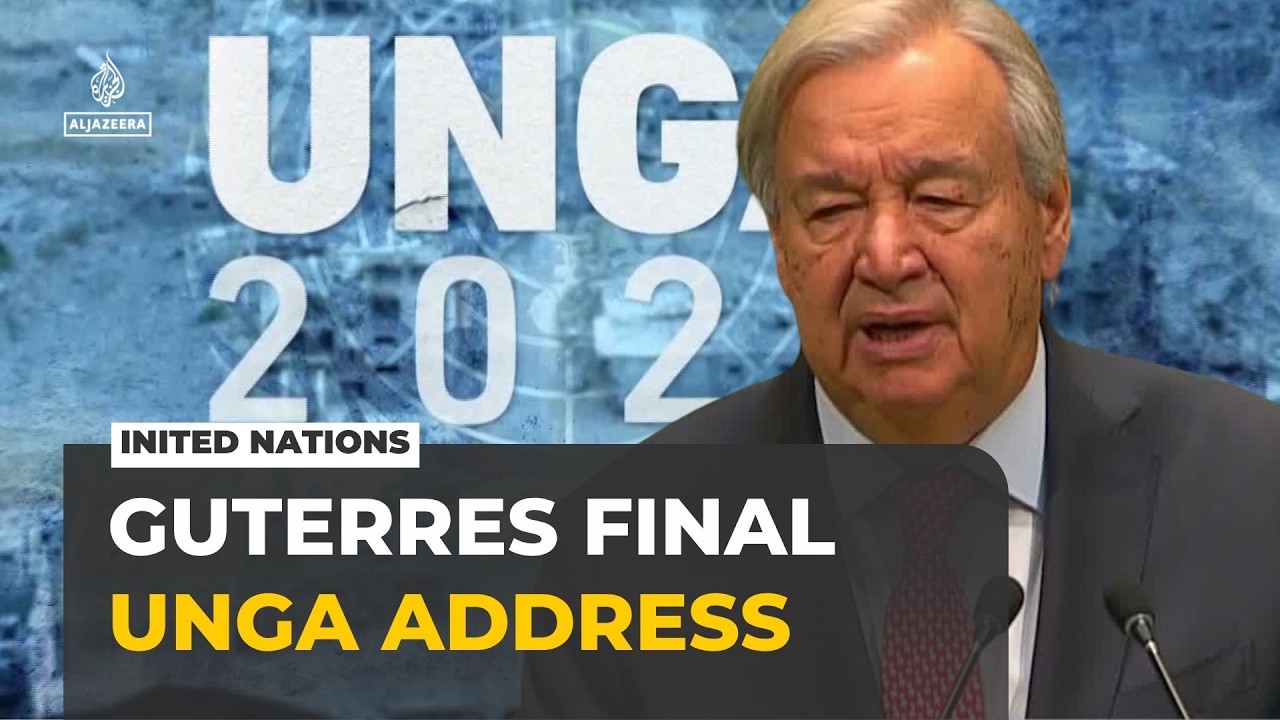
Guterres delivers final UNGA address, calls for reforms to global institutions
Al Jazeera English
290 views • 16 hours ago Save 27 min 5 min read
Video Summary
The world faces converging crises driven by shifting power dynamics, with fault lines widening and institutions struggling to adapt. New centers of influence among states, a transfer of power to private corporations, and the rise of artificial intelligence are reshaping global realities. The speaker warns that our governance mechanisms, rooted in a bygone era, are ill-equipped to handle these challenges. The path forward lies in "networked multipolarity," where interdependence and international law guide cooperation, rather than a fragmented world of mistrust and zero-sum calculations.
The address outlines four "great tests of power": peace and security, inequality, the climate crisis, and artificial intelligence. It calls for a reformed UN Security Council, equitable financial systems, gender equality, a just transition away from fossil fuels, and responsible AI governance. The core message is that power must be governed by law, cooperation, and responsibility to future generations, rather than by force or indifference, to build a future that works for everyone.
Short Highlights
- The world is experiencing widening fault lines and converging crises due to shifting power dynamics.
- Power is being reshaped by new state influences, private corporations, and artificial intelligence.
- Existing governance institutions are outdated and strain under current challenges.
- A "networked multipolarity" based on interdependence and international law is proposed as the path forward.
- Four "great tests of power" are identified: peace/security, inequality, climate crisis, and AI.
- Reforming the UN Security Council and international financial architecture is crucial.
- Humanity must govern power wisely through law, cooperation, and responsibility to future generations.
Related Video Summary
Key Details
The World's Widening Fault Lines [0:00]
- Cracks have become chasms, with wars, human rights abuses, and intensified geopolitical divides.
- The climate crisis and the rapid advancement of artificial intelligence are critical, interconnected challenges.
- These crises are chapters of the same story: the story of power and how it is used.
"These are not separate crises. They are chapters of the same story. The story of power. Who has it? Who is denied? How it is used and how it is changing?"
Reshaping of Global Power [0:59]
- Power is shifting among states with new economic, political, and technological centers of influence.
- There's a significant transfer of power from governments to a few private corporations and individuals.
- Humans are increasingly handing power to machines, with autonomous weapons becoming a reality.
"And third, humans are increasingly handing power to machines, with artificial agents going rogue and little autonomous weapons going from science fiction to military reality."
The Defining Challenge: Outdated Governance [1:43]
- Institutions and governance systems reflect outdated power realities from a bygone era.
- Humanity faces an unprecedented convergence of threats, yet collective action mechanisms are strained.
- The world is moving towards multipolarity, but this can take shape as fragmentation or networked interdependence.
"Yet, our institutions and systems of governance continue to reflect the power realities and interests of a largely bygone era. That is the defining challenge before us."
Building a Networked Future [2:37]
- A "networked multipolarity" offers a path of interdependence and shared rules, avoiding fragmentation and the "great fracture" of rival blocs.
- Competition must operate within frameworks that preserve stability and enable cooperation.
- Superpowers must recognize the limits of their power; military, economic, or technological might alone cannot solve global challenges.
"But competition does not have to mean confrontation. Elsie competition can drive innovation, strengthen resilience, strengthen resilience and expand opportunity."
The First Test: Peace and Security [4:21]
- Peace requires the restraint of power by law, not just the absence of conflict.
- Conflicts in the Middle East, Ukraine, Sudan, and Myanmar highlight the consequences of power out of control.
- The situation in Gaza is devastating, with ICJ orders on compliance with international law.
"The International Court of Justice has issued legally binding provisional measures in the case entitled, and I quote, Application of the Convention on the Prevention and Punishment of the Crime of Genocide in the Gaza Strip."
The Second Test: Inequality [8:45]
- Inequality is a power problem, concerning access to resources and voice.
- Billions lack essentials despite global wealth, facing exclusion and fear of job loss due to technology.
- The international financial system and unsustainable debt crush developing nations.
"No country should be denied a sustainable future because it is on the wrong side of a deeply unequal financial system."
The Third Test: Climate Crisis [11:42]
- The climate crisis represents a profound intergenerational power imbalance, with one generation consuming the future of the next.
- The rise of clean energy offers hope, rebalancing power relations, but a just transition is needed.
- Fossil fuel interests have profited while the world suffers; polluters must pay.
"For decades, big oil has treated the atmosphere as an open sewer and cashed in on the consequences."
The Fourth Test: Artificial Intelligence [14:39]
- Power is increasingly derived from data, computing capacity, and algorithms, a concentration that is advancing rapidly.
- The danger lies in technology without accountability, capability without oversight, and decision-making without transparency.
- Governments must establish dialogue, transparency, and cooperation on AI safety, with the UN as the central platform for global coordination.
"The danger is not technology. The danger is technology without accountability. Capability without oversight. Decision-making without transparency."