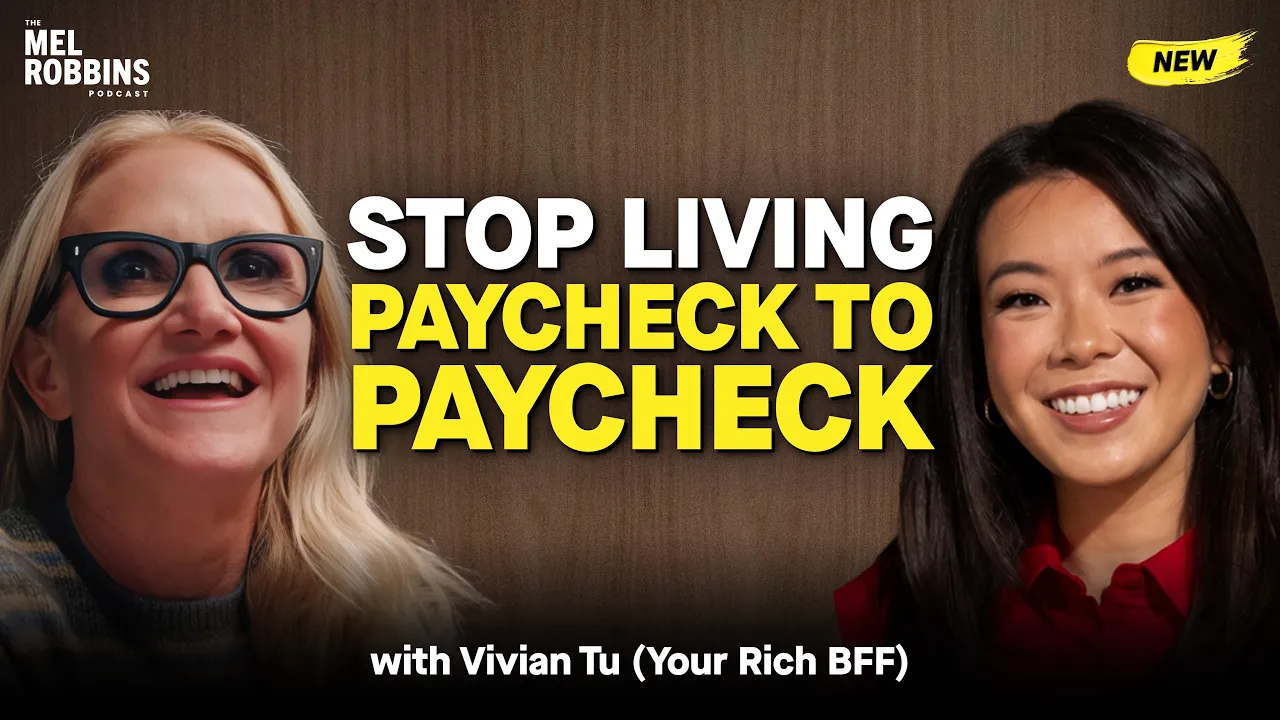
How to Stop Living Paycheck to Paycheck & Finally Get Ahead
Mel Robbins
34,080 views • 22 hours ago Save 60 min 5 min read
Video Summary
In a candid conversation on The Mel Robbins Podcast, personal finance educator Vivian Tu, also known as "your rich BFF," reveals that the "American dream" is unattainable for many due to systemic economic design. Tu argues that while wages have stagnated, the costs of housing, education, and living have skyrocketed, creating a system that benefits the wealthy and penalizes the poor. She emphasizes that regaining control of one's finances is paramount to achieving power and freedom, enabling individuals to become the "captain of their own ship."
Tu shares her own past struggles with debt and overspending, stemming from a frugal upbringing and the pressure to keep up appearances despite a high-paying Wall Street job. She debunks the myth that financial struggles are a moral failing, highlighting that external factors like economic policy play a significant role. The core message is one of empowerment: by shifting to an internal locus of control and implementing actionable strategies, individuals can improve their financial situation, regardless of their starting point. Tu offers practical advice on managing spending, building savings, increasing income, and investing, stressing that it's never too late to start taking control of one's financial future.
Short Highlights
- The "American dream" is designed to benefit the rich and disadvantage the poor due to rising costs of living and stagnant wages.
- Financial control equates to power and freedom, allowing individuals to steer their own lives.
- Past financial mistakes are not insurmountable; it's never too early or too late to start improving your financial situation.
- Economic hardship is not a moral failing; systemic issues often contribute to financial struggles.
- Cultivating an internal locus of control—believing you can influence your financial outcomes—is crucial.
- Key strategies include auditing spending, building savings, increasing income, and investing wisely.
- Taking control of your finances empowers you to make choices that align with your life goals.
Key Details
The Illusion of the American Dream [0:00]
- The current economic system is designed to favor the wealthy, making the traditional American dream unattainable for many.
- Exponential increases in housing, education, and cost of living have not been matched by wage growth.
- This disparity creates a situation where individuals are asked to do more with less.
"The American dream is dead, and it was designed that way because we are feeding the rich and starving the poor."
Money as Power and Freedom [1:15]
- Having money provides power and freedom, allowing individuals to be in control of their own lives.
- Many people feel a lack of agency due to external factors, but financial control can restore this.
- Financial empowerment comes from having actionable steps to improve one's situation.
"When you have money, you have the power, you have the freedom, you get to be the captain of your own ship."
Overcoming Past Financial Mistakes [2:45]
- Vivian Tu shares her personal journey of making significant financial errors, including overspending and facing declined cards.
- She emphasizes that very few financial mistakes are irreversible, even for someone who didn't grow up with wealth.
- Her background as the daughter of Chinese immigrants instilled frugality, but her Wall Street career brought its own set of financial challenges.
"I am the person who would overspend. I'm the person who had to wait at a bar until 12:01 when my direct deposit hit to be able to afford my bar tab."
Systemic Economic Design [4:00]
- The current economy is structured to benefit those who already have money and penalize those who do not.
- Macroeconomic forces like politics and legislation significantly impact personal finances.
- These external factors are often beyond individual control, making personal financial management even more critical.
"The way our economy is currently designed really benefits people who have money and penalizes and treats not having money like it's a crime."
Internal Locus of Control [5:30]
- Shifting from an external to an internal locus of control is key to financial improvement.
- Those with an internal locus of control believe their actions cause outcomes, motivating them to make smart financial decisions.
- This mindset empowers individuals to actively work towards a better financial position.
"People who have an external locus of control think things are happening to them, and people with an internal locus of control think things are happening because of them."
The High Cost of Being Broke [7:00]
- Being broke is expensive due to fees like overdraft charges.
- There's a frustration in trying to appear financially stable when you are not, leading to a "consumption hamster wheel."
- Societal pressure often equates wealth with morality, making financial struggles feel like a personal failure.
"One, it's very expensive to be broke. Think about it, right? Who gets charged overdraft fees? From their bank."
The Cockroach Apartment Incident [8:45]
- Vivian recounts a devastating experience of having to break a lease due to a severe cockroach infestation in a dream apartment.
- This setback, costing her all her savings, served as a crucial wake-up call to improve her financial habits.
- It highlighted that smart decisions compound over time, just as bad ones do, eventually leading to change.
"And ultimately, that was the moment. The belt-tightening, come-to-Jesus moment for me, where I was like, I actually need to be better."
Re-framing the Cockroach Apartment Story [10:30]
- Mel Robbins reframes the cockroach apartment story as an example of financial power: Vivian had the means to leave a bad situation.
- This demonstrates how financial control allows escape from undesirable circumstances, like a bad apartment or job.
- The key change was Vivian's decision to stop