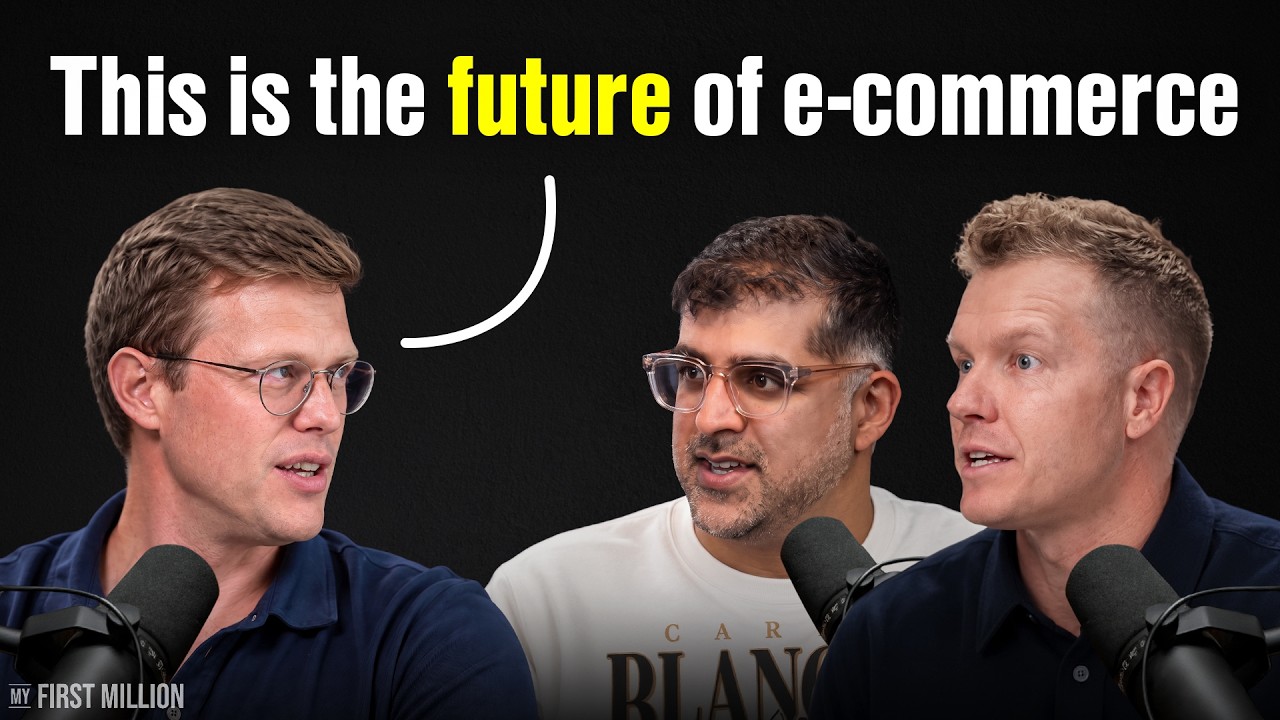
Whatnot founder: This is the future of e-commerce
My First Million
395 views • 16 hours ago Save 53 min 7 min read
Video Summary
From a near-dropout working in a deli to the founder of a $20 billion unicorn, Whatnot CEO Grant LaFontaine has redefined the digital marketplace by ignoring "visionary" myths in favor of gritty, user-driven execution. While skeptics once dismissed his platform as a niche site for Funko Pop collectors, LaFontaine leveraged viral growth hacks and an obsession with truth-seeking to scale Whatnot into a massive live-commerce ecosystem. By treating every business problem as a granular data challenge, he navigated the transition from a scrappy startup to a 1,400-employee powerhouse.
The company’s meteoric rise—from 30 sales in its first month to over $1 billion in annual volume—proves that massive scale often starts in the smallest, most overlooked corners of the market. LaFontaine’s insistence on "first principles" thinking and his refusal to rely on corporate jargon have created a culture that prioritizes raw performance over polished PR, positioning Whatnot to capitalize on an e-commerce shift that he predicts will eventually command 30% of the entire market.
Short Highlights
- Whatnot grew from 30 sales in its first month to over $1 billion in annual transaction volume in just a few years.
- The company initially targeted niche collectibles like Funko Pops to build a dedicated user base before expanding into broader categories.
- Early growth was driven by "gritty" tactics, including viral giveaway raffles and direct partnerships with niche influencers.
- LaFontaine rejects the "visionary founder" myth, instead prioritizing a customer-driven approach where the product evolves based on user feedback.
- The platform's success is built on live-streaming, which creates a more engaging, social shopping experience than static marketplaces like eBay.
- Future opportunities in the live-commerce space include:
- Wholesale supply marketplaces for sellers.
- Multi-channel networks (MCNs) dedicated to managing live-shopping operations.
- Specialized tools for inventory management and seller support.
Key Details
The $20 Billion Perspective [0:00]
- The company is now valued at $20 billion, exceeding the combined market caps of major brands like Wendy's, Under Armour, and Harley-Davidson.
- LaFontaine avoids focusing on the valuation, preferring to stay grounded in the daily work of solving problems.
I think we're pretty early in what we're doing. And so I just try not to think about it and just sort of look at, like, the problem ahead and put one step, one foot in front of the other.
The Origin in Tokyo [5:30]
- The idea for a marketplace business was born in a Tokyo bar where the founders bought 50 random domains.
- An initial attempt to build a "full-service Craigslist" failed due to unsustainable delivery costs.
We'll build like a better full service Craigslist, which is a horrific business idea, by the way.
Pivoting to Collectibles [7:50]
- The team analyzed eBay sales data via Terapeak to identify high-growth, underserved categories.
- They chose Funko Pops and Pokemon cards because the product experience had not evolved in 20 years.
We just felt like the product hadn't changed in 20 years materially. And it felt like it should.
Solving the Chicken-and-Egg Problem [10:15]
- In the early days, the founders acted as the primary sellers, authenticating inventory themselves to build trust.
- They used a pricing algorithm to scrape competitor sites and ensure they could secure inventory at profitable margins.
We were initially the, the, the seller on whatnot. And so all of the early inventory was, was us.
The Viral Giveaway Hack [12:30]
- To acquire users, they held weekly raffles for high-value "grail" items.
- The referral system rewarded users with more entries for sharing the platform, effectively taking over relevant subreddits and social groups.
In order to be able to enter, you would have to share. And we sort of built these mechanics where you could sort of have like unlimited sharing.
The First Major Flop [14:15]
- The first giveaway resulted in only 104 entries and zero sales, creating significant financial stress.
- They persisted, iterating the mechanic until it achieved exponential growth in participation.
The first, the first one was definitely a flop. So we gave away this like $500 item. And I think 104 people, there were 104 entries total in the raffle.
Launching Live Selling [16:20]
- The pivot to live-streamed auctions in July 2020 served as the primary catalyst for massive growth.
- The format allowed sellers to build more personal connections and move more inventory than traditional listings.
In July of 2020 is when we launched our first version of Alive and and that's when the business really started to take out.
Y Combinator and Early Funding [17:45]
- The founders raised roughly $250,000 from Y Combinator during the early stages of the pandemic.
- They focused on execution and speed, launching their product in just one week to prove viability.
We built our product for the YC interview in like a week like we built it and launched it and pushed it live.
Scaling from Millions to Billions [19:30]
- Transaction volume grew from roughly $2 million in 2020 to over $1 billion shortly thereafter.
- The platform benefited from the pandemic-era shift to online shopping but maintained growth through cross-category pollination.
The core live experience we built is really fun and and on the seller side you know transformational for business building.
Avoiding Corporate Gobbledygook [21:00]
- LaFontaine warns against hiring "big fancy executives" who rely on generic corporate strategies rather than specific, detailed execution.
- He emphasizes the need to be maniacally focused on the actual problems rather than following a pre-ordained "visionary" path.
I think one of the mistakes we made early on the business was just trying to be you know too corporate for lack of a better word.
Developing an Operating System [22:15]
- As the company reached 1,400 employees, LaFontaine had to implement formal systems and rhythms to maintain accountability.
- He shifted his management style to be less abrasive while maintaining high standards for truth-seeking.
You have to learn how to like construct an operating rhythm across the business.
The Socratic Method at Work [25:00]
- Inspired by his time at Twitch, LaFontaine uses a Socratic method to strip away assumptions and reach the root of business problems.
- He challenges team members to explain complex issues at a "middle school" level to ensure true understanding.
If you can't explain it to me like I'm in middle school you probably actually don't know what you're talking about.
Learning from Failure [27:30]
- A negative experience at Facebook, where a politicized project was managed poorly, taught LaFontaine how not to lead.
- He prioritizes empathy to ensure his team remains motivated to do their best work.
The way that was handled was never going to make me want to do more great work.
The Future of Live Commerce [30:00]
- LaFontaine predicts live commerce will eventually account for 30% of all e-commerce, up from current single-digit percentages.
- He believes the US market will eventually mirror the scale seen in China, where live shopping is a massive industry.
I think you're going to see over the next decade that live commerce will be 30 plus percent of all e-commerce.
Supporting the Ecosystem [31:30]
- The largest sellers on the platform are now running operations with 150-200 employees, built entirely on Whatnot.
- New business opportunities are emerging in wholesale supply and multi-channel management for these sellers.
There's going to be an immense number of really large businesses built.
Final Reflections [33:00]
- LaFontaine remains focused on the future, noting that he only reflects on the company's success for brief moments before returning to work.
- He emphasizes that his goal is to continue building and taking care of his family and employees.
It doesn't do me any good batting myself on the back that doesn't get me to the next step.