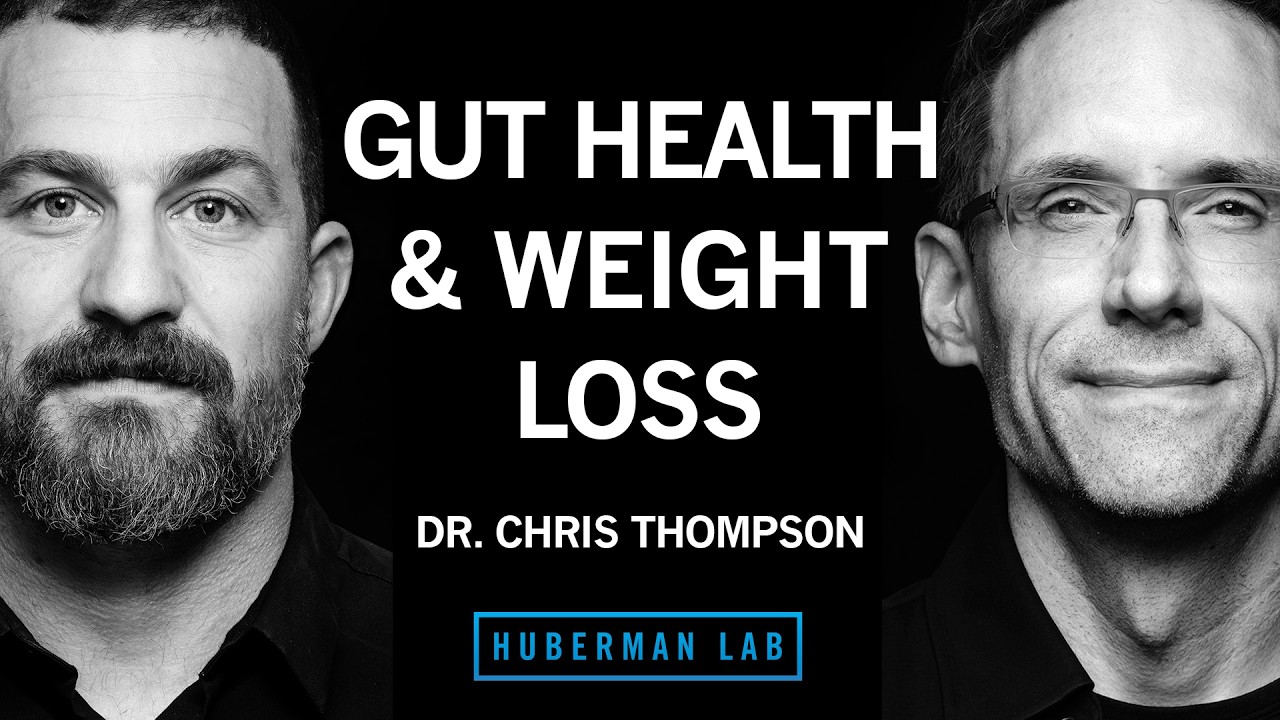
Best Tools for Gut Health & Weight Loss | Dr. Chris Thompson
Andrew Huberman
5,820 views • 15 hours ago Save 140 min 7 min read
Video Summary
The gastrointestinal tract is far more than a simple digestion tube; it acts as a sophisticated endocrine organ and the body's 'second brain.' When the gut microbiome is starved of fiber, it begins to consume the vital mucus lining of the intestinal wall, triggering a cascade of metabolic dysfunction, inflammation, and loss of barrier integrity. Maintaining this barrier is essential, as the gut's communication with the rest of the body regulates satiety, glucose metabolism, and overall systemic health.
Modern gastroenterology is shifting from reactive medicine to proactive, targeted interventions. By leveraging advanced endoscopic techniques, AI-assisted surgical guidance, and even gene therapy, experts are moving beyond broad-spectrum drugs toward personalized treatments that restore natural gut physiology. These innovations aim to address the root causes of metabolic disease, such as the loss of metabolic flexibility and the degradation of tight junctions, offering hope for long-term health beyond the limitations of current weight-loss medications.
Short Highlights
- The gut is a complex endocrine organ that requires dietary fiber to feed beneficial microbes and maintain the protective mucus layer.
- A healthy microbiome produces butyrate, which is critical for maintaining tight junctions and regulating metabolic signals like GLP-1.
- Metabolic dysregulation follows a predictable sequence: calorie excess, high fasting insulin, ectopic fat accumulation, and loss of metabolic flexibility.
- Standard screening for colon cancer should begin at age 45, or earlier based on family history, using colonoscopy or genetic stool tests.
- Intermittent fasting and time-restricted eating generally offer metabolic benefits that outweigh concerns regarding temporary gut microbiome shifts.
- Fermented, low-sugar foods like kefir and kimchi help reclaim microbial diversity and reduce inflammatory markers.
- Modern endoscopic procedures can now treat conditions like obesity and diabetes by mechanically and chemically resetting gut signaling pathways.
Key Details
The Digestive Tract's Role [0:05:44]
- The esophagus transports food safely, while the stomach acts as a reservoir that stretches to accommodate meals and secretes ghrelin.
- The small bowel is a one-cell-thick barrier responsible for nutrient absorption, relying on goblet cells and tight junctions to maintain integrity.
And if you're not feeding them fiber, they'll eat your mucus layer, okay? And we already talked about how thin that barrier is.
Colon Health and Cancer Screening [0:13:30]
- The colon relies on the microbiome to produce short-chain fatty acids like butyrate, which are vital for metabolic signaling.
- Colon cancer screening is recommended starting at age 45, with options including genetic stool tests like Cologuard or diagnostic colonoscopy.
In our line of work, it's the most frequent cause of cancer, unfortunately.
Swallowing Difficulties and Zenker's Diverticula [0:18:25]
- Difficulty swallowing can result from structural issues like Zenker's diverticula, where food traps in esophageal pockets.
- These conditions can be treated with minimally invasive endoscopic procedures that avoid traditional surgery.
It is something that should probably be taken seriously and looked at, even though it sounds funny, you know, it is something that can be a real problem.
Bowel Movement Metrics [0:21:09]
- A healthy bowel habit typically ranges from three movements per day to one every three days, with consistency being key.
- Hard, pebble-like stools often indicate insufficient fiber intake, which is common in Western diets.
The rule of thumb is, you know, you don't want to have more than three a day, and you don't want to go longer than three days without having a bowel movement.
The Importance of Fiber [0:23:05]
- Fiber is essential for feeding the microbiome; without it, bacteria may degrade the gut's mucosal barrier.
- Resistant starch supplementation has shown promise in improving fatty liver and insulin sensitivity.
It's like feeding microbes, you know, or they're going to eat you, right?
Fermented Foods and Inflammation [0:27:42]
- Low-sugar fermented foods like kimchi and kefir act as both prebiotics and probiotics to improve microbial diversity.
- These foods help maintain an acidic gut environment, which protects against the colonization of pathogenic organisms.
They're beneficial for a variety of reasons. You know, one, they're prebiotic, right? So you're feeding your microbiome things they want, which is phenomenal.
Understanding Ulcers [0:30:17]
- While H. pylori is a primary cause of gastric ulcers, stress and microvascular ischemia also play significant roles.
- Ulcers can arise from complex factors, including lifestyle and individual physiological susceptibility.
Stress can play a role. You know, it is certainly complicated.
GLP-1 Medications and Adherence [0:33:10]
- GLP-1 drugs have revolutionized obesity treatment but face high discontinuation rates due to side effects and administration fatigue.
- Muscle loss is a significant concern, emphasizing the need for resistance training while on these medications.
There's a number, over a million people a month are coming off GLP ones, right? And it's for a variety of reasons.
The Evolution of Weight Loss Surgery [0:40:22]
- Early surgeries focused on malabsorption, which often led to severe complications like renal failure.
- Modern procedures, such as sleeve gastrectomy, focus on hormonal and mechanical signaling to achieve sustainable weight loss.
The first procedures were focusing on malabsorption, right? So the idea was they're going to bypass a portion of the small bowel so that you don't absorb your calories.
Hunger and Satiety Hormones [0:46:17]
- Ghrelin, secreted in the fundus of the stomach, acts as the primary hunger signal, while CCK, PYY, and GLP-1 promote satiety.
- New drugs like retitrutide target multiple pathways, including GLP, GIP, and glucagon, to enhance weight loss and muscle preservation.
Ghrelin is one to watch because we actually use ghrelin. We work with ghrelin. It's one of the mechanisms we use to get our treatment effects.
Metabolic Dysregulation Sequence [0:55:10]
- Metabolic disease follows a progression: calorie excess, elevated fasting insulin, ectopic fat accumulation, and insulin resistance.
- Monitoring fasting insulin and glucose spikes via CGM can provide early warnings before traditional markers like A1C become abnormal.
Metabolic dysregulation follows a fairly predictable sequence, right? First, it's calorie excess.
AI in Surgical Practice [1:05:07]
- AI is beginning to provide real-time coaching during procedures, highlighting structures and grading performance to ensure safety.
- Robotics combined with AI may eventually democratize high-level surgical skill, reducing variability between surgeons.
AI starting to have an impact where it can actually coach you through procedures, which is kind of- How does that work? You have an earbud in or something?
The Reality of Leaky Gut [1:15:35]
- Increased gut permeability is a scientifically validated phenomenon linked to metabolic conditions like MASH.
- Disorganized tight junctions allow bacterial products like LPS to enter the bloodstream, triggering systemic inflammation.
Increased gut permeability is 100% real. But that's, I mean, I'm not pushing back on you. That sounds like a different language for leaky gut.
Artificial Sweeteners and Fats [1:21:40]
- While artificial sweeteners are generally preferred over high-fructose corn syrup, they are often found in highly processed foods.
- Olive oil remains the gold standard for healthy fats, while the debate over seed oils often ignores the impact of processing and oxidation.
Olive oil is the best, obviously, and then small amounts of butter.
The Body's Weight Set Point [1:26:00]
- Rapid weight loss often triggers hormonal countermeasures, including increased ghrelin and decreased satiety signals, leading to weight regain.
- Endoscopic procedures like ESG help by mechanically suppressing ghrelin and providing a physical satiety signal.
The body's smaller. So it burns less weight, okay? So you have to eat less to just maintain the same weight you're at now.
Future Gene Therapy [1:33:15]
- Researchers are exploring gene therapy to create nutrient-responsive GLP-1 secretion directly in the pancreas.
- This approach aims to provide a one-time treatment that mimics natural physiology rather than relying on constant exogenous drug administration.
They've developed a viral vector, right, that has the gene for GLP-1 in it. And they're using the promoter for the beta cell insulin gene, right?


![why stocks are skyrocketing [spoiler: it's just getting started]](https://i.ytimg.com/vi/ImLNQWvwLus/hqdefault.jpg)