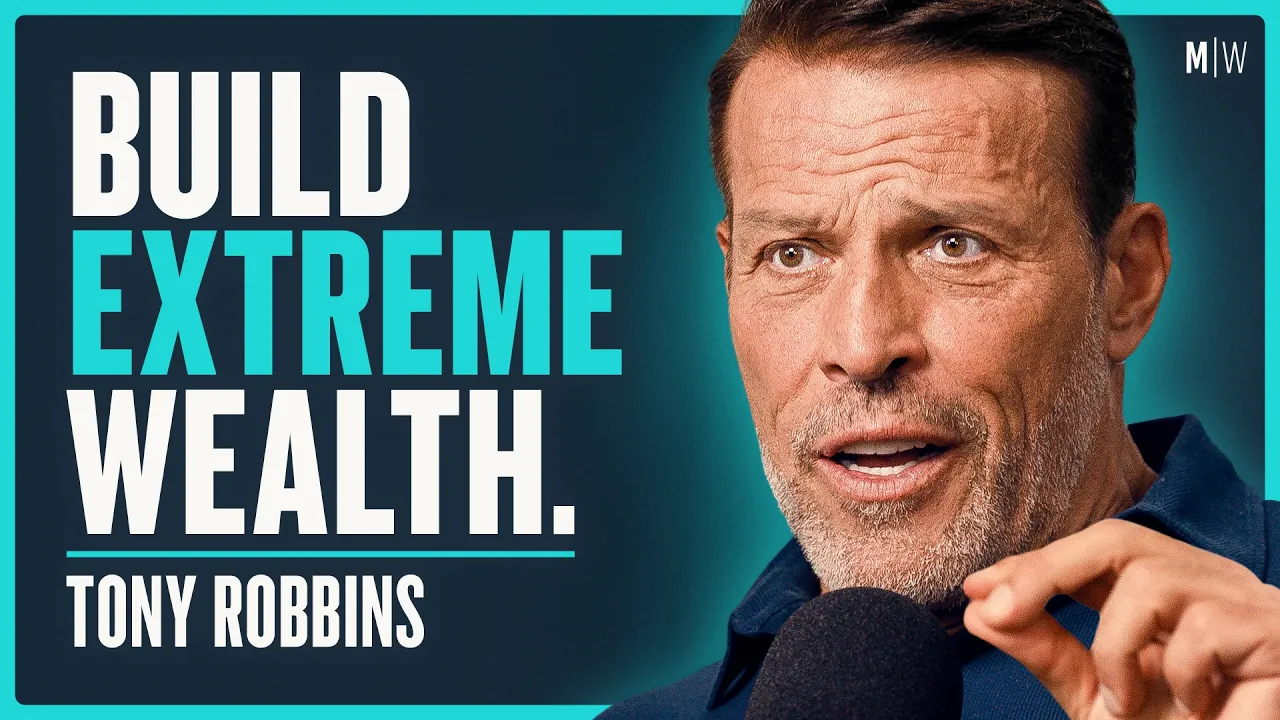
The New Way For Ordinary People To Build Wealth - Tony Robbins (4K)
Chris Williamson
1,094 views • 17 hours ago Save 84 min 6 min read
Video Summary
The traditional advice to dump all your money into the S&P 500 is increasingly dangerous, as market correlations have spiked to 82%, meaning most assets now crash in unison. To truly protect wealth and achieve superior returns, investors must pivot toward private equity and non-correlated assets that function independently of broad market volatility.
By adopting the "Holy Grail" of investing—a portfolio of eight to 12 uncorrelated assets—investors can reduce risk by 80% while capturing higher growth. This strategy, once reserved exclusively for the ultra-wealthy, is now becoming accessible to everyday investors through recent regulatory changes, allowing them to own stakes in professional sports franchises, private credit, and cutting-edge technology ventures.
Short Highlights
- The S&P 500 is no longer a safe haven due to record-high correlations between stocks.
- The "Holy Grail" of investing involves holding 8-12 non-correlated assets to reduce risk by 80%.
- Private equity has historically outperformed public markets, returning 15.7% vs. 9% for the S&P 500 over 39 years.
- Regulatory changes now allow non-accredited investors to access alternative assets for as little as $2,500.
- Wealthy investors allocate 52% of their capital to private markets, compared to only 29% in public stocks.
- True diversification requires assets that "zig and zag" independently, such as sports franchises, private credit, and venture capital.
- Asymmetric risk-reward is the core principle: never risk a dollar unless you have a high probability of making five.
Key Details
The Rigged Game [00:01:14]
- The financial system often rewards those who caused economic crises with more capital rather than punishment.
- The average person feels the game is rigged because they lack access to the tools used by the ultra-wealthy.
- "I'm going to interview 50 of the smartest financial investors in history... and I'm going to find from them whether the game is really winnable still."
Protecting Downside Risk [00:03:00]
- The best investors on earth focus primarily on not losing money rather than chasing high returns.
- Losing 50% of an investment requires a 100% gain just to break even.
- "The best investors on earth are all about don't lose money, which is so counterintuitive, but they do it by asset allocation."
Asymmetric Risk Reward [00:03:36]
- Professional traders aim to risk one dollar to make five, allowing them to be wrong four out of five times and remain profitable.
- This mindset is the opposite of the average person who takes massive risks hoping for a lucky payout.
- "He could be wrong four out of five times and be in good shape. Whereas the average person doesn't think that way."
The Nickel Principle [00:04:36]
- A riskless investment is rare, but tangible assets like nickels offer a unique hedge against government currency debasement.
- The melt-down value of older metal currency often exceeds its face value.
- "I called the federal reserve and said, how many nickels do you have? And I bought all the nickels they would sell me."
The Holy Grail of Investing [00:06:05]
- Ray Dalio defines the Holy Grail as holding 8-12 non-correlated investments to reduce risk by 80%.
- Most public assets are now highly correlated, meaning they all crash together during market stress.
- "I found out that if you will confine eight to 12 non-correlated investments, and they're things you believe in, you reduce your risk by 80% and increase your upside."
Private Equity Dominance [00:07:07]
- Private equity has outperformed the S&P 500 for 39 consecutive years.
- A million dollars in the S&P 500 grew to $28.7 million, while the same amount in private equity grew to $293 million.
- "Average private equity... averaged 15.7% returns. The S and P 500 of those 39 years is 9%."
The Shift in Public Markets [00:09:55]
- The number of public companies has halved from 8,000 to 4,000 over the last 30 years.
- 87% of all companies are now private, meaning the best growth opportunities are no longer on the stock exchange.
- "There used to be 8,000 companies 30 years ago. Now there's only 4,000 in the public markets."
The Magnificent Seven Trap [00:10:45]
- The "Magnificent Seven" tech stocks now account for roughly 32% of the S&P 500, creating massive concentration risk.
- When these seven stocks sell off, the entire index suffers disproportionately.
- "If one is zigging, the other is zigging as well. So they all get hit together."
New Access for Everyone [00:14:15]
- Recent SEC rule changes allow non-accredited investors to access alternative funds for as little as $2,500.
- The Department of Labor is working on rules to allow alternative investments in 401k plans.
- "People do not have to be an accredited investor anymore to invest in certain types of funds which own alternative assets."
Sports as an Asset Class [00:16:30]
- Professional sports franchises are non-correlated, recession-proof assets with a legal monopoly in their cities.
- These teams have evolved into modern media organizations that generate revenue regardless of market conditions.
- "In the last 10 years, they've had an 18% compounded return. But if you look at through history, through wars... sports have always done well."
The Military-Tech Pivot [00:20:00]
- Private companies like Saronic and Anduril are developing autonomous defense technology that is changing warfare.
- Investors can now gain exposure to these high-growth sectors that were previously locked behind institutional doors.
- "You can't use a Tomahawk missile to shoot down a 30,000 drone. So you have to come up with other ways to protect your people."
The Danger of Leverage [00:24:20]
- Leverage is dangerous for most investors because they lack the "staying power" to survive margin calls during volatility.
- Emotional reactions to market drops often lead to selling at the worst possible time.
- "If you can't see it turn into 50 cents overnight, you don't belong in it."
The Three-Bucket Strategy [00:27:00]
- Investors should divide wealth into a Security bucket (low risk), a Growth bucket (asymmetric risk), and a Dream bucket (lifestyle).
- When the Growth bucket produces a win, take a third and move it to Security to ensure long-term stability.
- "When they grow in their growth bucket... we say, take a third and put it in your security bucket."
The Power of Giving [00:32:30]
- Philanthropy and tithing are described as high-ROI activities that provide internal joy and purpose.
- Scaling charitable goals, such as feeding a billion people, creates a "why" that drives business growth.
- "If you don't give a dime out of a dollar, you're never going to give 10 million out of a hundred million."
Decision-Making Framework [00:39:50]
- Use the OOCMR process: Outcomes, Options, Consequences, Evaluate, Mitigate, and Resolve.
- Decisions should be made on paper, not in the head, to remove emotional bias.
- "The most important thing in decision-making is value clarification. When you know what's most important to you, you can make a decision."
The Energy Supply Crisis [00:37:30]
- Global energy demand is growing, but supply is flatlining, with a potential crossing point in 2028.
- AI and data centers will consume massive amounts of power, making energy a critical investment sector.
- "We're consuming at five times faster the rate than what we're creating new energy."