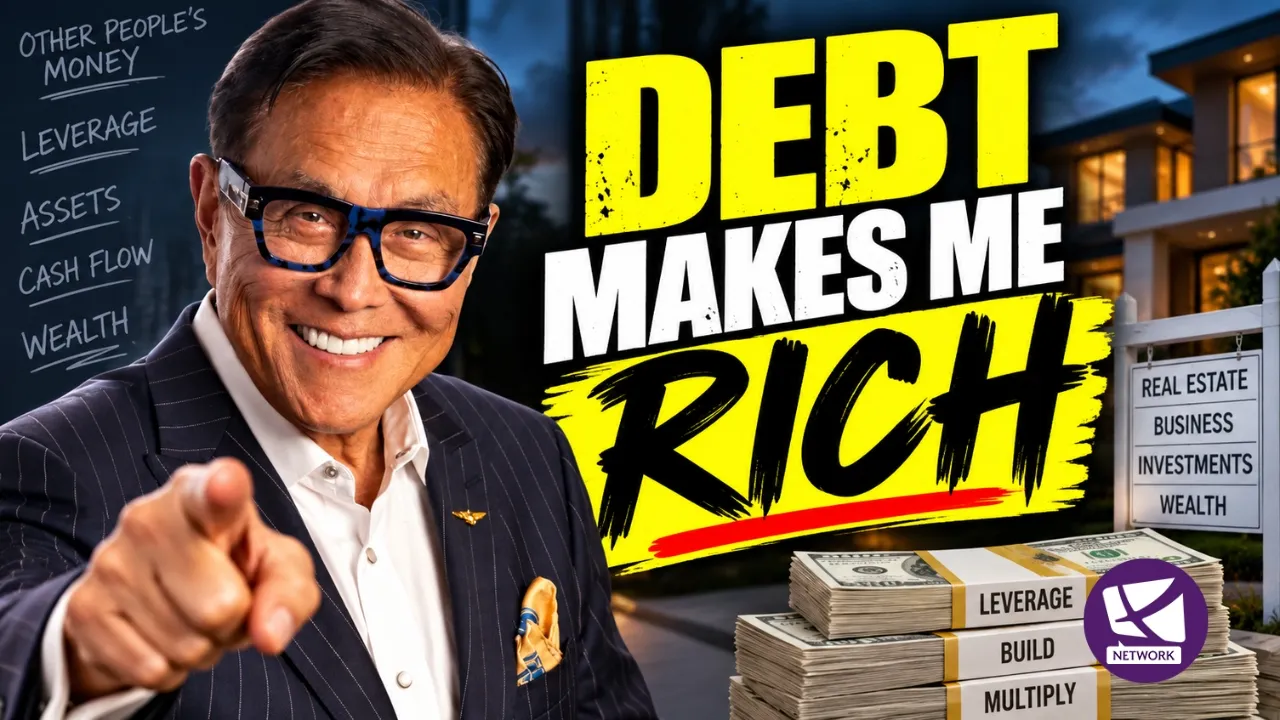
Robert Kiyosaki: Why I Use Debt Instead of Avoiding It
The Rich Dad Channel
263 views • 16 hours ago Save 17 min 6 min read
Video Summary
The US economy is on shaky ground, with maturing debt and crashing real estate markets presenting both peril and opportunity. Office buildings, once prized assets, are now facing obsolescence, with cities even subsidizing conversions to apartments. This downturn, however, creates a "buyer's market" for savvy investors who understand the power of debt and "other people's money" (OPM).
While amateur investors who jumped in late are facing losses, experts like Robert Kiyosaki and Ken McElroy highlight strategies for success. They emphasize that "your profit is made when you buy," advocating for a cash-flow strategy over capital gains and demonstrating how to achieve "infinite returns" by leveraging debt and equity. The core message is that understanding and utilizing debt, rather than avoiding it, is key to navigating financial challenges and capitalizing on market downturns.
Short Highlights
- Real Estate Crisis Creates Opportunities: While parts of the real estate market are in serious trouble, this downturn presents significant opportunities for informed investors.
- Debt is Essential, Not Evil: The US dollar is debt, and understanding how to use debt is crucial for financial success, contrary to advice to live debt-free.
- Office Buildings Facing Collapse: Once sought-after office buildings are now in decline, with cities offering incentives for their conversion into apartments.
- "Profit is Made When You Buy": Successful investing hinges on smart acquisition, focusing on cash flow rather than speculative capital gains.
- Leveraging "Other People's Money" (OPM): The principle that "lazy people use their own money" highlights the importance of using OPM for investment.
- Achieving "Infinite Returns": Sophisticated strategies allow investors to borrow out equity and gains, effectively getting their initial investment back tax-free and achieving infinite returns.
Related Video Summary
- Insiders' special 25th anniversary edition + the future of Australian politics | Insiders | ABC NEWS
- How the Rich Legally Pay Zero Taxes With Real Estate | ENCORE - Robert Kiyosaki, Kim Kiyosaki
- Asking Billionaires How They Got RICH! (Philadelphia)
- BlackRock's Rieder on Jobs Report, Fed Rates and Bonds
Key Details
Real Estate's Double-Edged Sword [0:00]
- The US economy faces significant challenges, particularly in the real estate sector, with maturing debt posing a major threat.
- However, these difficult times also create fertile ground for opportunistic investors who understand the market.
"And the subject is real estate, basically. And it's important, simply because it's real estate. You know, real estate's, parts of it are in serious, serious trouble right now."
The Paradox of Debt [1:00]
- The US dollar itself is a form of debt, making the concept of living entirely debt-free counterintuitive for wealth building.
- While advice to live debt-free is sound for those unfamiliar with managing debt, understanding and utilizing debt is presented as a key financial skill.
"And you may or may not know this, but the US dollar is debt. In other words, money cannot exist unless somebody borrows it."
Office Buildings in Peril [2:00]
- Office buildings are identified as one of the most troubled real estate sectors, with many expected to crash.
- Cities are actively trying to mitigate this by offering incentives for converting these buildings into apartments, acknowledging their potential to become eyesores.
"Some of the worst properties are the darling, it's called office buildings. Everybody thought, oh, I'm gonna own an office building in Manhattan and all this. And today they're gonna crash."
The "Fight the Fed, Be the Fed" Strategy [3:30]
- The current economic climate is described as strange and challenging, but also a period of great opportunity.
- A strategy of "being the Fed" by understanding and mirroring its actions is suggested as a way to navigate these markets.
"You actually did a closed event for us, and it was instead of fight the Fed, be the Fed."
The Disconnect Between Buyers and Sellers [4:30]
- Despite the market challenges, deals are still being made, though there's a significant gap between what sellers want and what buyers can offer.
- This disconnect is largely driven by the increased cost of debt (higher interest rates), which reduces purchasing power.
"So there's still deals. There's still, you know, there's a big disconnect between the seller and the buyer for sure. And the difference of course is the debt price."
The Amateur Investor's Plight [6:00]
- The current market conditions are causing amateur investors, who may have entered the market during its peak, to struggle.
- Unlike liquid assets like stocks, real estate is illiquid, making it difficult for unprepared investors to exit losing positions quickly.
"And the reason Kim and I invest with Kenny cause your partner's a former banker. Yep. Ross. Yeah. The best. And I tell you, it's, it is a game of debt. It is."
Opportunities Emerge from Crisis [8:00]
- The period since 2008, with its low interest rates, inflated asset bubbles across real estate, bonds, and stocks, is now seeing those bubbles burst.
- The biggest opportunities arise when "bodies start floating to the surface"—a metaphor for distressed assets becoming available at significant discounts.
"The biggest opportunities float when the bodies start floating, you know, when the bodies start floating to the surface, they go, Oh my God, I can't believe that came up."
The "Profit is Made When You Buy" Philosophy [10:00]
- The core investment principle emphasized is that profits are realized at the time of purchase, not sale.
- This contrasts with a capital gains strategy (flipping) and highlights the importance of acquiring cash-flowing assets.
"And then the cashflow versus capital gains strategy that you laid out and Bridgette Portet. People, this is the time where you're gonna start to realize that philosophy."
The "Infinite Return" Strategy [35:00]
- An "infinite return" is achieved when an investor can borrow out their initial investment and any subsequent gains, leaving them with zero capital at risk.
- This is accomplished through strategic refinancing, where new debt is used to pay back initial equity and debt holders, and importantly, borrowing against gains is tax-free as it's not a sale.
"Let's say Robert, Robert and Kim give me a million bucks. I pair it up with another nine. We buy a $10 million property. I grow the value to 15. I go to the bank and I put another $10 million loan on it."
Truth and Financial Reality [40:00]
- A key insight is that financial struggles often stem from being "farther from the truth."
- The concept that one's reality or perception can be distant from objective truth, impacting health and wealth, is explored.
"And the instructor said that the reason people are poor is because they're farther, farther from the truth."