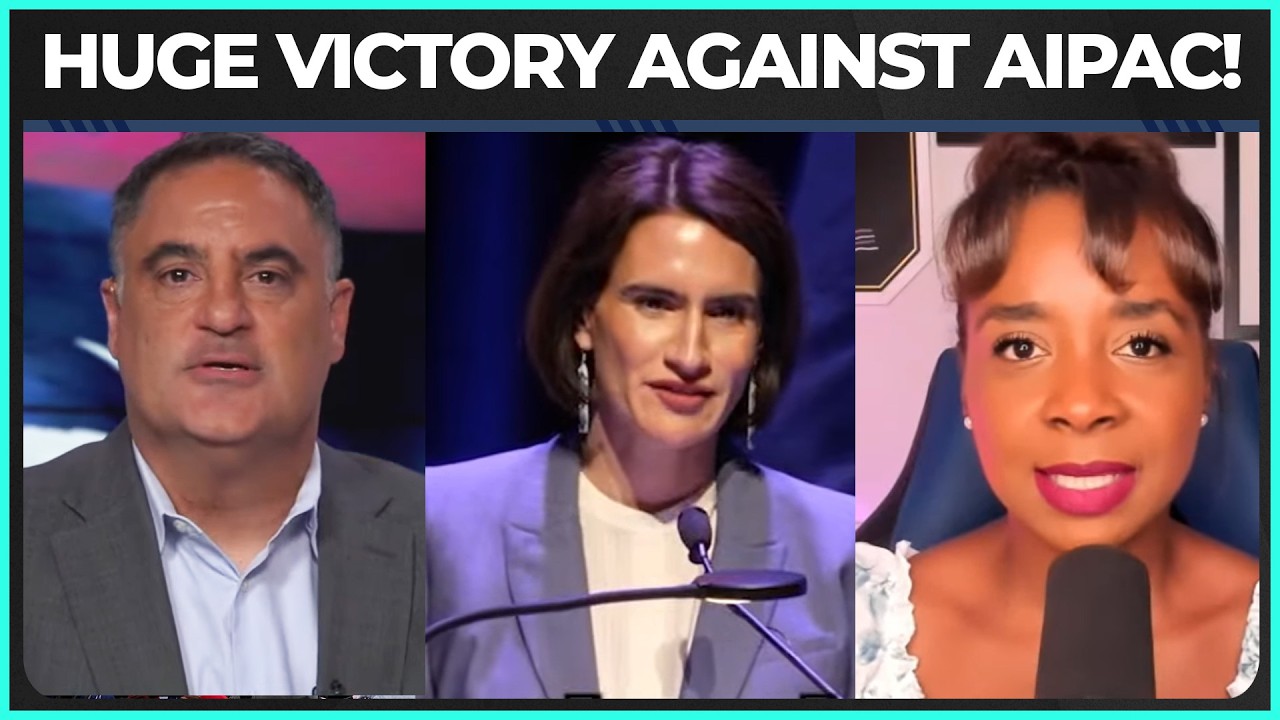
AIPAC Gets DEFEATED In Minnesota
The Young Turks
110,511 views • 2 months ago Save 21 min 6 min read
Video Summary
Despite mainstream media focus on progressive losses, AIPAC suffered significant defeats in Minnesota elections. Progressive candidate Peggy Flanagan won the Senate race against Angie Craig, who was heavily funded by AIPAC. Flanagan explicitly rejected AIPAC's support, stating her values did not align with the organization.
In another Minnesota race, Matt Little decisively defeated candidates Matt Klein and Kayla Berg. AIPAC reportedly funded both Klein and Berg in a strategy to undermine Little, but this tactic backfired. These victories highlight a trend where progressive candidates, focusing on domestic issues and running against "the many or the money," are successfully challenging well-funded establishment campaigns.
Short Highlights
- AIPAC experienced significant defeats in Minnesota elections.
- Peggy Flanagan won the Senate race against Angie Craig, who received substantial funding from AIPAC.
- Flanagan rejected AIPAC's financial support, citing value misalignment.
- Matt Little won his race, defeating candidates supported by AIPAC's strategy.
- Progressive candidates are focusing on domestic issues and challenging "the many or the money."
Related Video Summary
Key Details
AIPAC's Minnesota Defeat [0:00]
- AIPAC suffered significant losses in Minnesota elections, contrasting with mainstream media focus on other progressive candidate losses.
- Peggy Flanagan, a progressive candidate for Lieutenant Governor, ran for Senate and was heavily funded by AIPAC.
"Down goes AIPAC, down goes AIPAC."
Flanagan's Victory Over AIPAC Funding [0:45]
- Angie Craig, heavily funded by AIPAC with $710,000, lost the Senate race to Peggy Flanagan by approximately 20 points.
- Flanagan explicitly stated her values did not align with AIPAC and she would not accept their money.
"My values did not align with AIPAC, I'm not taking their money, and I think that this matters when it comes to how we engage in foreign policy."
Flanagan's Campaign Focus [1:40]
- Peggy Flanagan's campaign focused on "real life issues" such as the cost of childcare, medical bills, and economic struggles for working families.
- Her platform emphasized that "corporations and billionaires" were benefiting while families were falling behind.
"Election is about a fundamental choice in who our government serves, the many or the money."
Matt Little's Race Against AIPAC Strategy [2:51]
- Matt Little was running to replace Angie Craig in the House, aiming for a progressive to take her seat.
- AIPAC reportedly funded both Matt Klein (pro-Israel) and Kayla Berg (critic of Israel) to split the progressive vote and defeat Little.
"So what did AIPAC do? They not only gave to Klein, but they surreptitiously gave to Berg as well to try to knock out Little."
Little's Decisive Win [3:23]
- Despite AIPAC's strategy, Matt Little won his race decisively.
- This outcome is framed as another defeat for AIPAC.
"Little crushed them. So down goes AIPAC, down goes AIPAC in yet another race."
Broader Implications of AIPAC's Losses [3:48]
- The speaker argues that AIPAC's consistent losses indicate their diminishing power, regardless of spending.
- Mainstream media is accused of focusing on progressive losses while ignoring AIPAC's defeats.
"And no matter how much they spend, they keep losing and losing."
Progressive Policy Popularity [5:08]
- Matt Little's platform included popular progressive policies such as Medicare for All, universal childcare, a wealth tax, and overturning Citizens United.
- These policies are presented as having broad public support.
"If we're bold and brave, we can pass Medicare for all. Now, pause there to say that that polls is 65%."
Francesca Hong's Narrow Loss in Wisconsin [7:10]
- Francesca Hong, a progressive candidate in Wisconsin, narrowly lost her race.
- The race was extremely close, with a margin of 0.48% with 98% reporting, potentially allowing for a recount.
"She barely lost, just so you know, 39.81 to 39.33 with 98% reporting, good enough to be called."
Factors in Hong's Loss [8:00]
- Hong was reportedly "clobbered by national media" in the final two weeks, with negative publicity taking a toll.
- Lack of defensive TV ads and national progressive endorsements (specifically mentioning Bernie Sanders and AOC) are cited as contributing factors.
"The negative publicity for the last two weeks seems to have taken its toll."
Media Portrayal and Progressive Messaging [9:45]
- Mainstream media outlets like Axios framed Hong's loss as a rejection of "socialist fever."
- The speaker criticizes the media for smearing progressive candidates while ignoring establishment figures.
"Axios had the headline, socialist fever breaks, take away from Crowley's win."
The Role of Endorsements and Doubt [10:55]
- The lack of endorsements from prominent figures like Bernie Sanders and AOC is questioned for potentially creating doubt.
- Residents in Wisconsin noted that the current governor's endorsement of a different candidate influenced voters, creating doubt about Hong's electability.
"And then them hearing that over and over and over again, that created doubt."
Campaign Strategy and Funding [12:30]
- The importance of TV ads, especially for older voters, is highlighted, with some noting a lack of frequent advertising for Hong.
- The strategy of candidates, particularly progressives, and how they handle potentially unpopular stances like "defund the police" is discussed.
"So what that tells me is that if there were TV ads, they weren't as frequent."
Progressive Policies and Electoral Politics [14:15]
- The debate around "defund the police" and its impact on older voters is discussed.
- The speaker advocates for conviction in one's statements and criticizes politicians for backtracking on past positions.
"But what has been very clear to me is apparently when I have this conversation with a lot of older voters, they do not support defund the police."
Alternative Political Tools [15:30]
- Electoral politics is presented as one tool among many, with emphasis on mutual aid and ballot measures.
- The difficulty progressives face within the Democratic Party establishment and the potential for a separate party are explored.
"I see electoral politics as one tool in the toolbox. There are other tools that need to be utilized."
The Democratic Party Establishment [17:00]
- The Democratic Party establishment is seen as fighting harder against progressives than against Donald Trump, aiming to maintain its control.
- The role of superdelegates in past elections (e.g., Bernie Sanders in 2016) is cited as an example of the establishment blocking progressive candidates.
"And the Democratic Party, they fight harder against the DSA than they do against Donald Trump."
Future of the Democratic Party [18:40]
- Concerns are raised about the Democratic Party's willingness to learn lessons from past elections, particularly regarding progressive voices.
- The potential for progressives to eventually form their own party or seek independence is discussed as a response to perceived establishment obstruction.
"I felt like we were largely ignored. Many of us that were advocating for Gaza, many of us that were saying no more wars, the demands that we had towards Joe Biden and Kamala Harris."