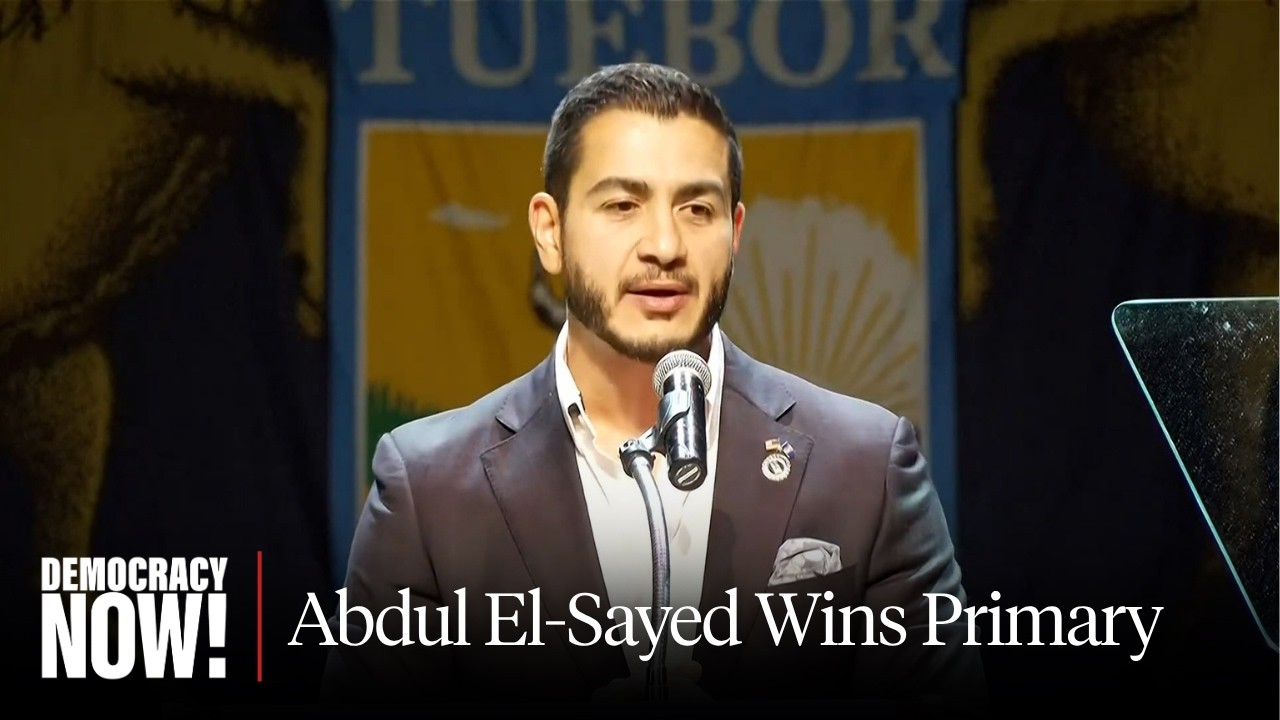
Dr. Abdul El-Sayed Wins Michigan Senate Primary in Major Defeat for AIPAC, Establishment Democrats
Democracy Now!
3,070 views • 1 month ago Save 19 min 5 min read
Video Summary
In a stunning upset, Dr. Abdullah El-Sayed has claimed victory in Michigan's Democratic Senate primary, defying a massive spending campaign by AIPAC and its allies that poured an estimated $46 million into the race. El-Sayed, who will face Republican Mike Rogers in November, framed his win as a triumph of people power over corporate and special interests, highlighting his campaign's focus on issues like Medicare for All and challenging the influence of money in politics. His supporters included prominent progressives like Senator Bernie Sanders and Representative Alexandria Ocasio-Cortez, signaling a potential shift in the Democratic Party's landscape.
The primaries across Kansas, Michigan, Missouri, Virginia, and Washington also saw other progressive victories and key referendums. Will Lawrence, a co-founder of the Sunrise Movement, won a U.S. House primary in Michigan's 7th District, campaigning on issues including AI data centers. In Missouri, Cindy Holscher secured the gubernatorial primary nomination, also utilizing the data center issue. Voters also defended citizen referendums in Missouri and rejected a measure that would have politicized the Kansas Supreme Court, indicating a broader trend of voters pushing back against elite and corporate influence.
Short Highlights
- Dr. Abdullah El-Sayed won the Democratic Senate primary in Michigan.
- AIPAC and affiliated groups spent an estimated $46 million to support his opponent.
- El-Sayed's campaign focused on issues like Medicare for All and challenging corporate influence.
- Will Lawrence won a U.S. House primary in Michigan's 7th District.
- Cindy Holscher won the Democratic primary for Missouri governor.
- Kansas voters rejected a referendum to politicize the Supreme Court.
- Missouri voters defended citizen referendums.
- The role of money in politics was a central theme in many races.
Related Video Summary
- California to approve Proposition 50 redistricting push, CNN projects
- ‘They’re spending more than I’d tax them’: Mamdani SLAMS mega-donors funding Cuomo
- ‘This was an epic blowout’: GOP strategist on Democrats’ election sweep
- Blue sweeps Negeri Sembilan and Johor. What does it mean for Anwar? | CNA Correspondent
Key Details
El-Sayed Claims Victory Amidst Massive Spending [0:00]
- Dr. Abdullah El-Sayed declared victory in the Michigan Democratic Senate primary, challenging Congresswoman Haley Stevens.
- NBC called the race, though other outlets noted it was still too close to call.
- Stevens was vastly outspent, with AIPAC and affiliated groups reportedly spending as much as $46 million, making it one of the most expensive Democratic Senate primaries in U.S. history.
"We all knew they were going to spend their money. We didn't know they were going to spend $70 million of their money. We're going to outspend us $11 to $1, and yet we're still standing."
El-Sayed's Message of Change [0:00]
- El-Sayed's victory message focused on taking government back from corporations and billionaires.
- He highlighted the campaign's ability to overcome an $11 to $1 spending disadvantage.
- His win positions him to face former Congressman Mike Rogers in November for the seat held by retiring Senator Gary Peters.
"Government of the people, by the people, and for the people, instead of government of the corporations, by the special interests, and for the billionaires."
Key Supporters and Potential Historic Win [0:00]
- Dr. El-Sayed's key supporters included Senator Bernie Sanders and Representative Alexandria Ocasio-Cortez.
- If he wins in November, El-Sayed would become the first Muslim senator in U.S. history.
- He previously served as the executive director of the Detroit Health Department and is a co-author of "Medicare for All, A Citizen's Guide."
"Money Out of Politics, Money in Your Pocket, Medicare for All, Michigan, We Won. I'm so proud to be your Democratic nominee for U.S. Senate. Let's win in November."
Stevens Focuses on November Election [0:00]
- Congresswoman Haley Stevens, El-Sayed's opponent, focused her remarks on the need to defeat Republicans in November.
- She warned of Republican goals to ban abortion, gut healthcare, and roll back workers' and voting rights.
- Stevens has served in the House of Representatives since 2019.
"They want to keep the Senate red so Mike Rogers can ban abortion, gut health care, and roll back workers' rights and voting rights. Friends, we are not going to let that happen."
The Role of AIPAC and Outside Spending [0:00]
- Andy Levin discussed the significant role of AIPAC, noting that most of its funding comes from Republicans.
- He criticized the practice of outside groups, particularly from the opposing party, choosing nominees.
- El-Sayed effectively made AIPAC's spending a central issue in his campaign.
"It's terrible. And so, but what Abdul did so effectively was make AIPAC one of the issues and try to expose the fact that what, 80 or 90 percent or more of the money spent on Haley Stevens' behalf was spent by this special interest group."
Progressive Wins Down the Ballot [0:00]
- Will Lawrence, a co-founder of the Sunrise Movement, won the Democratic primary for Michigan's 7th Congressional District.
- Donovan McKinney held a narrow lead in Michigan's 13th Congressional District, potentially making Detroit the first major city exclusively represented by DSA members.
- Abbas Alawiyeh, a co-founder of the Uncommitted Movement, won the Democratic primary for a Michigan State Senate seat.
"I'm running for U.S. Congress because I've never been afraid to stand up to corporate power. I'm backed by Bernie Sanders, and I don't take a dime from corporate PACs."
Broader Trends: Data Centers and Voter Wake-Up [0:00]
- John Nichols highlighted the emergence of issues like data centers and AI as connecting points for candidates with rural and out-state voters.
- He noted that voters are increasingly aware of and pushing back against corporate and elite power.
- Referendums in Kansas and Missouri also showed voters defending democratic processes like the rule of law and citizen referendums.
"It looks to me like in a lot of cases, not every case, but in a lot of cases, voters are starting to wake up and recognize that there are all sorts of assaults on their ability to push back against corporate power, to push back against elite power, and they're finding ways to do it."
![why stocks are skyrocketing [spoiler: it's just getting started]](https://i.ytimg.com/vi/ImLNQWvwLus/hqdefault.jpg)