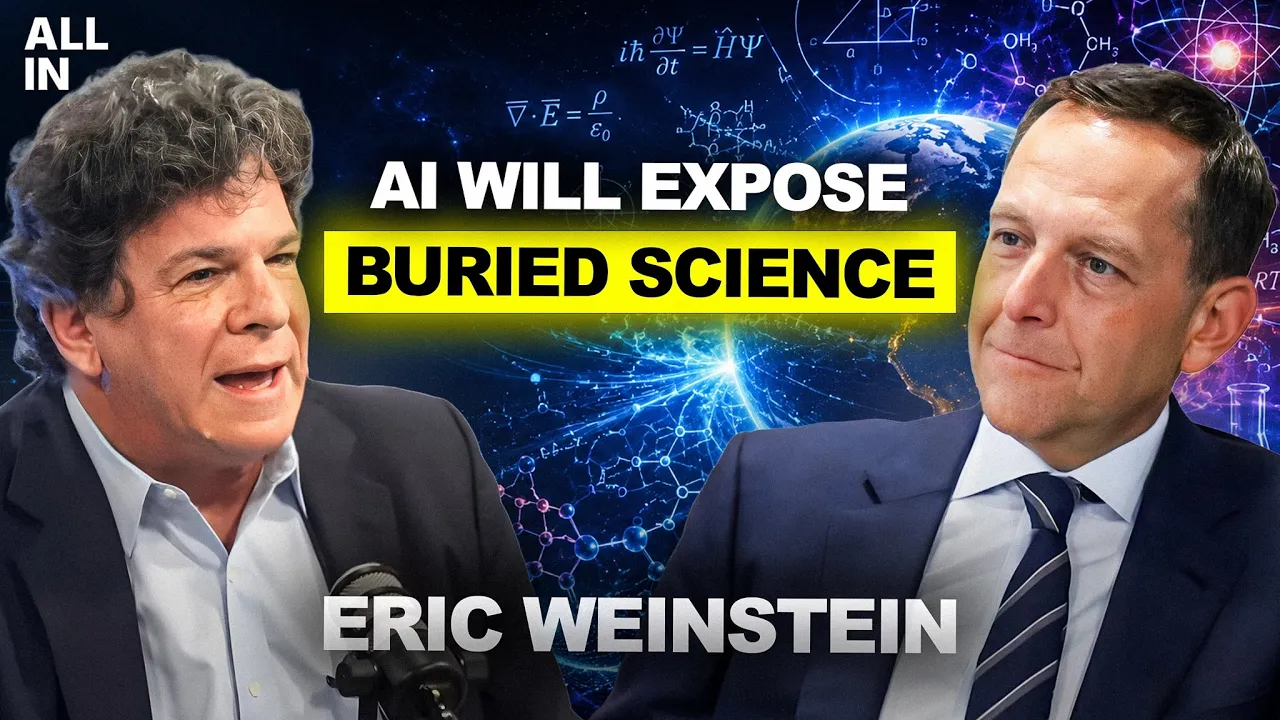
Eric Weinstein: The State of American Science, Breakthrough Coverups, and the Danger of Physics
All-In Podcast
516,071 views • 1 month ago Save 81 min 9 min read
Video Summary
Eric Weinstein, a mathematician and physicist, argues that American science is stagnating due to a "scientific precariat" where fear of social and economic repercussions stifles heterodox thinking. He contends that the emphasis on consensus and predictable outcomes, driven by funding structures and peer review, prevents the pursuit of "courageous science" and "bets no one else can afford to take on." Weinstein believes this stagnation, particularly in theoretical physics, is a dangerous departure from America's historical strength in "cowboy science" and individualistic inquiry, potentially leading to a loss of global leadership and an inability to address existential threats.
Weinstein proposes radical reforms, including challenging the Civil Rights Act's impact on scientific collaboration and dismantling the peer review system, which he claims was artificially introduced in the 1970s. He asserts that true scientific progress requires rewarding non-conformist thinkers and fostering an environment where scientists can pursue groundbreaking, albeit risky, ideas without fear of reprisal. He draws parallels to historical scientific secrecy and suggests that the current system is failing to cultivate the "dangerous minds" necessary for future breakthroughs, potentially leading to a loss of critical scientific talent to geopolitical rivals like China.
Short Highlights
- The "Scientific Precariat" Stifles Innovation: Fear of social and economic consequences prevents scientists from challenging established narratives or pursuing "courageous science."
- Peer Review is a "Fake Story": Introduced in the 1970s, it allegedly enforces consensus and discourages non-conformist ideas.
- Need for "Cowboy Science": America's strength lies in taking big, risky bets that others cannot afford, not in incremental, low-variance research.
- Theoretical Physics is "Off the Road": Since the early 1980s, the field has allegedly focused on abstract theories with no connection to the physical world.
- Radical Reforms Proposed: Weinstein calls for challenging the Civil Rights Act's impact on collaboration and rethinking funding structures.
- Talent Drain to Rivals: American scientists are reportedly seeking opportunities and freedom in countries like China.
- The Danger of Stagnation: Failure to innovate in physics could have severe consequences, potentially impacting national security and human survival.
Related Video Summary
- “YOU’RE The Evil Monster!” Mohammad Marandi vs Alan Dershowitz on Iran | Plus Netanyahu Spokesman
- The five desperate plots Putin is hatching against Ukraine & why tyrant will fight to dying breath
- The Leaked Epstein Files...
- Trump approves nuclear deal that could allow Saudi Arabia to enrich uranium, AP reports
Key Details
The "Scientific Precariat" and Stagnation [00:00:00]
- Eric Weinstein argues that American science is suffering from stagnation due to a "scientific precariat," where scientists fear social and economic repercussions for challenging consensus.
- He contrasts this with the need for "to take on the bets no one else can afford to take on," suggesting that current research is too incremental and careful.
-
"When we make this jump, the world will become unrecognizable."
DC Meetings and Science Reform [00:01:00]
- Weinstein discusses his meetings in Washington D.C. with figures like Director Kratzios at OSTP and the White House Science Advisor.
- He is excited about a major proposal to reform American science, the first since Vannevar Bush.
-
"So this couldn't be more exciting."
Critiquing the "Consensus" in Science [00:03:00]
- Weinstein expresses concern over scientific "consensus," viewing it as an artificial agreement often achieved through pressure.
- He uses the example of Jay Bhattacharya, who faced criticism for the Great Barrington Declaration.
-
"When I hear the word consensus, I get very, very nervous because a consensus is usually an artificial agreement achieved through pressure."
The "Fauci Killed 10 Million People" Controversy [00:05:00]
- Weinstein states he wants to know if "Fauci killed 10 million people" and criticizes the lack of scientific investigation into such questions.
- He links this to a perceived inability to use "cowboy science" to drive global progress.
-
"I want to know whether Fauci killed 10 million people?"
The Role of Skepticism During COVID-19 [00:07:00]
- Weinstein questions the lack of skeptics and scientists willing to question dogma during the COVID-19 pandemic.
- He posits that if everyone agrees, the conclusion is likely wrong.
-
"But it's almost like the asking questions stopped."
The "Scientific Precariat" Explained [00:09:00]
- Weinstein explains that the "scientific precariat" refers to a situation where professors cannot afford to go against a consensus due to funding and career pressures.
- He argues that consensus is unnecessary for established truths, like mathematical axioms.
-
"The Washington consensus is some sort of a thing where we're all going to go in a particular direction and if you don't go in that direction, you don't have a job."
The "Fringe Scientist" Label [00:11:00]
- Weinstein recounts being called a "fringe scientist" and an "outcast" for questioning the narrative around COVID-19 origins.
- He highlights that his equations from 1987 became accepted in 1994, yet he was mistreated.
-
"I was really treated incredibly badly."
The "Third Home" Incentive [00:13:00]
- Weinstein provocatively suggests scientists should be rewarded with "third homes" for standing up for their ideas, symbolizing security and prosperity.
- He criticizes the notion that "true scientists don't care about money."
-
"The fact is that we are providing your security and I say third homes to be deliberately provocative."
The Shift in Science Funding and Direction [00:15:00]
- Weinstein pinpoints the period between 1965 and 1975 as a critical turning point where science funding and direction changed.
- He mentions the Mansfield Amendment (1969-1971) restricting military funding to research with direct military purposes.
-
"The military was our best friend."
The "Ship of Fools" Analogy [00:17:00]
- Weinstein references Ted Kaczynski's "Ship of Fools" to illustrate how excessive concern with political correctness can lead to disaster.
- He argues that scientists, often "weirdos," need the freedom to express extreme or unconventional ideas.
-
"The point is that scientists are weirdos, or at least many scientists are weirdos."
"Spaying and Neutering" Best Minds [00:19:00]
- Weinstein believes the current system "spays and neuters" the best minds by forcing them into conformity.
- He contrasts this with figures like Palmer Luckey and Nima Arkani-Hamed, who embody a more irreverent, groundbreaking spirit.
-
"Um... Well, mostly what you're doing is you're spaying and neutering, uh, your best minds."
The Problem with Peer Review and Grants [00:21:00]
- Weinstein reiterates that peer review is a "fake story" and that grants are typically approved for "lower beta" (more predictable) outcomes.
- He argues this approach misses opportunities for high-beta bets on individuals and ideas.
-
"So we're appropriating modern portfolio theory to science to science love it"
The Market vs. Government Funding Argument [00:23:00]
- Weinstein argues that markets fail to price science because it is inexhaustible and in-excludable, necessitating government funding.
- He criticizes conservatives who believe markets can handle all scientific endeavors.
-
"Markets work really well as long as you're not in a category called market failure."
The Importance of Pure Mathematics and "Slush Funds" [00:25:00]
- He emphasizes the importance of funding pure mathematics like homotopy theory, even without immediate industrial applications.
- Weinstein advocates for a return to "slush funds" where trusted individuals can allocate resources to promising but unconventional research.
-
"My feeling is is that that's not an Ayn Randian thing. that's not a conservative thing."
The 1983-1984 Physics "Cliff" [00:27:00]
- Weinstein posits that theoretical physics "drove off a cliff" around 1983-1984, with figures like Edward Witten, Leonard Susskind, and David Gross shifting the field's direction.
- He argues that this shift led to a safe, non-confrontational physics devoid of real-world implications, making it safe to collaborate with geopolitical rivals.
-
"And now the achievement of this has not been any advance in our knowledge of the physical world but it has been something that no one knew was possible."
The "Reference Committee" and Secret Projects [00:29:00]
- Weinstein draws a parallel between the Manhattan Project's "reference committee" (1940-1945), which controlled chain reaction physics research, and potential modern secret projects.
- He speculates that Renaissance Technologies might be such a project, given its unusual hiring practices and close ties to Brookhaven National Laboratory and Stony Brook University.
-
"My claim is that I'm doing the Jack Raper thing and you're doing what happened to Jack Raper"
UAPs and Anti-Gravity Research [00:31:00]
- Weinstein believes Unidentified Aerial Phenomena (UAPs) are likely experimental weapons systems, possibly linked to anti-gravity or gravity shielding research.
- He references a 1971 Australian intelligence document suggesting such research was a primary driver for interest in general relativity.
-
"I don't believe general relativity is the last word I believe pinch to zoom exists"
Multi-Temporal Adversaries and Escape from Einstein's Prison [00:33:00]
- Weinstein discusses the terrifying possibility of "multi-temporal adversaries" who can move through time.
- He argues that humanity is trapped in "Einstein's prison" due to the speed of light limit and needs to escape the solar system.
-
"My claim is that we have been too long in Einstein's prison"
The Dark Energy Enigma and Geometric Unity [00:35:00]
- Weinstein anticipates that dark energy measurements will prove the cosmological constant is not constant, breaking general relativity.
- He proposes his own theory, Geometric Unity, as a candidate for the next grand unified theory.
-
"The dark energy measurement which we're going to end up having a very high accurate estimation right tells us that the general theory of relativity and the equations associated with it are wrong"
The Power and Danger of Science [00:37:00]
- Weinstein emphasizes the immense power and leverage of scientific knowledge, citing examples like easily made explosives and nuclear devices.
- He warns that this power, if not handled responsibly, could lead to self-destruction or be wielded by dangerous actors.
-
"The power of science the leverage of science is so profound that we should at least ask the question"
China's Approach to Science and AI [00:39:00]
- Weinstein suggests China is attracting Western scientists by offering more freedom and better compensation.
- He predicts AI will revolutionize science by analyzing "trash can corpus" ideas that mainstream science has dismissed.
-
"China is going to have a private model and they're going to say assume that the completely failed the most failed theory in the history of modern physics string theory and something called m theory and quantum gravity"
The Future of Physics and Civilization [00:41:00]
- Weinstein believes advancements in physics could lead to unrecognizable changes, including new forms of propulsion, energy, and weaponry.
- He stresses the importance of pursuing these advancements for human survival and expansion beyond Earth.
-
"When we make this jump, the world will become unrecognizable."
Call for Radical Change and Collaboration [00:43:00]
- Weinstein advocates for a radical overhaul of the scientific system, encouraging collaboration even with rivals.
- He urges scientists to engage with policymakers and to pursue groundbreaking, potentially heretical ideas.
-
"It's time for America to lead because there's no other nation I trust like I trust our people to take care of uh of this planet."