We're Racing Toward Bankruptcy — And No One Will Touch Entitlements
Tom Bilyeu
3,533 views • 20 hours ago Save 41 min 9 min read
Video Summary
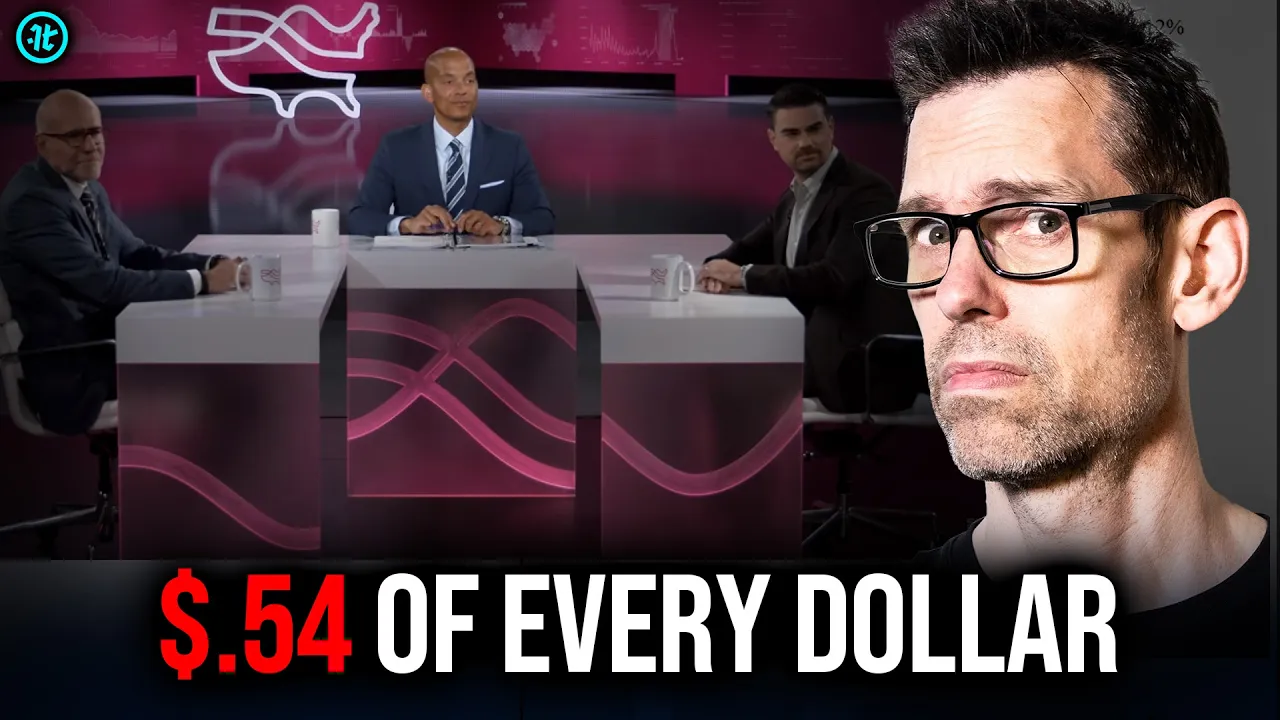
The United States is "racing towards bankruptcy" due to unsustainable government spending, particularly on mandatory entitlement programs like Social Security, Medicare, and Medicaid. These programs, which automatically renew without congressional approval, have ballooned from just over 35% of federal spending in 1980 to over 54% today, consuming more than half of every tax dollar collected. This unchecked growth, coupled with other spending, has driven the deficit from $295 billion in 1980 to a projected $1.78 trillion in 2025.
The debate centers on whether the government is doing too much or too little, with a strong argument that it's doing too much for some and not enough for others, particularly concerning the "freeloader problem" and "massive fraud" enabled by federal-level programs. Critics argue that many functions would be better handled at local and state levels, fostering community responsibility. Meanwhile, both major political parties are criticized for failing to address the unsustainable nature of entitlement programs, leading to a potential future of austerity measures, inflation, or back-door taxation.
Short Highlights
- Government Spending Crisis: Mandatory entitlement programs like Social Security, Medicare, and Medicaid now consume over 54% of total federal spending, up from 35% in 1980.
- Unsustainable Deficits: This spending growth has fueled a dramatic increase in the federal deficit, projected to reach $1.78 trillion in 2025.
- The "Freeloader Problem": Critics argue federal programs incentivize dependency and fraud, suggesting local and community-based solutions are more effective.
- Political Paralysis: Both major parties are accused of avoiding necessary reforms to entitlement programs, contributing to the fiscal crisis.
- Taxation vs. Services: Americans desire low taxes and fewer services, yet also want to maintain and increase spending on specific programs, creating a policy paradox.
- Economic Consequences: The nation faces potential austerity measures, inflation, or increased debt if current spending trends continue.
- Capital vs. Labor: A debate exists on whether the tax system unfairly favors capital gains over income earned through labor.
Key Details
The Nation's Fiscal Trajectory [0:00]
- The U.S. is on a path toward bankruptcy due to unsustainable government spending.
- A critical debate is needed on whether the government is doing too much or too little.
"This debate is the debate as a country we have to have because right now, we are racing towards bankruptcy."
Federal Transfers and Assistance Programs [0:40]
- Analysis of federal government transfers shows changes in program assistance since 2013.
- Social Security and Medicare serve the largest percentage of the population, around 20%, with increases due to an aging demographic.
"What you don't end up with is a debate where everybody's just pulling out these random facts and the fact checkers are scrambling behind the scenes to try to check it."
Program Participation and Spending Breakdown [1:38]
- Approximately 20% of individuals receive Medicaid, with a slight increase, and 11% receive food stamps, a decrease since 2013.
- Over half of spending on these programs benefits seniors, primarily through Social Security and Medicare.
"The other half of the spending on these programs is targeted more towards lower-earning families through programs like Medicaid, refundable tax credits, and food stamps."
Growth of Mandatory Assistance Programs [2:25]
- Mandatory assistance programs, including Medicare, Medicaid, and Affordable Care Act subsidies, have seen significant growth since 1980.
- Social Security spending remains flat, while Medicare is increasing, and Medicaid/health assistance is "skyrocketing."
"Social Security is flat, but Medicare is up, and Medicaid and other health assistance is skyrocketing, absolute insanity."
Federal Spending and Deficit Concerns [3:10]
- Combined mandatory programs grew from over 35% to over 54% of total federal spending between 1980 and the present.
- The federal deficit has surged from $295 billion in 1980 to an inflation-adjusted $1.78 trillion in 2025.
"Combined, these programs grew from just over 35% of total federal spending in 1980 to over 54% today."
Government's Role: Too Much or Too Little? [4:15]
- The debate questions whether the government is doing too little or too much, with federal debt and deficits suggesting it's deeply entrenched.
- There's a distinction between federal, state, and local government roles, with a preference for local and state involvement.
"I think it would be hard to argue, given the federal spending, the federal debt, the federal deficit, that the government is doing too little."
Community vs. Federal Responsibility [5:00]
- The argument is made that government functions should be more localized, emphasizing community and family support networks.
- Federal-level programs can lead to a "massive freeloader problem" and significant fraud.
"And that is precisely why the lower you push this stuff down, meaning it's more local at the family level, the family needs to carry the burden of their own relatives."
Bipartisan Agreement on Entitlements [6:45]
- Both major political parties agree on not touching entitlement programs, which are seen as driving the country toward bankruptcy.
- This includes stances from both Democratic and Republican administrations.
"Both parties agree that they will not touch the entitlement programs that are driving the country into bankruptcy."
Addressing Healthcare Costs and Personal Responsibility [7:40]
- Rising healthcare costs are identified as a major problem, with a call for individuals to take more responsibility for their health choices.
- The idea of risk-based pricing for healthcare, where healthier individuals pay less, is proposed.
"And if you're going to allow people to act a fool, eat whatever they want, be as obese as they want, drink whatever they want, and there's not going to be an increase in what they contribute, that is crazy."
The Unsustainability of Current Spending [8:45]
- Federal payments are projected to soon outstrip the defense budget, leading to a lack of funds.
- Potential solutions include backdoor taxation, inflation, or austerity measures.
"We are going to, Steve, sorry, Scott mentioned earlier that we are going to essentially have to backdoor tax everybody or inflate away our national debt."
Nordic Model and Taxation [9:30]
- The Nordic countries, while having large social safety nets, are free-market economies with very high tax rates.
- The bottom 50% of Americans currently pay only 3% of taxes, highlighting a disparity in contribution.
"But to have the massive social safety nets that they have, they tax everybody nigh to death."
Tax Loopholes and Corporate Benefits [10:40]
- A significant amount of money is returned to corporations and the wealthy through tax loopholes, estimated at $2.25 trillion.
- The effectiveness of tax exemptions as incentives for entrepreneurs is questioned.
"We then give $2.25 trillion back to corporations and the wealthy in the form of tax loopholes."
The "Step-Up Basis" and Wealth Transfer [12:15]
- The "step-up basis" allows heirs to inherit assets at their current market value, often avoiding taxes on accumulated gains.
- This mechanism is criticized for enabling generational wealth transfer without commensurate taxation.
"Now, that makes sense if the person has already paid tax on that going in and so, you know, they were being given cash or something like that, but if they've been borrowing money all along the way and they never actually paid tax..."
Fraud, Freeloading, and Incentives [13:40]
- Concerns are raised about honesty regarding fraud and the "freeloader problem," where individuals are incentivized to do nothing.
- The structure of welfare programs is seen as potentially creating perverse incentives.
"We're not being honest about fraud, we're not being honest about the freeloader problem where you're incentivizing people to do nothing and therefore they are going to do nothing."
The Role of Personal Decision-Making [16:10]
- Personal decision-making is highlighted as a key differentiator in individual success.
- Factors like being born into a two-parent household significantly impact outcomes.
"The number one factor that will lead to success in the United States were were you born into a two-parent household versus a single-parent household that makes a huge difference to you."
The Impact of Government Intervention [17:40]
- Government intervention, such as unemployment insurance and Pell Grants, can provide crucial support and lead to positive economic outcomes.
- The argument is made that investments in people, even if perceived as "their fault," yield significant returns.
"So some government government intervention to help people whether you think it was their fault or not pays off for all of us."
Societal Values and Marriage [19:30]
- Changes in societal values, including a decreased emphasis on marriage, are discussed as factors influencing family structures.
- The rise in single-parent households is linked to the expansion of the welfare state.
"The single intervening effect was the fact that the government started incentivizing people not to get married by essentially creating a subsidy program for people who were having children without two parents in the household."
Government Incentives and Decision-Making [23:00]
- Government incentives influence decision-making but are not the sole factor.
- Americans often desire conflicting outcomes, such as low taxes and robust services.
"Americans consistently say they want to protect major benefits keep taxes relatively low and reduce the debt Ben how should political leaders reconcile those demanding demand the American people want a bunch of things that don't make sense in coordination with one another."
Reconciling Conflicting Demands [24:00]
- Political leaders face the challenge of reconciling the public's desire for low taxes, high services, and reduced debt.
- The founders' expectation of civic virtue has been challenged by voters' desire for immediate benefits without future cost.
"The American people are in the end the ones who are responsible for the fact that we have blown our deficit out and we'll continue to blow our deficit out because we keep voting for politicians who want to do that."
The Path Forward: Leadership and Reform [25:40]
- There is a need for leadership and adult conversations regarding the restructuring of entitlement programs.
- Solutions may involve reducing benefits for those who don't need them and raising taxes.
"I do believe the American public is ready for leadership and adult conversation around reducing some entitlement benefits for people who may not need them and also raising taxes on people."
Addressing the Debt Spiral [27:30]
- The U.S. is in a debt spiral, with current spending far exceeding income.
- Potential solutions include closing the tax gap, collecting owed taxes, and reducing expenditures, particularly on entitlements.
"We are racing towards bankruptcy and if we don't change something we will end up there."