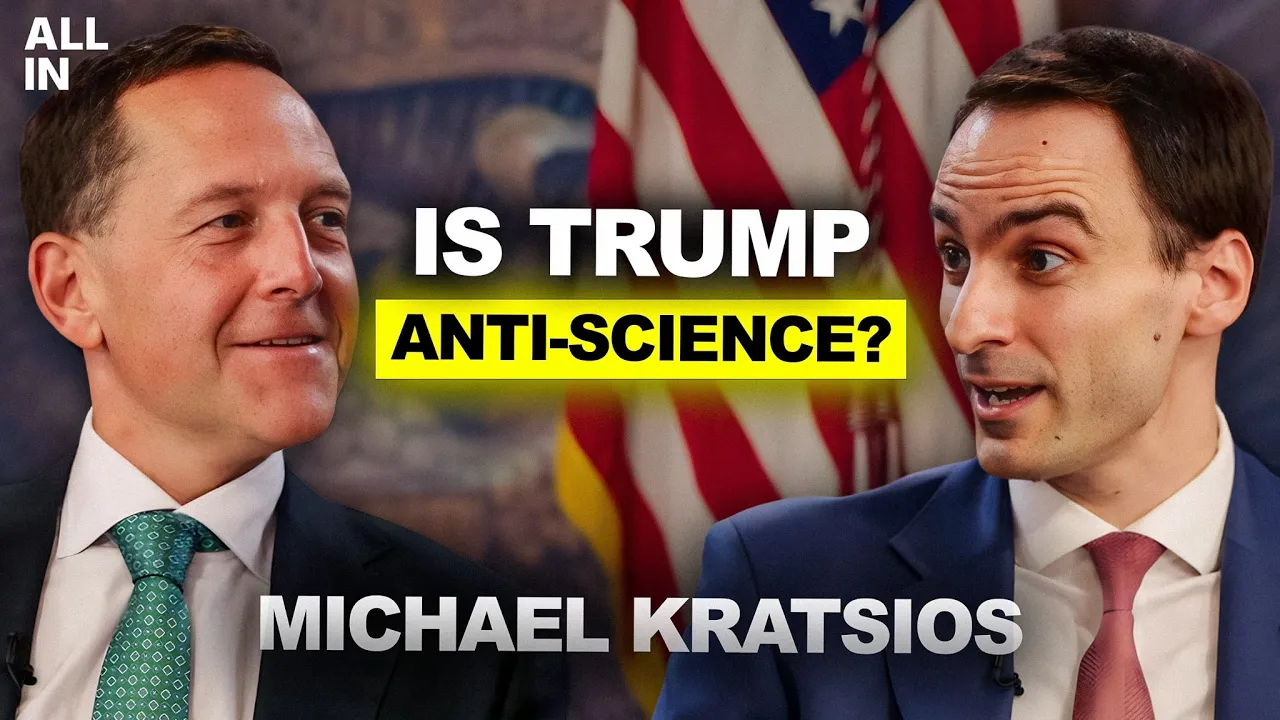
Inside Trump's Science Agenda: Anti-Science Claims, Fauci's Damage, DEI & China w/ Michael Kratsios
All-In Podcast
73,991 views • 1 month ago Save 41 min 14 min read
Video Summary
The Biden administration is not anti-science, and aims to "double the scientific output of the United States" by fostering innovation and empowering researchers, according to Michael Kratsios, Director of the Office of Science and Technology Policy.
Kratsios argues that science has become overly politicized, particularly during the COVID-19 pandemic, leading to a distrust in scientific institutions. He advocates for a return to the core principles of the scientific method—inquiry and evidence-based conclusions—and proposes a "New Golden Age" for American science. This initiative aims to re-evaluate how the government spends its $200 billion annual S&T funding, moving beyond simply increasing budgets to ensuring funds drive breakthroughs. Key proposals include experimenting with grant structures, such as "golden tickets" and varied grant durations, to incentivize bolder research and exploring alternative funding models beyond traditional university grants, like supporting individuals and focused research organizations. The administration also emphasizes investing in future-oriented technologies like fusion and quantum computing, while acknowledging the need to nurture domestic STEM talent and retain foreign-born graduates.
Short Highlights
- The administration asserts it is not anti-science, aiming to "double the scientific output of the United States" through a "New Golden Age" initiative.
- Science has become overly politicized, particularly during the COVID-19 pandemic, eroding public trust.
- The "New Golden Age" report proposes re-evaluating the allocation of $200 billion in annual S&T funding to drive breakthroughs.
- New grant structures, like "golden tickets" and varied durations, are being tested to encourage riskier, innovative research.
- The administration is exploring alternative funding models beyond traditional university grants, including supporting individuals and focused research organizations.
- Investment in future technologies such as fusion and quantum computing is a priority.
- There's a focus on nurturing domestic STEM talent and retaining foreign-born graduates to bolster the U.S. scientific workforce.
Key Details
The Administration's Stance on Science [00:00:00]
- The Office of Science and Technology Policy (OSTP) coordinates science and tech policy across the U.S. administration.
- OSTP's role is to work with the president to set the national S&T agenda and implement it across agencies.
- The administration is not anti-science; a new report, "Science, A New Golden Age," highlights its commitment to American science and technology.
"We really want the US to be the home for the next great scientific discoveries."
Politicization of Science and Shifting Perceptions [00:02:00]
- A Nature poll showed 86% of scientists supported Kamala Harris, while Donald Trump polled at 6%, indicating a perception gap.
- The speaker suggests the scientific community has "lost its way" and science has become deeply politicized over the last 15-20 years.
- The COVID-19 pandemic exemplified this, where dissent from a particular individual's views was labeled as anti-science.
"And to me, I think that is the most anti-science conclusion you could ever make."
The Scientific Method and Policy [00:05:00]
- The scientific method involves asking questions, inquiry, experiments, and data-driven conclusions.
- The government has not always applied these principles to its own science policy and R&D approach.
- The focus has often been solely on increasing R&D budgets, rather than questioning if the spending drives the best breakthroughs.
"The more important question that every scientist should be asking is, is the way that the US government spends at $200 billion in S&T funding every year, is it actually driving the best breakthroughs and biggest breakthroughs of American people?"
Budget Allocation vs. Funding Cuts [00:07:00]
- There's a perception that the administration is cutting science funding, but the speaker clarifies it's about the allocation of resources.
- A distinction is made between proposed budgets and appropriated funds by Congress.
- Spending more money on the "wrong types of things" is seen as poor policy.
"Spending more money on the wrong types of things is not the right policy action."
DEI Initiatives and Climate Science Research [00:09:00]
- The administration terminated or froze $3 billion in unspent funds on active grants in 2025.
- A significant portion of National Science Foundation (NSF) grants during the Biden administration went towards DEI-related science, estimated at $2 billion a year.
- Cuts to climate science research have drawn criticism, with the administration questioning the "climate emergency" narrative.
"And if you think about that, that's an astronomical amount. That is roughly $2 billion a year times four years. That's $8 billion of science funding that went to these DEI-related initiatives."
The Nuance of Climate Change Data [00:12:00]
- While acknowledging human contribution to CO2, the administration disputes the claim of a "climate emergency."
- The extreme RCP 8.5 climate scenario was deemed unsubstantiated by scientific integrity and subsequently removed.
- This extreme scenario, often highlighted in media, was based on a simulation that has not materialized.
"And ultimately, they determined a few months ago that they could not with any scientific integrity substantiate continuing to have this scenario play out."
Investing in Abundant Energy Technologies [00:15:00]
- The focus is on investing in technologies and science that create abundant energy for Americans.
- This includes winning the "fusion race" by 2035 and advancing nuclear energy.
- Technology is seen as the key to making the biggest impact on everyday Americans.
"So to us, I think technology is what's going to have the biggest impact for everyday Americans."
Economic Impact and Global Carbon Emissions [00:17:00]
- China's carbon output eclipses the rest of the world, making U.S. reductions less impactful on a global scale.
- Extreme climate policies could disproportionately harm poorer communities by increasing energy costs.
- Clean fossil fuels could significantly improve the quality of life for billions globally who use dirty fuels for cooking.
"And this leads, I mean, the UN has reported it leads to roughly 3 million deaths every year because of this."
Stagnation of Scientific Progress in the U.S. [00:19:00]
- Despite advancements like AI and gene editing, there's a perceived stagnation in scientific progress, particularly in outcomes per dollar spent.
- NIH funding has tripled since 1998, but there hasn't been a proportional rise in breakthrough treatments.
- Erum's Law suggests a significant decrease in efficiency for scientific outcomes per dollar spent over time.
"So the budget has more than tripled since 1998, but there has not been a proportional rise in breakthrough treatments coming out of that funding."
Reforming Science Funding and Innovation [00:22:00]
- The "New Golden Age" report questions why innovation in areas like flight speed has regressed.
- The issue isn't just solved problems, but a lack of innovation in how science is conducted and funded.
- There's a need to ask harder questions about funding allocation, types of scientists, and institutions.
"But I think broadly the issue is we have not been innovative in any way on the way that we actually conduct the science."
Meta-Science and Experimental Funding Models [00:25:00]
- Meta-science units are being established at NSF and NIH to run experiments on funding allocation.
- The goal is to analyze different funding methods and direct money towards areas of innovation.
- Experiments include "golden tickets" for reviewers to unilaterally select grants, incentivizing bolder ideas.
"So you incentivize folks to have more interesting grants."
Encouraging Risk-Taking in Research [00:28:00]
- Traditional grant processes often incentivize low-risk proposals that are likely to succeed.
- Venture capital models embrace risk, with a few high-return failures leading to significant breakthroughs.
- The aim is to create an environment where failure is accepted as part of the process for achieving significant discoveries.
"The reality is in venture capital, which you and I know well, you're going to have one out of 10 things work."
Alternative Grant Durations and Individual Funding [00:30:00]
- Testing different grant durations, including "fast track" grants for shorter projects (e.g., six months).
- Funding individuals, similar to venture capital's focus on entrepreneurs, is another model being explored.
- This approach trusts talented individuals to pursue their research without excessive scrutiny.
"And the idea there is, we will give you this money to go pursue your PhD, but it's totally portable."
Big Projects vs. Individual Research [00:33:00]
- The U.S. has a history of successful centrally planned projects like the Apollo mission.
- China excels at central planning for large objectives.
- The administration advocates for a return to such large-scale projects alongside other research models.
"And we advocate for and golden ages. We have to return to that."
Flagship Projects: Space, Quantum, and AI [00:35:00]
- Projects include returning to the moon by 2028, establishing a nuclear reactor in space, and a moon base by 2030.
- A national quantum initiative aims for a scientifically relevant quantum computer by 2028.
- The "Genesis Mission" aims to double U.S. scientific output by applying AI to scientific challenges.
"We fundamentally believe that AI is going to be the biggest unlock to scientific discovery in the history of the world."
Government's Role in Basic Research [00:38:00]
- The government's primary focus should be on basic, early-stage, pre-competitive R&D where the private sector is not incentivized.
- This includes areas like deep space research and fundamental physics.
- The government's role is to fund discovery science and create instruments for scientific advancement, like a quantum computer for discovery.
"That is an area where, you know, the private sector is not incentivized to participate in, and only the government can do that."
The Vannevar Bush Model and Its Evolution [00:41:00]
- Vannevar Bush's "Science Endless Frontier" (1945) established the model of government funding basic research primarily at universities.
- Historically, the government funded ~70% of R&D; now, the private sector funds ~70%.
- New institutions like philanthropies have emerged, prompting a re-evaluation of the current model's relevance.
"And the question now is, is that model that Bush pushed forward and promulgated and actually led to the great discoveries of the last 50 years, is that still as relevant today as it was then?"
Prioritizing Government-Funded Research [00:44:00]
- Government funding should target areas the private sector or philanthropy are not incentivized to pursue.
- The government should have a thesis on national priorities, such as AI, quantum, nuclear, and bio.
- This ensures the government steps in to fill gaps where other sectors cannot.
"And I think that is something that sometimes it almost is like a tension with the science community."
University Funding and Administrative Fees [00:46:00]
- The administration aims to fund the best scientists wherever they are, including outside universities.
- This approach is not anti-academic but pro-scientist.
- Concerns exist about universities using allocated research funds for administrative fees.
"If they're at a university, we should fund them. If they're at a focused research organization, we should fund them."
The U.S. vs. China: A Scientific Race [00:48:00]
- China's R&D spending increased 19x from 2000 to 2021, while the U.S. increased by ~3x.
- China now publishes more scientific papers than the U.S. in most domains.
- Technological and scientific leadership is crucial for economic and national security.
"China increased spending by 19x. Over the same time period, the US increased spending by roughly 3x."
China's Strategy and U.S. Response [00:51:00]
- China's playbook involves copying, creating cheaper alternatives, and market dumping.
- Concerns exist about China's control over critical minerals in the tech supply chain.
- The U.S. needs to prepare for greater independence in these areas.
"The playbook that they have used for a long time is essentially copying RIP, creating cheaper alternatives to that particular technology, dumping them in the United States, getting our businesses to go out of business, and then squeezing us."
China's Output Efficiency and U.S. STEM Pipeline [00:54:00]
- Estimates suggest China gets 2x to 10x more output per dollar spent on R&D due to lower labor and supply chain costs.
- A critical issue for the U.S. is encouraging more Americans to enter STEM fields.
- The percentage of U.S.-born PhD recipients in computer science has inverted from 70% American to 70% foreign.
"So on a dollar for dollar basis, they're, they're way overspending relative to us in terms of generating output."
Supporting Young Scientists and Immigration Policy [00:57:00]
- Young scientists, particularly post-PhDs, are often underpaid and face challenging career paths.
- The U.S. needs to actively retain foreign-born talent who receive PhDs in the U.S.
- Encouraging young Americans to pursue STEM degrees is paramount, alongside legal pathways for foreign talent to stay.
"And, and for those who do want to stay, allow them to sort of pursue legal pathways to stay here."
Reversing Declining STEM Education Trends [01:00:00]
- Programs that supported gifted and talented students in K-12 STEM were discontinued.
- Policies discouraging advanced math education and standardized testing (like SATs) are harming the STEM pipeline.
- This actively discourages talented students from pursuing STEM careers.
"And that has to stop."
Elevating the Scientist and Combating Anti-Science Sentiment [01:03:00]
- The "New Golden Age" initiative centers on elevating scientists, regardless of their institution.
- In the 20th century, scientists were celebrities; this status has diminished.
- There's a deep anti-science and anti-technology sentiment in the West, partly fueled by populist movements viewing science as a tool of the elite.
"We have to allow people to understand and trust what science is about and see that it's an inspiring and a good thing and can change our way of life."
Lessons from COVID-19 and Trust in Science [01:06:00]
- The handling of the COVID-19 pandemic, particularly figures like Dr. Fauci, is seen as having done a "disservice to science."
- Contradictory public health guidance eroded trust, making it difficult for the public to take science seriously.
- A return to the "roots of gold standard science" is needed to rebuild trust and emphasize science as a process of inquiry, not dogma.
"And as a result, not only did it kind of destroy trust in science, but I think it brings to light questions."
The Aging Scientific Workforce [01:09:00]
- The median age of an intramural researcher at NIH is alarmingly high at 71 years old.
- This highlights a critical need to bring younger scientists into research institutions.
- There's an opportunity for significant change and innovation at NIH.
"Was that the median age?"
Prioritizing Fundamental Research Amidst AI Focus [01:11:00]
- Despite the focus on AI, fundamental research in physics, mathematics, and astronomy remains crucial.
- The R&D priorities memo lists basic fundamental research as a top priority for agencies like NSF.
- The government should focus on areas that the private sector, with its massive AI investments, does not fund.
"And I think those are things that you mentioned. And I think that memo kind of serves as the policy United States on how agencies like NSF should be prioritizing those things."
Implementing "New Golden Age" Recommendations [01:13:00]
- The R&D priorities memo directs agencies on budget allocation and practices.
- Top research agencies must report on their implementation plans within 90 days.
- Agencies are already announcing initiatives like NSF's X-Labs and four-year PhD programs with industry partnerships.
"So you've already started seeing announcements from the agencies on how they're implementing the report."
Navigating Congressional Demands and Bipartisan Support [01:15:00]
- Balancing the mission of science with congressional demands for district-specific funding is a challenge.
- Many "New Golden Age" recommendations are bipartisan, focusing on improving the scientific ecosystem.
- Highlighting that funding the best scientists nationwide, regardless of location, can garner broad support.
"I think the idea of rethinking about the methods by which we deploy science capital and try to fund different institutions and promote individual scientists are all things that I think will be uniformly sort of accepted or people excited about on the Hill."
Institutionalizing Scientific Progress [01:18:00]
- The administration hopes to create institutional memory and bipartisan support for its scientific initiatives.
- The goal is to demonstrate the effectiveness of these changes over the next two years.
- The focus is on ensuring scientific progress is driven by merit and innovation, not solely social or political factors.
"And our hope is that we can run really hard through the tape over the next two years and prove that they're actually working and sort of changing it or turning around is going to be costly from a political capital standpoint because they'll be working."