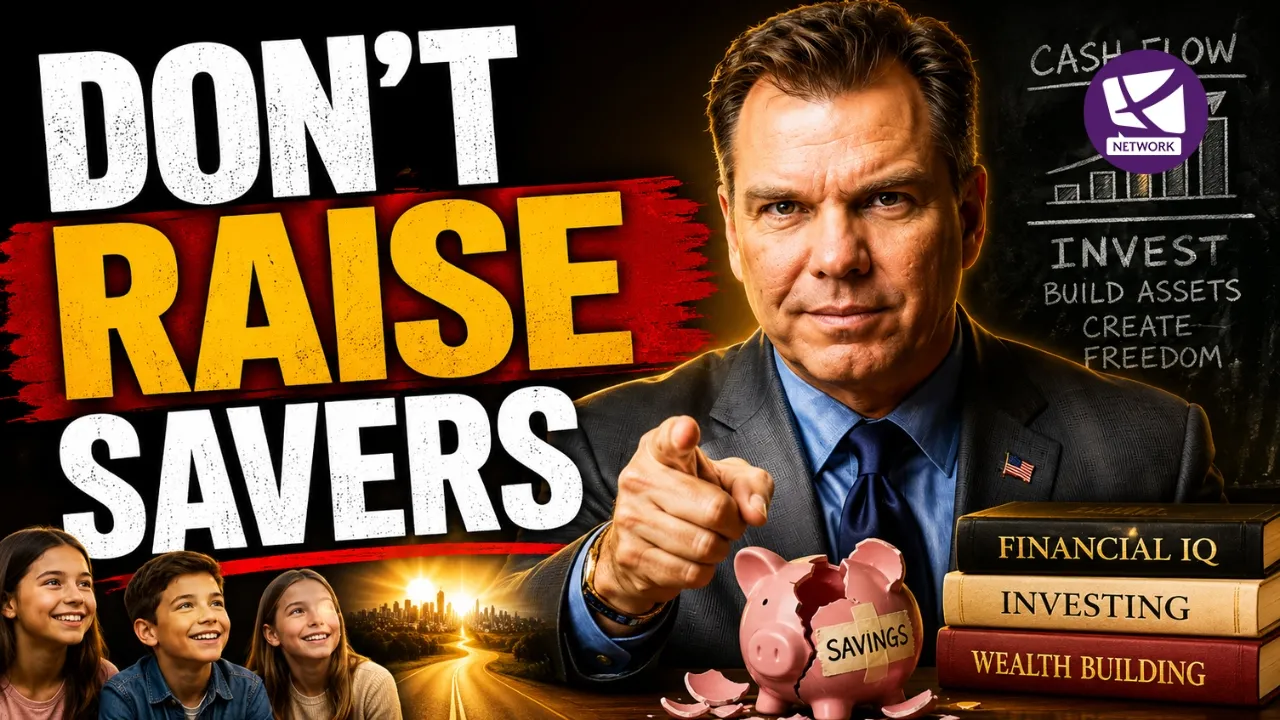
What Every Parent Should Teach Their Kids About Money - Andy Tanner, Del Denney
The Rich Dad Channel
4,933 views • 1 month ago Save 23 min 5 min read
Video Summary
Parents are urged to prioritize teaching children about money and investing, arguing that financial literacy is a more valuable gift than monetary inheritance. Expert Andy Tanner emphasizes that this education should begin as soon as children can talk, with foundational lessons starting as early as age four through activities like a lemonade stand. These early lessons focus on the principle of providing more value than is received, a core tenet of capitalism and entrepreneurship.
The discussion highlights a progression from simple entrepreneurial endeavors to understanding ownership through stock investing. Tanner recounts how his own sons learned to transition from actively working in a business to passively profiting as shareholders by owning companies like Disney and McDonald's. This shift underscores the concept of participating in business at the lowest possible level—ownership—and collecting profits without direct labor, a key differentiator from working within the business itself.
Short Highlights
- Financial education is a crucial gift, more valuable than money itself.
- Start teaching investing concepts as soon as children can talk.
- Early lessons focus on providing value and understanding capitalism.
- Transition from active work to passive ownership through stocks.
- The "Cashflow Game" is the ultimate tool for teaching financial literacy.
Key Details
The Greatest Investment: Your Kids [0:00]
- Parents often aim to leave children money, but teaching them how money works offers lasting wealth creation.
- Most schools fail to teach essential investing, cash flow, and financial independence concepts.
- Rich Dad expert Andy Tanner joins host Del Denny to discuss teaching kids investing at any age.
"What if the greatest gift isn't money at all? What if it's teaching them how money works so they can create wealth for themselves?"
Free Investing Tools Available [1:00]
- Stockcastbonus.com offers free investing tools, spreadsheets, calculators, and eBooks.
- Webinars cover techniques like "click and get paid" and generating multiple income streams from a single stock.
- These resources are designed for organized learning and are free to help people get acquainted with their programs.
"We have all kinds of resources depending. I mean, you can look at the menu of things."
The Parent's Crucial Role [3:30]
- Andy Tanner emphasizes parents' primary responsibility in teaching children, especially about money, over schools or teachers.
- He criticizes parents who are not "stewards" of their children, leading to societal problems.
- The family unit is presented as the foundational place for learning culture and life skills.
"Me, man, I go after fricking parents. And, and when I look at, you know, when, when, some people look at society's problems, they look at school as a big problem."
Early Financial Lessons: The Lemonade Stand [7:00]
- Tanner's sons started learning about money as soon as they could speak, with a lemonade stand at age four.
- The lemonade stand taught the lesson that money comes from offering a product or service.
- It introduced the concept of inequality in capitalism: providing more value than is received to make a successful trade.
"The first lesson is you need to give more than you receive. You need to give out more value than you take in if you're going to be successful."
From Lemonade Stand to Shareholder [12:00]
- Warren Buffett's quote about the average person outperforming Wall Street is discussed.
- The "lowest way to participate in business" is identified as stock ownership, where one collects profits without direct labor.
- Tanner's sons transitioned from their lemonade stand (working in a business) to owning stocks like Disney and McDonald's, learning to make money passively.
"So the second lesson was we taught that work and value brings money in the lemonade stand. And they would go out there and guess where when we would do it the best? We'd work when everyone else was playing."
Understanding Cash Flow Conceptually [16:30]
- Children learned cash flow conceptually through drawing arrows, even before mastering math.
- The "Cashflow" board game was used to make decisions, learn from mistakes, and understand financial statements.
- Education was simplified and brought down to the children's level, rather than expecting their intellect to rise.
"So they learned how cashflow worked conceptually without having to know any amounts. And we would get out and drew the arrows."
Practical Application and Real-World Learning [20:00]
- Children were involved in discussions about tax advisors and business figures, relating them to characters like Robin Hood and Prince John.
- As they got older, they participated in syndications with their own money, invested alongside parents.
- One son homeschooled for a year, focusing on real estate, taxes, stocks, options, and business, learning to cashflow the stock market.
"And then when they were a little bit older, probably 10, 12 years old, we, we bought this syndication."
Natural Financial Acumen [23:30]
- One son's accounting teacher noted his exceptional, natural understanding of cash flow, balance sheets, and income statements.
- This highlights that financial intelligence can be developed through early, practical education.
- The importance of mentors and positive role models like Tom Wheelwright is also mentioned.
"She goes, I've never seen anyone that just has a natural vision of how a cashflow and accounting and balance sheets and income statements."
The First Step for Parents [25:00]
- The absolute first step for parents wanting to raise financially confident kids is to get and play the "Cashflow Game."
- The game's value lies not just in playing on the board, but in understanding the financial statements.
- This game is presented as far superior to other educational tools or even complex accounting education for wealth building.
"Get the cashflow game. I don't know how much it costs. It doesn't matter because the cashflow game is pay about 10% of the cashflow games on the board, you know, moving pieces around, landing on stuff, drawing cards. That's 10% of the game."