Big Tech Cut 950,000 Jobs... And Then Hired Them All Back
How Money Works
814,193 views • 1 month ago Save 19 min 3 min read
Video Summary
Major technology companies have engaged in widespread layoffs over the last four years, collectively cutting approximately 40,000 jobs despite maintaining workforce levels comparable to their pre-layoff peaks. While executives often cited artificial intelligence development and efficiency as justifications, research indicates these actions have failed to improve financial performance or productivity. Instead, companies have faced significant costs related to severance, recruitment, and the loss of institutional knowledge, leading many to quietly rehire for roles previously eliminated.
Beyond the operational failures, these layoffs have been driven by a desire to reassert management control over a workforce that had gained leverage during the pandemic. By utilizing return-to-office mandates and mass terminations, leadership aimed to curb employee autonomy and reduce the financial burden of unvested restricted stock units (RSUs). Ultimately, the strategy has damaged workplace morale and reputation, forcing firms to pay premiums to attract talent while struggling to integrate AI systems that have frequently underperformed.
Short Highlights
- Major tech companies have cut roughly 40,000 jobs since 2020 while maintaining similar total headcount levels.
- Layoffs have frequently failed to reduce costs, often resulting in expensive rehiring and loss of institutional knowledge.
- Executives have used AI as a justification for cuts to appease shareholders, despite many AI implementations underperforming.
- Companies have used layoffs and return-to-office mandates to reassert control over employees and reduce RSU dilution.
Key Details
The Scale of Tech Layoffs [0:00]
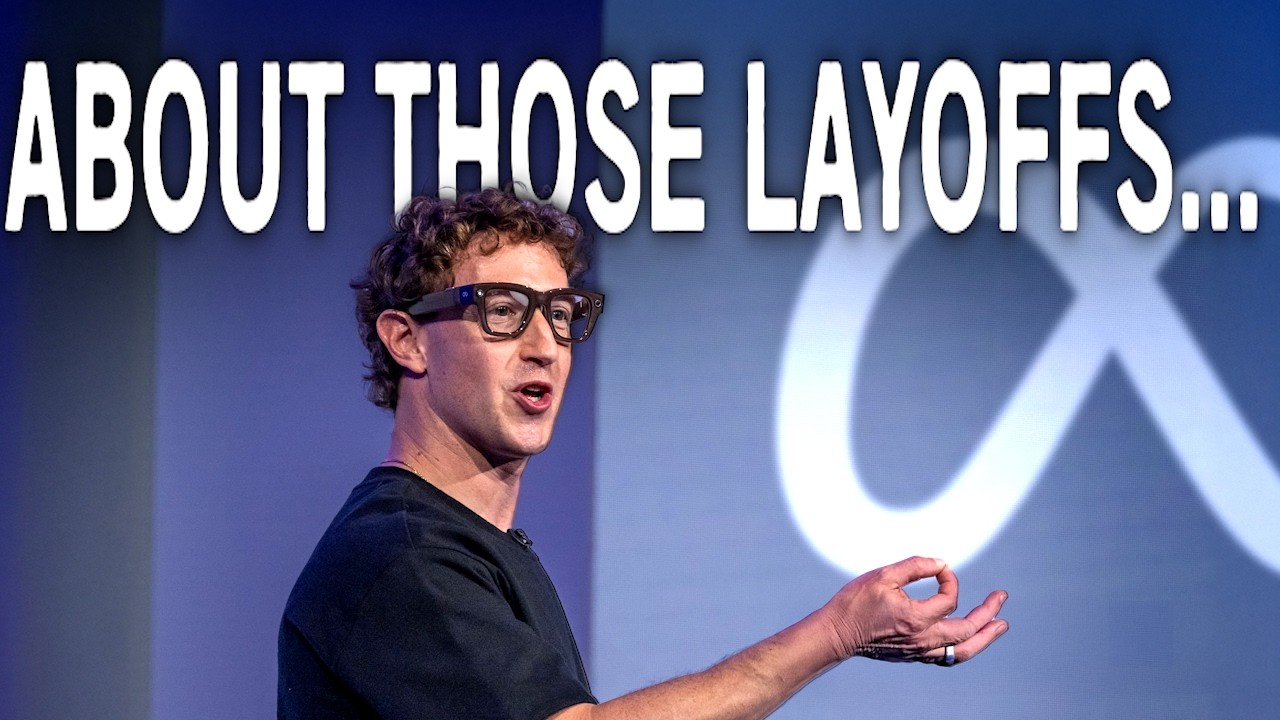
- Meta and other major tech firms have conducted massive, repeated rounds of layoffs over the last four and a half years.
- Despite these cuts, many companies have returned to their previous total headcount levels.
-
if you do the math that's collectively around 40 000 people that have been laid off over the last four and a half years all from a company that only had around 75 000 employees to begin with
Operational and Morale Damage [1:45]
- Layoffs have triggered "turnover contagion," where remaining employees lose trust and seek new employment.
- Companies have lost critical institutional knowledge, leading to the rehiring of experienced staff at a premium.
-
workplace researchers have observed what they have dubbed turnover contagion the idea is that when a round of layoffs goes through the survivors start updating the resumes
The Role of Stock Compensation [5:30]
- Companies use layoffs to prevent the vesting of restricted stock units (RSUs), thereby reducing shareholder dilution.
- High-value stock packages have become a significant financial liability that firms are attempting to manage through churn.
-
when someone gets cut before their rsu's finished vesting the unvested shares just disappear they were never created so the dilution never happens
AI Implementation Failures [7:25]
- Several companies, including Ford and Coinbase, have faced technical failures after attempting to replace human workers with AI systems.
- Many firms have admitted that citing AI as a reason for layoffs was a strategic choice to satisfy stakeholders rather than a reflection of operational reality.
-
the systems were not getting the desired results while quality failures were costing the company billions so ford went out and rehired roughly 350 of their veteran graybeard engineers