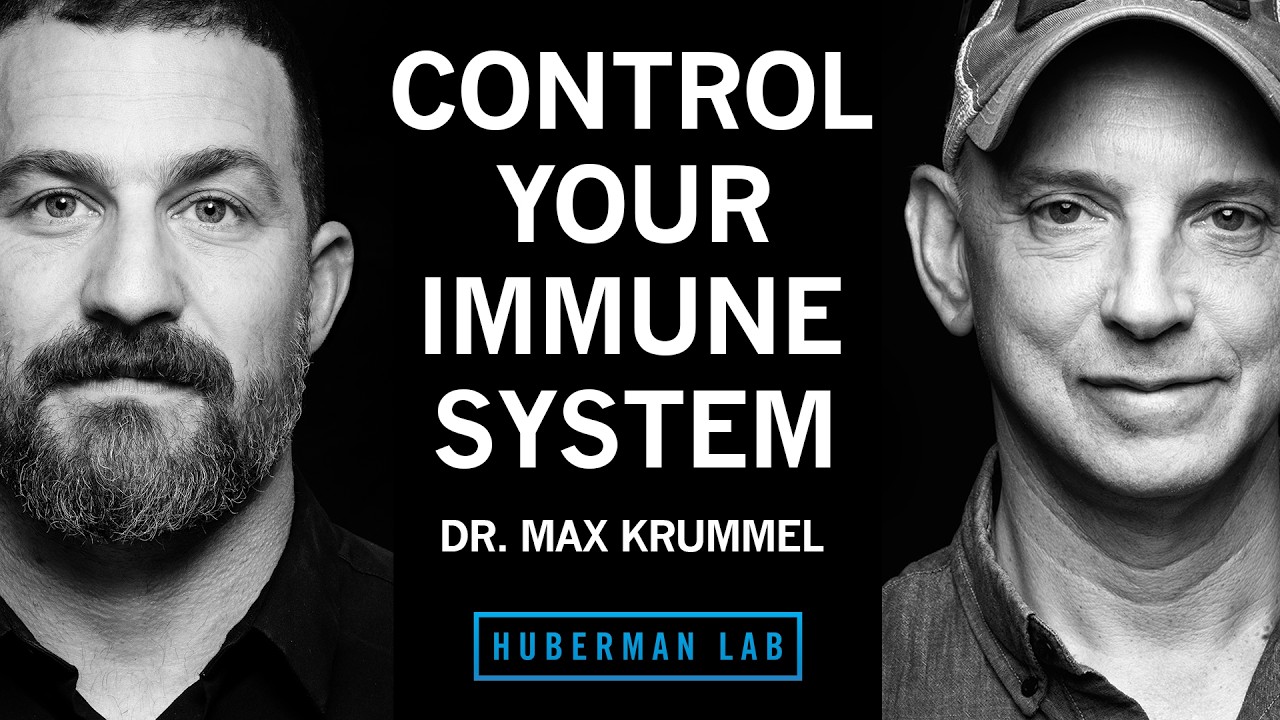
How Your Immune System Works & How to Improve It | Dr. Max Krummel
Andrew Huberman
41,029 views • 1 month ago Save 139 min 8 min read
Video Summary
The immune system is far more complex and integrated than previously understood, extending beyond fighting foreign invaders to regulating bodily functions and even influencing memory and brain states. Dr. Max Krummel explains how aging introduces complexity, making the immune system's self-vs-non-self discrimination more challenging due to accumulated cellular mutations. This internal "noise" can lead to increased susceptibility to illness and cancer. The conversation also delves into the developmental trajectory of the immune system, its role in maintaining a symbiotic relationship with microbes, and the fascinating implications of its presence throughout the body, from the gut to the heart, and even the brain.
Short Highlights
- The immune system's primary function is self vs. non-self discrimination.
- Aging increases the body's complexity, making this discrimination harder due to accumulated mutations.
- The immune system plays roles beyond fighting pathogens, including regulating organ function and influencing memory.
- Sleep is crucial for immune cell migration and repair processes.
- The thymus is vital for T-cell development and education, involuting with age.
Key Details
The Immune System: A Complex, Tunable System [00:02:00]
- Initially viewed as a simple "foreign vs. self" defense mechanism.
- Cancer immunotherapy revealed it as a tunable system, altering T-cell activation thresholds.
- Now understood to have roles in the nervous system (microglia), gut (microbe regulation), liver (metabolism), and heart (cardiomyocyte function).
"So there's all these additional functions that kind of before we're, we're lost in the, in the just, you know, the foreign battle against the foreign."
The Evolution of Immunology [00:05:00]
- Once considered a niche field, immunology has rapidly expanded in the last 20 years.
- The AIDS epidemic highlighted the immune system's critical role in fighting various infections and opportunistic diseases.
- Discoveries were fueled by curiosity about cell types and triggers, leading to a better understanding of molecules and behaviors.
"So regardless of whether, you know, it was a field or not, it was clearly important."
T Cells: The Body's Sensory Network [00:10:00]
- Each T cell acts as a free agent and part of a vast sensory system.
- T cells measure concentrations of biomolecules (peptides) and signal if levels are out of range.
- The body possesses approximately 10^11 T cells constantly monitoring and curating the internal environment.
"So it's like you have like 10 to the 11th little sensors going around you, curating you, you know, making sure you're the right thing."
Immune System Development in Childhood [00:15:00]
- Infants have a less trained immune system for the first six months to prevent self-attack during rapid development.
- Children aged 1-10 experience frequent illnesses as their immune system encounters numerous new pathogens.
- This exposure trains the immune system, with the exception of lethal viruses/bacteria like measles, necessitating vaccination.
"So every single virus and pathogen that hits it is going to elicit some, you know, some amount of illness."
Aging and Immune System Decline [00:20:00]
- Immune cells become less functional, and their production decreases with age.
- This may be due to a lack of evolutionary selection pressure for longevity beyond reproductive age.
- The body becomes a mosaic of cells with accumulating mutations, complicating immune recognition.
"And then a virus doesn't necessarily have anything unique about it."
The Body as a Mosaic of Mutations [00:25:00]
- DNA replication and environmental factors (like UV radiation) cause mutations in cells over time.
- Each cell accumulates unique mutations, creating a mosaic of genetic information within the body.
- This cellular diversity challenges the immune system's ability to distinguish 'self' from 'non-self'.
"So now, again, I ask you like, who are you now?"
The Thymus: A Crucial Immune Organ [00:35:00]
- The thymus is essential for the development and education of T cells.
- It involutes (shrinks) with age, reducing the production of new T cells.
- Revitalizing the thymus is of interest for potential therapeutic applications, such as in cancer immunotherapy.
"And the reason why there's interest in like these peptides, but all these other approaches to like revitalize the thymus is that like in cancer, for example, wouldn't you like to have a whole bunch of new T cells..."
T Cell Education in the Thymus [00:40:00]
- Developing T cells have a vast potential range of receptors to detect different molecules.
- The thymus ensures T cells are not overly reactive to the body's own tissues (self-tolerance).
- It educates T cells by presenting self-antigens and eliminating those that react too strongly.
"So the thymus has the role of producing T cells. But also of educating them in some ways of only letting the ones that come out that have sensors that are correctly tuned to let you be you in that way."
Sleep and Immune Function [00:50:00]
- Sleep deprivation impairs immune system effectiveness.
- During sleep, immune cells migrate to bone marrow, and tissues undergo repair processes.
- This "cleanup phase" is essential for resetting and maintaining immune function.
"One of the things that's happening is that a lot of your immune cells clear back to the bone marrow."
Spatial Biology and Immune System Compartmentalization [00:55:00]
- The immune system exhibits both migratory and resident cell populations.
- Resident immune cells protect specific tissues, while circulating cells patrol the body.
- Spatial compartmentalization is crucial, but the immune system also relies on cell migration for surveillance.
"So although there's, you know, these mass migration of cells, there's also in, like, even just in T cells, there's T cells that lodge in particular settings."
Autoimmunity: Misplaced Immune Responses [01:10:00]
- Autoimmune conditions arise when the immune system mistakenly attacks the body's own tissues.
- Genetic factors play a role, such as defective receptors that normally regulate immune responses.
- Conditions like asthma, psoriasis, and inflammatory bowel disease can have varied underlying immune mechanisms.
"And so the origins of some of those are genetic for sure."
Diversity and Resilience in Immunity [01:15:00]
- Genetic diversity within a population, even with susceptibility to certain diseases (e.g., sickle cell trait), can confer advantages against others (e.g., malaria).
- This diversity is crucial for population-level resilience against evolving threats.
- What appears as a "loser" trait in one context might be advantageous in another.
"And this is a case of like, you know, crowd fitness that comes from diversity of genes."
The Role of the Insular Cortex in Immune States [01:00:00]
- The insular cortex can influence immune system states in peripheral organs.
- This connection may involve the vagus nerve and can be triggered by thoughts, emotions, or external cues.
- Recalling memories associated with specific immune states can potentially reactivate those states.
"And the cues for that, in that case, were a drug. But we know that we can, you know, cue the insular cortex, like me watching you do things."
The Challenge of Data Sparsity in Science [01:20:00]
- Making decisions with limited data, as seen in the early days of COVID-19, leads to confusion and uncertainty.
- Societal decision-making processes are not always adept at handling data-sparse situations.
- This highlights the need for robust data collection and clear communication, especially for novel treatments.
"I think that's a, that's a data sparse situation."
Nuance and Communication in Public Health [01:25:00]
- Polarized communication strategies around vaccines and public health have proven ineffective.
- A more nuanced approach, involving educated experts and open dialogue, is essential for public trust and behavior change.
- The historical context of medical mistrust, particularly within certain communities, underscores the need for sensitive and transparent communication.
"The idea that you need to push back with just a fire hose of do this or else did not work."
The Immune System's Adaptability and Trade-offs [01:30:00]
- Mild autoimmune conditions might confer resistance to certain infections, representing an evolutionary trade-off.
- The immune system's response is context-dependent, with different stimuli and environments eliciting varied reactions.
- Understanding these trade-offs is crucial for appreciating the complexity of immune function and disease.
"So having that, I think this is true a lot of these situations where the diversity of the human population over time, by having some of these things that make some people hypersensitive to, you know, to maybe bacterial viral infection at the cost of having things like psoriasis pop up..."
The Importance of Basic Research and Discovery [01:35:00]
- Scientific breakthroughs often arise from unexpected directions and curiosity-driven research (e.g., CRISPR from bacteria).
- The process involves numerous failures and dead ends, with significant discoveries being rare but impactful.
- Fostering an environment for exploration and discovery, even without immediate commercial application, is vital for advancing knowledge.
"And that's all kind of what we already know. That's human knowledge. We want to build human knowledge."
The Future of Immune System Therapies [01:40:00]
- Future therapies may involve complex sequences of interventions rather than single "magic bullet" solutions.
- Understanding developmental biology and cellular signaling pathways is key to guiding immune system responses.
- AI and machine learning can aid in analyzing complex biological data and proposing experimental hypotheses.
"And to get from one to the next, we need to understand how it does it developmentally."